49 Free AK STAR Grade 5 Math Worksheets for Alaska Students (Aligned, One Skill Per Page)
TL;DR: 49 free aligned AK STAR Grade 5 math worksheets for Alaska students, one skill per page – decimals, fractions, volume, coordinate plane, expressions, and multi-step word problems aligned with the Alaska Mathematics Standards.
Key takeaways:
- AK STAR grade 5 math weights fractions, decimals, and multi-step problems heavily.
- 49 single-skill worksheets – one focused topic per page.
- All worksheets are free PDFs with step-by-step answer keys.
- Aligned with the Alaska Mathematics Standards at grade 5.
- Daily practice (20-30 minutes) over 6-8 weeks builds AK STAR-ready fluency.
Fifth grade is where math quietly shifts. A student who has spent years adding, subtracting, and memorizing facts is now asked to make sense of decimals to the thousandths, find common denominators on the fly, multiply and divide fractions, measure volume with stacked unit cubes, and plot ordered pairs on a coordinate plane. None of those moves are arithmetic, they are ideas about numbers, and they reward steady, single-skill practice more than long packets.
These 49 worksheets were built to make fifth-grade math walkable, one skill at a time. Whether your fifth grader is in Anchorage, Fairbanks, Juneau, or Wasilla, each PDF gives them a single idea, a clear example, and enough practice to make it feel ordinary.
What’s on this page
Forty-nine single-skill PDFs, each aligned to the Alaska Mathematics Standards (Common Core-aligned) at Grade 5. Every file does one job. A student practicing decimal division is not also being quizzed on volume, and a student working through line plots is not getting pulled sideways into fractions. One skill, one page of practice, one clear focus.
Each PDF opens with a one-page Quick Review that explains the skill in plain language and walks through a fully worked example. Then come around 14-17 practice problems that build from easy to genuinely challenging, followed by word problems that put the skill in a real situation. The last page is a student-facing answer key, not bare answers, but short, friendly explanations a fifth grader can read alone and actually learn from.
Place Value and Number Sense
- Understanding Place Value, [5.NBT.A.1] name the value of every digit in a multi-digit number
- Multiplying and Dividing by Powers of 10, [5.NBT.A.2] shift the decimal point by 10, 100, or 1,000
- Reading and Writing Decimals to Thousandths, [5.NBT.A.3.A] say and write decimals out to the thousandths place
- Comparing and Ordering Decimals, [5.NBT.A.3.B] line up the place values to compare and order decimals
- Rounding Decimals, [5.NBT.A.4] round to the nearest whole, tenth, hundredth, or thousandth
Operations with Whole Numbers
- Multiplying Multi-Digit Whole Numbers, [5.NBT.B.5] the standard algorithm for multiplying large whole numbers
- Dividing by One-Digit Divisors, [5.NBT.B.6] long division with single-digit divisors
- Dividing by Two-Digit Divisors, [5.NBT.B.6] long division when the divisor has two digits
- Word Problems: Multiplication and Division, [5.NBT.B.6] turn a real situation into a multiplication or division problem
Numerical Expressions and Patterns
- Order of Operations, [5.OA.A.1] PEMDAS, the order that makes every expression have one answer
- Parentheses, Brackets, and Braces, [5.OA.A.1] grouping symbols and how they change the order of work
- Writing and Interpreting Numerical Expressions, [5.OA.A.2] turn a sentence into an expression, and read one back
- Prime Factorization, [4.OA.B.4] break a number down into a product of primes
- Numerical Patterns and Relationships, [5.OA.B.3] spot the rule and continue the pattern
Adding and Subtracting Fractions
- Finding Common Denominators, [5.NF.A.1] rewrite fractions so they share a denominator
- Adding Fractions with Unlike Denominators, [5.NF.A.1] find a common denominator, then add
- Subtracting Fractions with Unlike Denominators, [5.NF.A.1] find a common denominator, then subtract
- Adding and Subtracting Mixed Numbers, [5.NF.A.1] work with the whole and fraction parts, including regrouping
- Estimating with Benchmark Fractions, [5.NF.A.2] use 0, 1/2, and 1 to estimate a fraction sum or difference
- Word Problems: Adding and Subtracting Fractions, [5.NF.A.2] fraction word problems with realistic numbers
Multiplying Fractions
- Fractions as Division, [5.NF.B.3] a fraction is the numerator divided by the denominator
- Multiplying Fractions by Whole Numbers, [5.NF.B.4.A] scale a fraction up using a whole-number multiplier
- Multiplying Fractions by Fractions, [5.NF.B.4.A] multiply across the numerators and across the denominators
- Multiplying Mixed Numbers, [5.NF.B.4] rename as improper fractions, then multiply
- Multiplication as Scaling (Resizing), [5.NF.B.5] multiplying by less than 1 makes a number smaller, and why
- Word Problems: Multiplying Fractions, [5.NF.B.6] fraction-of-a-whole stories you have to set up
Dividing with Unit Fractions
- Dividing Unit Fractions by Whole Numbers, [5.NF.B.7.A] split a unit fraction into a whole number of equal pieces
- Dividing Whole Numbers by Unit Fractions, [5.NF.B.7.B] how many halves, thirds, or fourths fit in a whole number
- Word Problems: Dividing with Unit Fractions, [5.NF.B.7.C] set up a division word problem with unit fractions
Decimal Operations
- Adding Decimals, [5.NBT.B.7] line up the decimal points and add by place value
- Subtracting Decimals, [5.NBT.B.7] line up the decimal points and subtract, regrouping when needed
- Multiplying Decimals, [5.NBT.B.7] multiply like whole numbers, then count decimal places
- Dividing Decimals by Whole Numbers, [5.NBT.B.7] long division when the dividend has a decimal point
- Dividing Decimals by Decimals, [5.NBT.B.7] shift both decimals so the divisor becomes a whole number
- Word Problems with Decimals, [5.NBT.B.7] money, measurement, and other decimal word problems
Measurement and Data
- Converting Customary Units of Length, [5.MD.A.1] inches, feet, yards, miles, and how to switch between them
- Converting Customary Units of Weight and Capacity, [5.MD.A.1] ounces, pounds, cups, pints, quarts, gallons
- Converting Metric Units, [5.MD.A.1] millimeters, centimeters, meters, kilometers, same idea for grams and liters
- Line Plots with Fractions, [5.MD.B.2] graph fractional measurements and read the data
Volume
- Understanding Volume and Unit Cubes, [5.MD.C.3] what volume measures, and how unit cubes fill a solid
- Measuring Volume by Counting Unit Cubes, [5.MD.C.4] count the cubes in layers to find a solid’s volume
- Volume of Rectangular Prisms, [5.MD.C.5.B] length × width × height, and base × height
- Additive Volume (Composite Figures), [5.MD.C.5.C] break a complicated solid into prisms and add the volumes
- Word Problems with Volume, [5.MD.C.5] real-world volume problems with boxes, tanks, and rooms
Geometry and Coordinate Graphing
- Understanding the Coordinate Plane, [5.G.A.1] the x-axis, the y-axis, and how an ordered pair locates a point
- Graphing Points in the First Quadrant, [5.G.A.2] plot points and read coordinates in the first quadrant
- Properties of Two-Dimensional Figures, [5.G.B.3] name the properties that make a shape a shape
- Classifying Two-Dimensional Figures, [5.G.B.4] sort polygons into categories and subcategories
- Graphing Patterns on the Coordinate Plane, [5.OA.B.3] graph two related patterns and compare the lines
How to use these worksheets at home
The trick with fifth-grade math is sequence. Skills here come in families, and a worksheet lands much softer when the one before it set it up. Try Finding Common Denominators before Adding Fractions with Unlike Denominators, once a student is fluent at making the denominators match, the addition page feels like the same problem with one more step. Do Understanding Volume and Unit Cubes before Volume of Rectangular Prisms; the formula stops feeling like a rule to memorize and starts feeling like a description of what’s already happening in the box.
Keep the sessions short. Most of these PDFs take fifteen or twenty minutes, which is about as long as a fifth grader’s full attention lasts on a school night. Two afternoons a week, done steadily, will move a student further than a long Saturday session that nobody enjoys. Let them keep a pencil and scratch paper handy and resist the urge to correct mid-problem, the answer key is there for after.
One more habit worth building: when a worksheet goes well, do the next skill in the same family the following session, while the idea is still warm. When one goes badly, don’t pile on, set it aside and come back to that single page in a few days. A skill that felt impossible on Tuesday often feels merely tricky by Friday, and a fifth grader who experiences that shift a few times starts to trust the process. That trust is worth as much as any single skill on the list.
A note about AK STAR at Grade 5
Alaska students take Alaska System of Academic Readiness, Mathematics in spring. AK STAR is built on the Alaska Mathematics Standards (Common Core-aligned), the same framework these worksheets are aligned to, so the skills your student practices here and the skills the test asks about come from one source.
At Grade 5, AK STAR expects students to read and write decimals to the thousandths, line up the decimal point to add and subtract, multiply and divide multi-digit numbers, find common denominators and operate on fractions (including unit-fraction division), convert measurement units, plot data on line plots, calculate the volume of rectangular prisms (including composite figures), and plot points in the first quadrant of the coordinate plane. Because each PDF on this page targets exactly one of those skills, the testing window doubles as a checklist. If your student is solid on volume but shaky on dividing fractions, you can see it plainly and spend your time only where it is needed.
A short closing
Fifth-grade math is a year of new ideas, but it is not a year a student has to face all at once. Bookmark this page, print one PDF tonight, and let your fifth grader start with a single skill. Alaska kids handle hard things well when the next step is clear, and a worksheet on the table is about as clear as it gets.
Best Bundle to Ace the Alaska AK STAR Grade 5 Math Test
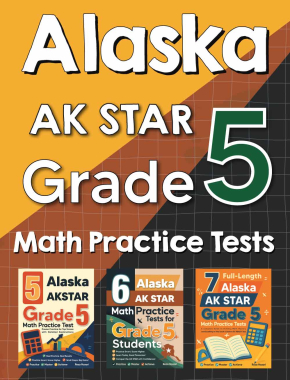
Want the fastest path through Alaska AK STAR Grade 5 math? This bundle pulls it together, practice-test books, full-length practice tests, and complete step-by-step answer keys, instant PDF download.
Recommended EffortlessMath Books
For a workbook to pair with these printable practice pages, Mastering Grade 5 Math covers every fifth-grade topic with worked examples and practice sets. For the multi-step word problems and fraction work that fifth graders find hardest, see Mastering Grade 5 Math Word Problems.
Frequently Asked Questions
What topics are covered in these Alaska Grade 5 worksheets?
Place value to thousandths, multi-digit multiplication and division, adding and subtracting fractions with unlike denominators, multiplying and dividing fractions, decimal operations to hundredths, volume of rectangular prisms, the coordinate plane (first quadrant), writing numerical expressions, measurement conversions, and multi-step word problems.
Is a calculator allowed on AK STAR grade 5 math?
No. Alaska doesn’t permit calculators on the grade-5 AK STAR math test. By grade 5 the test expects fluent multi-digit arithmetic and fraction work by hand – practice that way from day one.
Are these worksheets free?
Yes – every worksheet is a free PDF. No login, no email, no paid tier. Print as many copies as you need for home or your classroom.
Are these aligned with the Alaska Mathematics Standards?
Yes. Each worksheet maps to a grade-5 expectation in the Alaska Mathematics Standards – operations and algebraic thinking, base-ten, fractions, measurement and data, and geometry.
How often should my fifth grader practice?
20-30 minutes a day, four or five days a week, fits most fifth graders. In the 6-8 weeks before AK STAR, swap one weekday page for a longer mixed-review session to get your child used to switching topics under time pressure.
What if my child gets stuck?
Pause and work one problem together. If a topic is too hard, back up to the prerequisite. Before fraction division, for example, make sure fraction multiplication and “reciprocal” feel easy. Building that step is faster than pushing through frustration.
Is there an answer key?
Yes – every worksheet PDF includes a step-by-step answer key. Walk through it together so your child sees how to fix the thinking, not just the final answer.
How can we prep for AK STAR grade 5 math?
Build skill by skill with these worksheets, then take one full-length timed practice test about three weeks out. Spend the last two weeks on the two weakest topics from that test – usually fraction operations, decimal operations, and multi-step word problems.
Any tips for Alaska parents?
Make sure multiplication and division facts are automatic. Read every word problem aloud twice. Ask your child to estimate before calculating – decimal-place errors are the most common point-loss on AK STAR, and estimation catches them.
Where can we find more grade 5 practice?
EffortlessMath has more grade 5 worksheets by topic, the Mastering Grade 5 Math workbook, and a Grade 5 Math Word Problems book. The Related Lessons section below links to step-by-step explanations of the biggest grade-5 topics.
Related EffortlessMath Lessons
If a topic on this page feels rusty, these short lessons go deeper:
- How to multiply and divide decimals
- Adding and subtracting fractions with unlike denominators
- How to find the volume of a rectangular prism
- Order of operations (PEMDAS)
- How to solve word problems

Related to This Article
More math articles
- How to Solve One-Step Inequalities? (+FREE Worksheet!)
- Classifying a Conic Section (in Standard Form)
- Party organization
- Your Winning Game Plan: How to Use Angle Relationships to Write and Solve Equations
- The Best Grade 3 Math Book for Kentucky Students
- ParaPro Math Flashcards (Free Online: Formulas, Terms & Concepts)
- How to Find the Number of Solutions to a System of Equations by Graphing
- Winner-take-all allocation
- Words for Conflict and Cooperation
- 10 Most Common 3rd Grade SBAC Math Questions









What people say about "Alaska AK STAR Grade 5 Math: Free Worksheets"?
No one replied yet.