Representation and the Construction of Social Reality
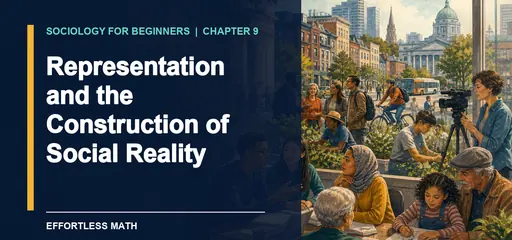
Chapter 9 of the Sociology for Beginners study guide on Effortless Math covers Representation and the Construction of Social Reality: the key terms, the core ideas, and worked examples showing how this topic is tested on this course.
Sociology for Beginners · Chapter 9
Representation and the Construction of Social Reality
Representation is the way media depict people, groups, places, events, and ideas. A representation is not a transparent copy of reality. Producers choose a scene, angle, category, voice, statistic, and comparison. Audiences then interpret those choices through cultural knowledge. Sociologists study the patterns that emerge across many messages and the institutional routines that produce them.
One unusual character does not establish a pattern. Researchers may code hundreds of programs, advertisements, articles, or posts to ask who appears, who speaks, which occupations are assigned, how conflict is resolved, and which traits are treated as normal or remarkable. This is content analysis. Interviews and audience studies can then explore how viewers interpret those portrayals. Exposure alone does not guarantee one effect because people can negotiate, reject, or parody a message.
Visibility and absence both matter. Repeatedly showing one group only as criminals, victims, experts, or caregivers narrows the social roles available in the media world. Rarely showing a group at all can make its ordinary life less publicly visible. Yet counting representation is only a beginning. A researcher also asks who controls production, which market assumptions guide casting, how stereotypes affect interpretation, and whether portrayals change after organizational reform.
Cultivation research asks whether long-term exposure to recurring media patterns is associated with broad beliefs about social reality. A viewer who watches many crime dramas may overestimate the frequency of violent crime. A careful study still needs to address selection: people who already fear crime may choose more crime programming. Longitudinal data, measures of prior belief, and comparisons across exposure can strengthen the explanation.
Interaction also changes representation. People use profile photos, captions, likes, and comments to present a self to an audience. Goffman’s ideas about front stage, audience segregation, and impression management remain useful online. The technical setting adds new features. A post can persist, travel beyond its intended audience, be copied without context, and become searchable years later. These affordances alter the conditions of self-presentation.
Quick review: Separate three questions. Who appears and how? Which routine produced that portrayal? How did an audience interpret it? Content, production, and reception require different evidence.
Watch the lesson connection
Media and Social Media gives you a second explanation of the ideas surrounding this lesson. As you watch, pause when the lesson concept appears and explain how the example fits.
Try the idea yourself
Write one original example, one close nonexample, and one observation that would help you tell them apart. That small exercise turns a definition into a sociological tool you can use in daily life.

Related to This Article
More math articles
- Sexual privacy
- FREE 3rd Grade PARCC Math Practice Test
- Grade 3 Math: Measuring Length
- Free Grade 3 English Worksheets for New York Students
- What is the Side Splitter Theorem? A Complete Introduction and Exploration
- World Problems Involving Fractions of a Group
- How to Use Exponents to Write Powers of Ten?
- Relative Deprivation
- The Ultimate 6th Grade TNReady Math Course (+FREE Worksheets)
- 6th Grade PEAKS Math Worksheets: FREE & Printable



















What people say about "Media Representation and Social Reality"?
No one replied yet.