Trigonometry Basics: SOH-CAH-TOA Made Easy
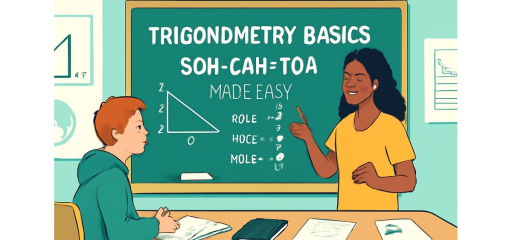
Trigonometry sounds like a college subject, but the basics fit on a sticky note: three ratios in a right triangle. Once you have them, you can find missing sides, missing angles, and solve real problems involving heights, distances, and ramps.
The setup: a right triangle
Trig works with right triangles (one 90° angle). Pick a non-right angle to focus on, call it \(\theta\). The three sides relative to \(\theta\) are:
- Opposite, the side across from \(\theta\).
- Adjacent, the side next to \(\theta\) that’s not the hypotenuse.
- Hypotenuse, the longest side, opposite the right angle.
The three ratios
\[\sin \theta = \dfrac{\text{Opposite}}{\text{Hypotenuse}}\]
\[\cos \theta = \dfrac{\text{Adjacent}}{\text{Hypotenuse}}\]
\[\tan \theta = \dfrac{\text{Opposite}}{\text{Adjacent}}\]
The classic mnemonic: SOH-CAH-TOA.
How to use them
Find a missing side:
A right triangle has a 30° angle and a hypotenuse of 10. Find the opposite side.
\(\sin 30° = \tfrac{\text{opp}}{10} \to \text{opp} = 10 \sin 30° = 10 \cdot 0.5 = 5\).
Find a missing angle:
A ladder is 13 ft long and reaches 12 ft up a wall. What angle does it make with the ground?
\(\sin \theta = \tfrac{12}{13} \to \theta = \sin^{-1}(12/13) \approx 67.4°\).
Special angles to memorize
| Angle | sin | cos | tan |
|---|---|---|---|
| 30° | \(\tfrac{1}{2}\) | \(\tfrac{\sqrt{3}}{2}\) | \(\tfrac{1}{\sqrt{3}}\) |
| 45° | \(\tfrac{\sqrt{2}}{2}\) | \(\tfrac{\sqrt{2}}{2}\) | 1 |
| 60° | \(\tfrac{\sqrt{3}}{2}\) | \(\tfrac{1}{2}\) | \(\sqrt{3}\) |
These show up on every standardized test.
Real-world examples
- Ladders against walls (angle of inclination).
- Ramps (slope angle from rise over run).
- Surveying (measuring tall buildings using angle of elevation).
- Navigation (bearings and headings).
Common mistakes
- Mixing up opposite and adjacent.
- Using the calculator in radian mode when you want degrees.
- Forgetting that the inverse functions (\(\sin^{-1}\), etc.) give you the angle.
FAQ
What does SOH-CAH-TOA mean?
Sine = Opposite/Hypotenuse; Cosine = Adjacent/Hypotenuse; Tangent = Opposite/Adjacent.
Does trig only work for right triangles?
The SOH-CAH-TOA rules, yes. Other triangles use the Law of Sines and Law of Cosines.
What’s the difference between sin and arcsin?
Sin takes an angle and gives a ratio. Arcsin (or \(\sin^{-1}\)) takes a ratio and gives the angle.
Is trigonometry on the SAT?
Yes, basic right-triangle trig is part of the SAT math section.
Extra study tips that move the needle
Most students don’t fail because the math is too hard. They fail because their practice habits are inefficient. Here are the habits that separate the students who improve fast from those who stall.
Practice with a timer. Untimed practice teaches you to eventually get the right answer; timed practice teaches you to get it in test conditions. Set a stopwatch every time you sit down. Aim for 90 seconds per question on most standardized tests.
Keep an error log. A simple spreadsheet with three columns, Problem, My answer, Correct answer, Why I missed it, is the single most powerful study tool ever invented. Review your error log weekly. The same mistakes show up again and again until you name them.
Mix topics every session. Doing 20 problems on the same topic feels productive, but spaced and interleaved practice, mixing topics, builds retrieval skills, which is what the test actually measures. Spend 70% of your time on mixed sets and only 30% on isolated drills.
Sleep on it. Memory consolidation happens during sleep. A 30-minute session the night before a quiz, followed by 7+ hours of sleep, beats a 3-hour cram session that ends at midnight. This is settled cognitive science.
Teach the topic out loud. If you can’t explain it, you don’t fully know it. Either record yourself, write a one-paragraph “how I’d teach this” explanation, or grab a friend to listen. Teaching exposes the gaps your problem sets hid.
When to ask for help
Spinning your wheels for more than 15 minutes on a single problem is a signal, not of failure, but of a missing piece of background. Stop, mark the problem, and either ask a teacher, post in our community, or watch a video on the relevant subtopic. Resuming after gaining the missing piece is much more efficient than guessing your way forward.
A quick self-assessment
Before you close this tab, answer these three questions honestly:
- What’s the one topic in this article you understood best?
- What’s the one topic that still feels fuzzy?
- What concrete next step (a worksheet, a practice test, a video) will you take in the next 48 hours?
Writing those answers down, even just in a notes app, has been shown to roughly double the chance you actually follow through. Treat the next 48 hours as a small, doable experiment, not a marathon. Your future test-day self will thank you.
A deeper dive into common questions
The questions students ask after reading an article like this one tend to cluster. Here are the most useful ones, and short, direct answers.
Why does this topic keep coming up on tests? Because it sits at the intersection of foundational skills and real-world application. Test designers love topics that reveal whether you understand the underlying idea or only memorized a procedure. The students who do best on standardized tests are the ones who can explain a topic in their own words to a friend who hasn’t taken the class yet.
Is there a shortcut? Sometimes. But shortcuts only work when you understand why they work. A shortcut you can’t justify is a trap waiting to fire on a tricky test question. Learn the long way first, then collect shortcuts as bonuses.
How long until this clicks? For most people, real fluency takes 3 to 5 sessions of focused practice, spaced over 1 to 2 weeks. The first session feels confusing; the second feels mechanical; the third starts to feel natural; by the fourth or fifth, you’ll forget that it ever felt hard.
What if I’m starting from really far behind? Then you’re in the best position to make rapid progress. Beginners gain the fastest because they have the most low-hanging fruit. Don’t compare your week 1 to someone else’s week 50.
A short worked example you can copy
Here’s a typical worked example pattern that applies to many problems in this article’s topic:
- Identify the question. What exactly is being asked? Underline it.
- Identify the given information. What numbers and relationships are you handed?
- Pick the relevant formula or rule. From your toolkit, which one connects the given info to the question?
- Plug in carefully. Write each substitution explicitly. Don’t do steps in your head.
- Simplify. Reduce fractions, combine like terms, simplify radicals.
- Verify. Plug your answer back into the original setup. Does it make sense?
This 6-step pattern handles roughly 80% of problems you’ll see in middle-school, high-school, and standardized-test math.
Mini-glossary
A few terms that come up repeatedly in this topic and its neighbors:
- Variable. A letter (often \(x\) or \(y\)) that stands in for an unknown number.
- Coefficient. The number multiplying a variable. In $3x$, the coefficient is 3.
- Expression. A combination of numbers, variables, and operations, without an equals sign. Example: $3x + 5$.
- Equation. Two expressions joined by an equals sign. Example: \(3x + 5 = 14\).
- Inequality. Two expressions joined by $<$, $>$, \(\le\), or \(\ge\).
- Solution. A value (or set of values) of the variable that makes an equation or inequality true.
- Evaluate. Substitute a number for the variable and simplify to a single value.
- Simplify. Rewrite the expression in its cleanest equivalent form.
Internalize this vocabulary. Test questions assume you know it.
Your next 7 days
If this article inspired you to act, here’s a small, doable 7-day plan:
- Day 1. Re-read the worked examples. Try them with the page covered.
- Day 2. Do a 15-minute warm-up of related practice problems.
- Day 3. Take a short timed quiz. Score yourself.
- Day 4. Review your misses. Write one sentence about each.
- Day 5. Do a mixed practice set blending this topic with two others.
- Day 6. Rest, or do a light review.
- Day 7. Take a longer timed practice set and track your progress.
Seven days is enough to feel a real shift. Two or three of those cycles, and the topic moves from “hard” to “easy.”
One last reminder
Progress in math compounds. A 1% improvement every day for 100 days yields nearly a 3x improvement overall, because each new concept builds on the last. The students who pull ahead aren’t the ones who study the longest. They’re the ones who study consistently, review their mistakes, and refuse to skip the foundations. Show up tomorrow. Then show up the day after. The results take care of themselves.
If you found something useful here, save this article and revisit it after your next practice session. You’ll catch nuances on the second read that you missed on the first, because by then you’ll have the experience to recognize them. Happy practicing.
What grade is trigonometry?
Usually introduced in geometry (10th grade) and developed more in Algebra 2 / Pre-Calculus.

Related to This Article
More math articles
- How to Find the x-Intercept of a Line?
- How to Ace AP Calculus AB in 2026: Self-Study or Classroom Playbook
- Free Alabama Grade 2 Math Worksheets
- CLEP College Algebra Formulas
- South Carolina SC READY Grade 3 Math Worksheets — 49 Free Printable Single-Skill PDFs
- Montana MAST Grade 8 Math Free Worksheets: Free Printable PDF Worksheets with Full Solutions
- Cleaning, Disinfection, and Sterilization
- The Ultimate PSAT 10 Math Course (+FREE Worksheets & Tests)
- Free Grade 5 Math PDFs for Iowa ISASP: 49 Single-Skill Worksheets with Step-by-Step Keys
- How to Select the Right Tool for the Job



















What people say about "Trigonometry Basics: SOH-CAH-TOA Made Easy"?
No one replied yet.