Inverse Function Calculator (Free, with Graph)
AlgebraFreeNo sign-up
An inverse function calculator undoes a function: write y = f(x), swap x and y, and solve for y. For f(x) = 3x − 5, swapping gives x = 3y − 5, so f⁻¹(x) = (x + 5)/3. For f(x) = (2x + 1)/(x − 3), the same steps give f⁻¹(x) = (3x + 1)/(x − 2).
Show steps
- Swap x and yWrite y = f(x), then swap the letters: x = 2y + 1y − 3
- Multiply both sides by the denominatorx(y − 3) = 2y + 1
- Expandxy − 3x = 2y + 1
- Collect the y-terms on one sideMove every term with y to the left and the rest to the right, then factor out y: y(x − 2) = 3x + 1
- Divide by x − 2y = 3x + 1x − 2
- Verify by compositionf(f⁻¹(x)) = f((3x + 1)/(x − 2)) = x ✓ for every x in the domain of f⁻¹ (checked at 10 test points) Also f⁻¹(f(x)) = x for every x in the domain of f.
- Domain and range swapThe domain of f⁻¹ is the range of f: (−∞, 2) ∪ (2, ∞). The range of f⁻¹ is the domain of f: (−∞, 3) ∪ (3, ∞).
- Answerf⁻¹(x) = 3x + 1x − 2
Related: check f(g(x)) with the composition calculator · domain and range calculator · function grapher
How to use the inverse function calculator
- Type the function in the box, for example
(2x + 1)/(x - 3),sqrt(x - 1)ore^(2x) + 1. The “Reads as” line shows how it was understood. - If f is not one-to-one (like x²), choose which half of the domain to keep: the right half or the left half.
- Prefer coefficients? Open the Coefficients tab and enter a, b, c and d for f(x) = (ax + b)/(cx + d).
- Read f⁻¹(x), the domain and range of both functions, and the check f(f⁻¹(x)) = x. Type a value in “Find f⁻¹ at” to evaluate the inverse.
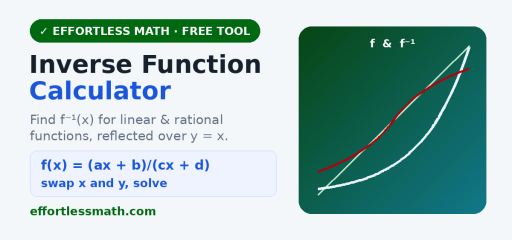
- Open “Show steps” for the swap-and-solve working. In the graph, f and f⁻¹ are reflections of each other across the dashed line y = x.
How to find an inverse function: swap and solve
- Replace f(x) with y.
- Swap x and y.
- Solve the new equation for y, undoing the operations in reverse order.
- Replace y with f⁻¹(x), and check that f(f⁻¹(x)) = x.
Example 1. f(x) = (x + 4)/2. Swap: x = (y + 4)/2. Multiply by 2: 2x = y + 4. Subtract 4: f⁻¹(x) = 2x − 4. Check: f(2x − 4) = (2x − 4 + 4)/2 = x.
Example 2 (a rational function). f(x) = (2x + 1)/(x − 3). Swap: x = (2y + 1)/(y − 3). Multiply both sides by y − 3: xy − 3x = 2y + 1. Collect the y-terms: xy − 2y = 3x + 1, so y(x − 2) = 3x + 1. Divide: f⁻¹(x) = (3x + 1)/(x − 2).
The same steps work for every function of this form. The inverse of f(x) = (ax + b)/(cx + d) is f⁻¹(x) = (b − dx)/(cx − a), as long as ad − bc ≠ 0. If ad − bc = 0, the fraction simplifies to a constant, and a constant has no inverse.
Inverses of roots, powers, exponentials and logarithms
Each operation has an undo. A square root is undone by squaring, a cube by a cube root, eˣ by ln x and 10ˣ by log x. The calculator undoes the outermost operation first, one step at a time:
| f(x) | f⁻¹(x) | Domain of f⁻¹ (= range of f) |
|---|---|---|
| 3x − 5 | (x + 5)/3 | all real numbers |
| x³ + 2 | ∛(x − 2) | all real numbers |
| √(x − 1) | x² + 1 | x ≥ 0 |
| e^(2x) + 1 | ln(x − 1)/2 | x > 1 |
| ln(x + 4) | eˣ − 4 | all real numbers |
| 2ˣ | ln x/ln 2 = log₂ x | x > 0 |
| 1/x | 1/x | x ≠ 0 |
| x² (x ≥ 0) | √x | x ≥ 0 |
Watch the √(x − 1) row. The formula x² + 1 works for any x, but the inverse only takes x ≥ 0, because a square root never gives a negative output. The calculator always reports the domain of the inverse as the range of f, not just the natural domain of the formula.
When a function has no inverse: one-to-one and domain restriction
A function has an inverse only if it is one-to-one: different inputs always give different outputs. On a graph, this is the horizontal line test. If some horizontal line crosses the graph twice, there is no inverse. For f(x) = x², both 2 and −2 give 4, so f⁻¹(4) would have to be two numbers at once.
The fix is to restrict the domain to a piece where the function is one-to-one. With x ≥ 0, the inverse of x² is √x. With x ≤ 0, it is −√x. For a quadratic such as x² − 4x + 1, the calculator first completes the square, (x − 2)² − 3. Keeping x ≥ 2 gives f⁻¹(x) = √(x + 3) + 2, with domain x ≥ −3. Trig functions use their standard principal intervals: sin x on −π/2 ≤ x ≤ π/2 has inverse arcsin x, and cos x on 0 ≤ x ≤ π has inverse arccos x.
Some one-to-one functions, like x + eˣ or x³ + x, still have no inverse formula, because x appears in two places that algebra cannot combine. The calculator says so and still draws the inverse as the reflection of f. It can also find f⁻¹ of a single value numerically.
Domain, range and the graph of an inverse
Inputs and outputs trade places, so the domain of f⁻¹ is the range of f, and the range of f⁻¹ is the domain of f. For f(x) = (2x + 1)/(x − 3), f has domain x ≠ 3 and range y ≠ 2. So f⁻¹(x) = (3x + 1)/(x − 2) has domain x ≠ 2 and range y ≠ 3. Every point (a, b) on f becomes the point (b, a) on f⁻¹. That swap is a reflection across the line y = x, which is why the graph uses equal scales on both axes.
Common mistakes with inverse functions
| Mistake | Fix |
|---|---|
| Reading f⁻¹(x) as 1/f(x) | The −1 means “inverse”, not a power: for f(x) = 3x − 5, f⁻¹(x) = (x + 5)/3, not 1/(3x − 5). |
| Undoing operations in the wrong order | Undo the last operation first, like taking off shoes before socks. |
| Writing ±√ in the answer | An inverse must be a function: restrict the domain and keep one sign. |
| Forgetting the domain of the inverse | Use the range of f: the inverse of √(x − 1) is x² + 1 for x ≥ 0 only. |
| Not checking | Compose: f(f⁻¹(x)) should simplify to x. |
Using the calculator for homework
Solve by hand first, then compare with the steps here. If your answer looks different, check whether it is the same function: substitute a number into both, or compose it with f. When a problem asks for “the inverse” of a function that is not one-to-one, state the domain restriction you used. Teachers usually expect the restriction as part of the answer.
Inverse functions practice quiz: 10 questions
Test yourself with 10 multiple-choice questions. Choose an answer and press Submit to see if you are right and why. Your score appears at the end.
x(y + 1) = y − 2 gives xy − y = −x − 2, so y(x − 1) = −(x + 2) and y = (x + 2)/(1 − x).
Squaring x = √(y + 5) gives y = x² − 5. The range of f is y ≥ 0, so the inverse only takes x ≥ 0.
The vertex is at x = −1. On x ≥ −1 the function increases, and solving gives y = √x − 1.
Inverses swap inputs and outputs, so the outputs of f are the inputs of f⁻¹.
x² + 1 gives the same output for x and −x (for example f(2) = f(−2) = 5), so it fails the horizontal line test.
Quiz complete
Frequently asked questions
What is an inverse function?
An inverse function reverses the original function. If f(2) = 7, then f⁻¹(7) = 2. Composing them in either order gives back the input: f(f⁻¹(x)) = x and f⁻¹(f(x)) = x. Only one-to-one functions have inverses.
How do you find an inverse function without a calculator?
Swap x and y in y = f(x) and solve for y. For f(x) = 3x − 5: x = 3y − 5, so 3y = x + 5 and f⁻¹(x) = (x + 5)/3. Check it: f((x + 5)/3) = 3·(x + 5)/3 − 5 = x.
How do you find an inverse function with a calculator?
Type the function into this page, or use the Coefficients tab for (ax + b)/(cx + d). For f(x) = (2x + 1)/(x − 3), enter a = 2, b = 1, c = 1, d = −3 and the result is f⁻¹(x) = (3x + 1)/(x − 2), with every step shown.
How do you find the domain of an inverse function?
Find the range of the original function: that is the domain of the inverse. For f(x) = (2x + 1)/(x − 3), the range is every y except 2, so f⁻¹ has domain x ≠ 2. Its range is y ≠ 3, the domain of f.
How do you find an inverse function on a graphing calculator?
Graphing calculators draw the inverse instead of solving for it. On a TI-84, enter f as Y1, then use DrawInv Y1 from the DRAW menu (2nd, PRGM). Graph Y2 = X as well to see the mirror line. To get the formula, solve algebraically or use this page.
How do you use the inverse function on a scientific calculator?
The SHIFT or 2nd key gives built-in inverses such as sin⁻¹, cos⁻¹, 10ˣ and eˣ. These evaluate an inverse at a single number, for example sin⁻¹(0.5) = 30° or π/6. A scientific calculator cannot find the formula for a new function. For f(x) = (x + 4)/2, you still find f⁻¹(x) = 2x − 4 by algebra.
Related calculators
- Function composition calculator: check f(g(x)) and g(f(x)).
- Domain and range calculator: the range of f is the domain of f⁻¹.
- Function grapher: plot f and its reflection.
- Inverse trig calculator: arcsin, arccos and arctan values.
- Logarithm calculator: logarithms are the inverses of exponentials.
More algebra calculators

Related to This Article
More math articles
- Multiplying Mixed Numbers for 5th Grade: Convert and Multiply
- A Comprehensive Collection of FREE SAT Math Practice Tests
- How to Combine Like Terms? (+FREE Worksheet!)
- Ocean Water Changes with Depth
- Enlightenment and Print Culture: Ideas, Franklin and Zenger
- 10 Most Common 8th Grade MAP Math Questions
- Separate the three decisions hidden in one firm question
- Eigenvalue and Eigenvector Calculator (2×2 and 3×3)
- How to Prepare for the AFOQT Math Test?
- The Math Game Show: How to Find Probability of Simple and Opposite Events







What people say about "Inverse Function Calculator With Steps & Graph (Free)"?
No one replied yet.