Free game · No sign-up
2048 Math — Merge Tiles and Learn Powers of 2
Merge, double and race to 2048! Powers of 2
- 🎮 16 free games
- 💾 Progress saves on this device
- 📱 Works on phones & tablets
Play 2048 Math
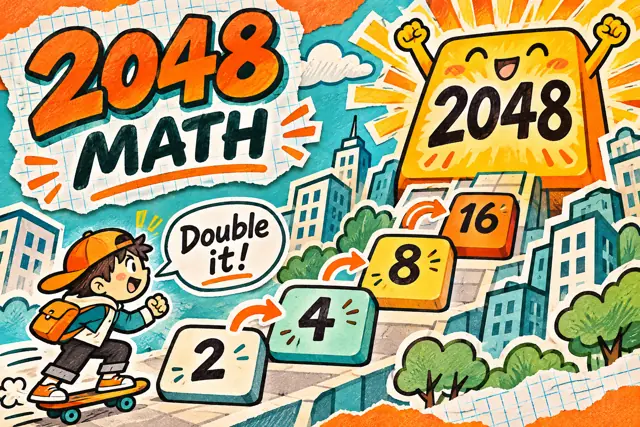
Merge, double and race to 2048! Your stars, stickers and streak save on this device.
- 🔥Keep a streakPlay a little each day to grow your day streak.
- ⭐Aim for 3 starsBeat your best score and earn every star.
- 🏅Collect stickersUnlock achievements in your sticker book.
- 💪Mistakes are OKEvery round makes your brain a little stronger.
How it works
Everything you need to know about 2048 Math
2048 Math is a free 2048 math game: slide the tiles, merge matching numbers, and double your way to the 2048 tile. It plays exactly like the classic 2048 puzzle, with a learning twist. Switch on Powers view to see every tile as a power of 2 (2048 = 2¹¹), or turn on doubling hints to watch each merge as an addition fact such as 8 + 8 = 16. Choose a 3×3, 4×4 or 5×5 board. There is nothing to download and no sign-up, and your game saves automatically in your browser.
How to play 2048
- Start the board. The game begins with two tiles. Each new tile is a 2 nine times out of ten, and a 4 the rest of the time.
- Slide every tile at once. Choose up, down, left or right. All tiles move as far as they can in that direction, and then one new tile appears in a random empty square.
- Merge matching tiles. When two tiles with the same number collide, they join into one tile worth their sum: 2 + 2 = 4, 4 + 4 = 8, 8 + 8 = 16, and so on. A tile can merge only once per move.
- Know the tie-break rules. If three equal tiles line up, the two closest to the wall you are sliding toward merge first. A full row of four equal tiles becomes two merged tiles.
- Reach the goal tile. On the standard 4×4 board the goal is 2048. When you make it, choose Keep going to chase a bigger tile or Collect stars to finish. The game ends when the board is full and no neighboring tiles match.
New to 2048? A short how-to card appears the first time you play, and you can press Finish at any point to bank your stars.
Controls and power-ups
- Keyboard: arrow keys or W, A, S, D. Press U, or Ctrl/Cmd + Z, to undo.
- Touch or mouse: swipe or drag across the board. The page does not scroll while you swipe on the board, so phones and tablets play smoothly.
- On-screen buttons: arrow buttons plus Undo, Swap, New game and Finish.
- Undo takes back your last move. You start each game with one undo and earn another every time you make a new highest tile of 128 or more.
- Swap trades the places of any two tiles: press Swap, then tap the two tiles. You start with one swap and earn another for each new highest tile of 256 or more. Press Esc or Cancel to leave swap mode.
A small pop-up tells you whenever you earn a new undo or swap, so you always know what you have in reserve.
2048 strategy tips
- Pick a corner and stay loyal to it. Keep your biggest tile in one corner and build the row next to it in decreasing order, like 256, 128, 64, 32.
- Use mostly two or three directions. For a bottom-left corner, favor Left and Down. Press Right only when you must, and Up as a last resort, because it can pull your big tile out of the corner.
- Keep your strongest row full. A full row cannot slide out of place, so your big tiles stay put when you move sideways.
- Plan merges in chains. Two 32s make a 64, which can join another 64 to make 128. Line up equal tiles so one move sets up the next.
- Merge small tiles early. Lots of 2s and 4s scattered around are what fill the board. Clear them before they block your chain.
- Save undo and swap for emergencies. They are most useful when a stray 2 lands in your corner.
- Try 5×5 to learn, 3×3 for a challenge. The 5×5 board leaves more room to recover from mistakes; the 3×3 board is the hardest.
The math behind 2048: powers of 2 and exponents
Every tile in 2048 is a power of 2, because each tile is made by doubling. Use Number view above the board to see the game three ways:
- 2, 4, 8: the classic look, with plain numbers.
- 2¹, 2², 2³: Powers view writes each tile as 2 raised to an exponent. 16 appears as 2⁴ because 2 × 2 × 2 × 2 = 16.
- 8+8=16: doubling hints show the addition fact above every merge.
In Powers view you can see the rule behind the game: merging two equal tiles adds 1 to the exponent, so 2³ + 2³ = 2⁴. That is the same as saying 8 + 8 = 16, or 2 × 8 = 16. The goal tile 2048 is 2¹¹, which means it takes the equivalent of 1,024 tiles of 2 to build it. Because each move adds only one new 2 or 4, reaching 2048 takes several hundred moves; with mostly 2s appearing, a winning game usually runs to roughly 900 moves or more.
The Did you know? panel shows a new fact each time you reach a higher tile. For example, 64 = 2⁶ is the number of squares on a chessboard, and 1024 = 2¹⁰ is why a kilobyte is 1,024 bytes. The colored ladder under the facts shows which powers of 2 you have already reached. To go deeper, read our guide to exponent rules, look up the meaning of an exponent, see how doubling becomes exponential growth, or check big powers with the exponent calculator.
Boards, stars and scoring
| Board | Goal tile (3 stars) | 2 stars | 1 star |
|---|---|---|---|
| 3×3 | 512 (2⁹) | 256 | 64 |
| 4×4 | 2048 (2¹¹) | 1024 | 256 |
| 5×5 | 4096 (2¹²) | 2048 | 512 |
- Score: every merge adds the value of the new tile, so merging two 64s adds 128 points.
- Saves and records: each board size keeps its own game in progress and its own best score, so you can leave and come back later on the same device.
- Stickers and XP: collect 8 stickers, such as making 2048 without using undo or making 256 on the tiny 3×3 board. Every game also earns XP toward your Effortless Math player level and daily goal.
Tips for parents and teachers
2048 works well from about grade 3, when students can double numbers, and keeps its value through middle school when exponents arrive. It supports the Common Core Mathematical Practices of persevering in problem solving (MP1) and looking for structure (MP7), and Powers view connects directly to writing and evaluating whole-number exponents (6.EE.A.1).
- Doubling warm-up: younger players can turn on doubling hints and say each fact out loud as it appears.
- Exponent talk: older students play in Powers view and explain why 2⁵ + 2⁵ = 2⁶ but 2⁵ + 2⁴ cannot merge.
- Strategy reflection: after a round, ask students to write the corner strategy they used and what they would change.
- Estimation question: how many tiles of 2 are “inside” a 512 tile? (256.)
Enjoy number puzzles? Try Equation Guess, a daily equation puzzle, or the cage-based logic grid Math Doku. You will find every title on our free math games page.
Who created 2048? A short history
2048 was created by Italian web developer Gabriele Cirulli and released in March 2014. He built it over a weekend as a free, open-source browser game, inspired by the earlier sliding-tile games 1024 and Threes!. It spread almost overnight: the original site drew more than 4 million visitors in less than a week, and hundreds of copies and variants followed.
The rules have stayed the same ever since: a 4×4 board, new tiles that are usually 2s (sometimes 4s), and merges that double a tile. 2048 Math keeps those classic rules and adds what a math classroom needs: Powers view (2¹, 2², 2³ …), doubling hints, 3×3 and 5×5 boards, saved games, stars and stickers.
2048 math game FAQ
Is there a trick to 2048?
The best-known trick is the corner strategy: keep your biggest tile in one corner, build the row next to it in decreasing order (such as 256, 128, 64, 32), and mostly use only two or three directions. That keeps big tiles together so they can merge, instead of scattering them across the board.
What power of 2 is 2048?
2048 is 2¹¹, which means 2 multiplied by itself 11 times: 2 × 2 × 2 × 2 × 2 × 2 × 2 × 2 × 2 × 2 × 2 = 2048. In the game every tile is a power of 2, and each merge adds 1 to the exponent, so 2¹⁰ + 2¹⁰ = 1024 + 1024 = 2¹¹ = 2048. Turn on Powers view to see this on every tile.
Does 2048 require luck?
A little. Each new tile appears in a random empty square and is a 2 nine times out of ten or a 4 one time in ten, so an unlucky spawn can block a plan. Most of the outcome is skill, though: players who follow a corner strategy and think a move or two ahead reach 2048 far more often than players who swipe at random.
Is there a cheat code for 2048?
The classic game has no cheat codes. In 2048 Math you get built-in power-ups instead: one Undo and one Swap per game, plus an extra Undo for each new highest tile from 128 and an extra Swap for each new highest tile from 256. Using them wisely is part of the strategy.
Is playing 2048 good for your brain?
2048 is a good workout for planning ahead, spotting patterns and keeping track of several moves at once, and in this version it also practices doubling facts and powers of 2. Like any puzzle, it is practice rather than a shortcut to being smarter, so short, regular sessions work best.
Is 2048 Math free?
Yes. It is free to play in your browser, on computers, phones and tablets, with no sign-up.
Is 2048 a good math game for kids?
Yes. Every merge is a doubling fact, the tiles are powers of 2, and winning takes planning several moves ahead. Powers view and doubling hints make the math visible.
Will I lose my game if I close the page?
No. Your current game on each board size is saved in this browser, so you can come back and continue. Clearing your browser data removes it.
Can I keep playing after 2048?
Yes. Choose Keep going to aim for 4096 and beyond, or Collect stars to finish.
What is the highest tile possible in 2048?
On a 4×4 board the largest tile that can exist is 131,072 (2¹⁷), because the board runs out of space before anything bigger can be built. Reaching it is extremely rare.
Can you win every game of 2048?
No. New tiles appear in random squares, so some games cannot be won. A steady corner strategy wins far more often than random moves.
Which board is best for beginners?
Try 5×5 first. It has more room to recover from mistakes. The 3×3 board is the hardest challenge.
Can I print a certificate?
Yes. When you finish a round with at least one star, type a name in the box on the results screen and press 🖨️ Print certificate. The certificate shows the game, the stars earned, the main scores and the date — a nice way to celebrate progress at home or in class.
Keep playing
More free math games
Practice facts, solve puzzles and build number sense. Every game is free.
 Practice & SpeedTimes Tables RacePlay now →Strategy & PuzzlesMultiplication GamePlay now →Strategy & PuzzlesMake the NumberPlay now →Strategy & PuzzlesMagic SquarePlay now →
 Strategy & PuzzlesEquation GuessPlay now →
 Strategy & PuzzlesMath DokuPlay now →Number Sense & AlgebraSkip CountingPlay now →Number Sense & AlgebraGuess My NumberPlay now →
 Number Sense & AlgebraFraction PizzaPlay now →
 Number Sense & AlgebraBalance AlgebraPlay now →

Related to This Article
More math articles
- How to Evaluate Two Variables? (+FREE Worksheet!)
- The Best Algebra 1 Book for Idaho Students
- How to Divide Decimals by Whole Numbers?
- P-value Calculator — from z, t, or Chi-Square
- Unlocking the Secrets of Triangle Angle Bisectors
- Bust Size Calculator
- Mean Absolute Deviation Calculator
- The Best Grade 3 ELA Practice Tests for Alabama Students
- Writing Functions
- How to Solve Powers of Products and Quotients? (+FREE Worksheet!)



What people say about "2048 Math Game — Play Free Online & Learn Powers of 2"?
No one replied yet.