Free game · No sign-up
Math Doku — Free Calcudoku-Style Math Logic Puzzle
Think like a detective and fill the grid! Logic & arithmetic
- 🎮 16 free games
- 💾 Progress saves on this device
- 📱 Works on phones & tablets
Play Math Doku
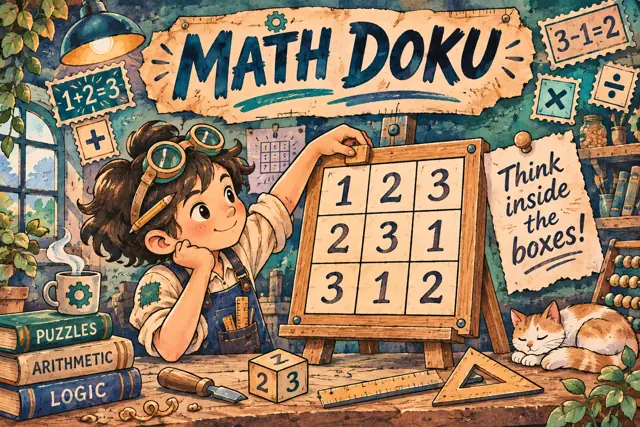
Think like a detective and fill the grid! Your stars, stickers and streak save on this device.
- 🔥Keep a streakPlay a little each day to grow your day streak.
- ⭐Aim for 3 starsBeat your best score and earn every star.
- 🏅Collect stickersUnlock achievements in your sticker book.
- 💪Mistakes are OKEvery round makes your brain a little stronger.
How it works
Everything you need to know about Math Doku
Math Doku is a free MathDoku puzzle you can play online: fill the grid so every row and column uses each number once, and every outlined cage hits its target with +, −, × or ÷. It is a calcudoku-style logic puzzle, part Sudoku and part mental math. Choose a grid from 3×3 to 9×9 and an Easy, Medium or Hard level, try the daily puzzle, or print any puzzle with an answer key. Every puzzle is checked to have exactly one solution. Notes, hints and a guided tutorial help first-timers, and there is no sign-up.
How to play MathDoku
- Know the numbers. On a grid of size n you use the numbers 1 to n: 1–4 on a 4×4 grid, 1–6 on a 6×6 grid, and so on.
- Follow the Sudoku rule. Each row and each column must contain every number exactly once.
- Hit every cage target. The grid is split into outlined groups of cells called cages. The label in the top-left cell, such as 12×, says what the numbers in that cage must make with that operation.
- Fill a cell. Tap or click a cell, then a number on the keypad, or type it. Switch to Notes mode to pencil in possibilities instead.
- Finish the grid. When every cell is filled correctly, the puzzle is solved and the results screen shows your time and stars.
First time? Press Quick tutorial for a guided 3×3 puzzle that walks you through the rules one step at a time.
Reading the cages
- Addition (+): the cage’s numbers add up to the target. A 2-cell “7+” cage on a 4×4 grid must be 3 and 4.
- Multiplication (×): the numbers multiply to the target. A 2-cell “12×” cage on a 4×4 grid must be 3 and 4.
- Subtraction (−): always two cells; the larger number minus the smaller equals the target, in either order. On a 4×4 grid, “3−” must be 1 and 4.
- Division (÷): always two cells; the larger number divided by the smaller equals the target. “2÷” on a 4×4 grid could be 1 and 2, or 2 and 4.
- Single cells: a one-cell cage simply shows its number. Fill it in first.
A number may repeat inside a cage as long as the copies are in different rows and columns. For example, on a 6×6 grid an L-shaped “6×” cage could hold 1, 6 and 1.
Sizes, levels and the daily puzzle
| Level | Operations used | Good for |
|---|---|---|
| Easy | + and − | Learning the rules, younger solvers |
| Medium | +, − and × | Multiplication fact practice |
| Hard | +, −, × and ÷ | Experienced solvers |
Pick any grid from 3×3 to 9×9 with any level. Small grids take a minute or two; 8×8 and 9×9 Hard grids are a real workout. Press Today’s puzzle for the daily MathDoku: there is one daily puzzle for each size and level, the same for everyone on the same date, and finishing it adds a “Daily ✓” badge with your time. Press New Puzzle for unlimited fresh grids. Each one is generated on the spot and checked by a solver so it has exactly one answer.
MathDoku solving strategies
- Start with the giveaways. Fill single-cell cages, then cages with only one possible combination, like “3−” or “7+” on a 4×4 grid.
- List combinations. For a 6×6 “15×” cage of two cells, the only pair is 3 and 5. For “10+” in three cells there are several options, so pencil them in as notes.
- Use the row and column total. Every row of an n×n grid adds to the same total: 10 on 4×4, 15 on 5×5, 21 on 6×6. If a row is all cages except one cell, subtraction gives you the missing number.
- Look for pairs. If two cells in a row can only be 2 or 5, then no other cell in that row can be 2 or 5. Cross them off your notes.
- Use the big numbers. Large products and sums force large numbers. A 3-cell “120×” cage on a 6×6 grid must use 4, 5 and 6.
- Check parity. An odd product means every number in the cage is odd.
How to solve a MathDoku: a worked 4×4 example
Here is a complete 4×4 puzzle (numbers 1–4) solved step by step, using only logic. Rows are numbered 1–4 from the top and columns 1–4 from the left, so r2c3 means row 2, column 3.
| Cage | Cells | Target |
|---|---|---|
| A | r1c1, r2c1 | 3÷ |
| B | r1c2, r1c3 | 6× |
| C | r1c4, r2c4 | 8× |
| D | r2c2, r2c3 | 3− |
| E | r3c1, r4c1 | 8× |
| F | r3c2, r3c3, r4c2 | 6+ |
| G | r4c3, r4c4 | 3− |
| H | r3c4 | 3 |
- Single cell first. Cage H is one cell, so r3c4 = 3.
- Column 4. Cage C is 8× in two cells, so it must be 2 and 4. With 3 already in r3c4, the last cell r4c4 = 1.
- Cage G. 3− in two cells is 1 and 4. Since r4c4 = 1, r4c3 = 4.
- Cage E. 8× is 2 and 4 again. Row 4 already has a 4, so r4c1 = 2 and r3c1 = 4. Row 4 now needs a 3, so r4c2 = 3.
- Cage A. 3÷ is 1 and 3. Cage D (3−) means row 2 already uses 1 and 4, so r2c1 = 3 and r1c1 = 1.
- Cage B. 6× in two cells is 2 and 3, so the last cell of row 1 is r1c4 = 4 and therefore r2c4 = 2. Column 2 already has a 3 (r4c2), so r1c2 = 2 and r1c3 = 3.
- Finish with cage F. 6+ minus the 3 in r4c2 leaves 3 for r3c2 + r3c3, so they are 1 and 2. Column 2 already has a 2, so r3c2 = 1, r3c3 = 2, and cage D gives r2c2 = 4 and r2c3 = 1.
Solution: row 1 = 1 2 3 4, row 2 = 3 4 1 2, row 3 = 4 1 2 3, row 4 = 2 3 4 1. Every row and column uses 1–4 once and every cage hits its target. The same moves (single cells, forced pairs, the last cell of a row, then elimination) solve every grid size; bigger grids just need more notes.
Notes, hints and controls
- Number and Notes modes: Notes pencils in small candidate numbers. Placing a number clears that number from the notes in the same row and column. Auto-notes fills in every number that is still allowed.
- Live feedback: repeated numbers in a row or column turn red. A finished cage turns green when it hits its target, and its label turns red when it misses.
- Check marks wrong cells. Hint fixes the selected cell if it is wrong, or fills the empty cell with the fewest possibilities, and Ollie explains how it fits its cage. Reveal shows the whole solution.
- Undo, Redo, Erase and Restart let you experiment freely. Reveal, New and Restart ask for a second tap so you do not lose a grid by accident.
- Keyboard: arrow keys move, number keys fill, Shift + number adds a note, N toggles Notes, Backspace erases, and Ctrl + Z / Ctrl + Y undo and redo.
- Stars and records: solve with no hints and no wrong checks for 3 stars, with up to two hints for 2 stars, or with more help for 1 star; Reveal earns 0. The timer pauses when you switch tabs, and your best time is saved for each size and level. Eleven stickers include finishing the tutorial, solving a Hard grid, solving the daily puzzle and conquering an 8×8 or 9×9 grid.
MathDoku for kids: which grid to start with
MathDoku works well for children because the difficulty grows in two separate ways: the grid size sets how many numbers you juggle, and the level sets which operations appear. Easy uses only + and − cages, Medium adds ×, and Hard adds ÷ with bigger cages.
- First puzzles (about ages 7–8): the guided 3×3 tutorial, then 3×3 or 4×4 on Easy. Only adding and subtracting small numbers.
- Times-table practice (about ages 8–10): 4×4 or 5×5 on Medium, where × cages ask for factor pairs such as 12× = 3 × 4.
- Confident solvers (about ages 10–12): 6×6 on Medium or Hard, using notes and the row-total trick.
- Teens and adults: 7×7, 8×8 and 9×9 on Hard. A 9×9 grid uses the numbers 1–9, the same as a Sudoku.
The ages are only a guide. If a child gets stuck, drop one grid size or one level rather than giving hints on every cell; finishing a smaller puzzle builds more confidence than being walked through a big one.
Printable MathDoku puzzles with answer keys
Every puzzle you open can also be printed. Start a puzzle, press 🖨️ Print, and you get a clean black-and-white page with thick cage borders, the targets in the corners, empty cells, short rules and a line for a name and time. The answer key prints on a separate page, so you can keep it for checking.
To build a worksheet set, choose a size and level, print, press New, and print again. Because each puzzle is generated fresh and checked for exactly one solution, you can print as many different puzzles as you need. The daily puzzle is the same for everyone that day, which makes it handy for a whole class.
Big grids have more to keep track of: every row and column of an n×n grid adds to n(n+1)/2, so the totals are 28 on 7×7, 36 on 8×8 and 45 on 9×9. On phones, the 🔍 Zoom in button enlarges 7×7 to 9×9 grids so the cage labels stay readable.
What Math Doku teaches
MathDoku turns fact practice into reasoning. To fill a cage, students must find all the ways to make a number, which builds fluency with addition, subtraction, multiplication and division facts and with factor pairs (Common Core 3.OA.C.7 for multiplication and division within 100, 4.OA.B.4 for factor pairs). The Sudoku rule adds deductive logic and the habit of checking several constraints at once (Mathematical Practices MP1 and MP7). Easy 3×3 and 4×4 grids suit about grade 2 and up; 6×6 to 9×9 Hard grids challenge middle schoolers and adults.
For the classroom, solve the guided tutorial together, then have pairs explain how they cracked one cage. Students who need fact support can review the multiplication table, learn fun ways to memorize multiplication tables, or brush up on division. To see why grid puzzles help, read how Sudoku builds logical thinking.
If you like Math Doku, try the Magic Square puzzle, where every line must reach the same total, or the daily Equation Guess. Browse every title on our free math games page.
MathDoku FAQ
What is MathDoku?
MathDoku is a number logic puzzle that combines Sudoku’s rule (each number once per row and column) with arithmetic cages that must reach a target. It is also called Calcudoku.
How do you play MathDoku?
Fill an n×n grid with the numbers 1 to n so no number repeats in a row or column, and make the numbers in each cage combine with the cage’s operation to reach its target.
What Japanese math game is similar to Sudoku?
KenKen, created by Japanese teacher Tetsuya Miyamoto, uses the same cage-and-grid idea. KenKen is a trademark of KenKen Puzzle LLC; Math Doku is our own free calcudoku-style version.
What is math Sudoku called?
Arithmetic versions of Sudoku are usually called MathDoku, Calcudoku or KenKen. Killer Sudoku is a related puzzle that uses only sums.
Does a number have to be different inside a cage?
No. A number can appear twice in one cage if the two copies are in different rows and different columns.
Is Math Doku free, and does it work on phones?
Yes. It is free in your browser with a touch keypad for phones and tablets, plus full keyboard support on computers.
Is CalcuDoku the same as KenKen?
Yes, the rules are the same: fill an n×n grid with 1 to n without repeats in any row or column, and make every cage reach its target. KenKen is a registered trademark of KenKen Puzzle LLC; MathDoku, CalcuDoku and KenDoku are other names used for the same kind of puzzle.
Is there a 9×9 MathDoku?
Yes. Math Doku offers every size from 3×3 to 9×9 on Easy, Medium and Hard, plus a daily puzzle at each size. A 9×9 grid uses the numbers 1–9 and every row and column adds to 45.
Is there a MathDoku solver?
Each puzzle comes with its own help: Check marks wrong cells, Hint fills one cell and explains why it fits its cage, and Reveal shows the whole answer. Every puzzle is checked by a built-in solver before you see it, so it always has exactly one solution.
Can I print a Math Doku puzzle?
Yes. Press 🖨️ Print during a puzzle to print it in black and white, with the answer key on a second page. On 7×7 and bigger grids, 🔍 Zoom in makes the grid larger on small screens so every cage label is easy to read.
Can I print a certificate?
Yes. When you finish a round with at least one star, type a name in the box on the results screen and press 🖨️ Print certificate. The certificate shows the game, the stars earned, the main scores and the date — a nice way to celebrate progress at home or in class.
Keep playing
More free math games
Practice facts, solve puzzles and build number sense. Every game is free.
 Practice & SpeedTimes Tables RacePlay now →Strategy & PuzzlesMultiplication GamePlay now →Strategy & PuzzlesMake the NumberPlay now →Strategy & PuzzlesMagic SquarePlay now →
 Strategy & Puzzles2048 MathPlay now →
 Strategy & PuzzlesEquation GuessPlay now →Number Sense & AlgebraSkip CountingPlay now →Number Sense & AlgebraGuess My NumberPlay now →
 Number Sense & AlgebraFraction PizzaPlay now →
 Number Sense & AlgebraBalance AlgebraPlay now →

Related to This Article
More math articles
- Community
- Wrenches, Sockets, and Pliers: Making the Right Match
- Teams, Work Groups, Roles, and Accountability
- Top 10 5th Grade FSA Math Practice Questions
- Structure of the federal judiciary
- Empirical and Molecular Formulas: Calculate Atom Ratios
- How to Create a GED Math Study Plan?
- LCM Calculator: Least Common Multiple of Two or More Numbers (with Steps)
- Converting Units of Capacity for 4th Grade
- Comparison and Number Ordering



What people say about "MathDoku Online Free — Math Doku Puzzles 3×3 to 9×9"?
No one replied yet.