Geometry Puzzle – Challenge 69
A rectangle's length grows by 20%, so length goes from L to 1.2L. To keep the area the same, the width has to shrink by a compensating factor. Solve: W times 1.2L = W' times 1.2L should equal the old area W times L, so W' = W/1.2 = (5/6) W. That is a decrease of 1/6, or about 16.67%.
Key takeaways:
- Area of rectangle = Width times Length.
- Length increases by 20%: new length = 1.2L.
- New width must satisfy W' times 1.2L = W times L.
- Solve: W' = W/1.2 = (5/6) W, a decrease of 1/6.
- 1/6 as a percent: about 16.67% (16 and 2/3 percent).
Who can solve this math puzzle quickly? This is a great logic challenge for those who love critical thinking challenges. Let’s challenge your brain!
Challenge:
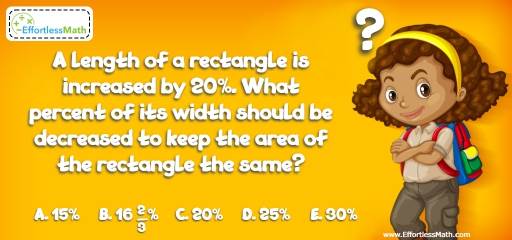
A length of a rectangle is increased by \(20\%\). What percent of its width should be decreased to keep the area of the rectangle the same?
A- \(15\%\)
B- \(16\frac{2}{3}\%\)
C- \(20\%\)
D- \(25\%\)
E- \(30\%\)
The Absolute Best Book to Challenge Your Smart Student!

The correct answer is B.
Original price was: $27.99.$17.99Current price is: $17.99.
The area of a rectangle is the product of its width and length. Let x be the area of the rectangle.
Area of a rectangle = Width × Length = x
Length → 1.2Length → Area of a rectangle = Width × 1.2Length = x
Let W1 be the width of the first rectangle and W2 be the width of the second rectangle.
W1 × 1.2L = W2 × L → W1 × 1.2 = W2 → W1 \(= \frac{1}{1.2}\)W2 →
W1 \(= \frac{5}{6 }\)W2
To keep the area of the rectangle the same \(\frac{1}{6 }\) or \(16\frac{2}{3}\) percent of the width should be decreased.
The Best Books to Ace Algebra
Frequently Asked Questions
How do I set up the equation?
Original area = W times L. New area = W’ times 1.2L. Setting them equal: W’ times 1.2L = W times L. Divide both sides by 1.2L: W’ = W/1.2.
Why is W/1.2 the same as (5/6)W?
1.2 = 6/5, so dividing by 6/5 is the same as multiplying by 5/6. Therefore W/1.2 = (5/6) W.
What is the percent decrease?
Decrease = 1 – 5/6 = 1/6, which is approximately 0.1667, or 16.67% (also written 16 and 2/3 percent).
Why isn’t the answer 20%?
Common intuition says “increase by 20%, decrease by 20%”, but the compensations are NOT symmetric. A 20% increase requires only about a 16.67% decrease to compensate, because the new (larger) base shrinks proportionally less than 20%.
Can I check with a concrete example?
Yes. Original 10 by 10, area = 100. New length 12 (20% increase). To keep area 100, new width must be 100/12 = 8.33 (which is 10 – 1.67, a 16.67% decrease).
What if length increases by 50% instead?
New length = 1.5L. New width = W/1.5 = (2/3)W, a decrease of 1/3 ≈ 33.33%.
What if length doubles?
New length = 2L. New width = W/2 = 0.5W, a decrease of 50%.
Why is percent compensation not symmetric?
Because the BASE for the inverse change differs from the original base. A 20% increase from 10 gives 12. To get back to 10 from 12 requires losing 2 out of 12, which is about 16.67%, not 20% out of 12.
What is the general formula?
If length increases by p (as a decimal), the width must decrease by p/(1+p) to keep area constant. For p = 0.2: decrease = 0.2/1.2 = 1/6.
Where does this principle show up?
Pricing (a discount and re-markup are not equal), efficiency calculations (a 25% productivity loss requires more than 25% to recover), economics (inflation-adjusted values).
Related Lessons You May Like
- How to find the area of rectangles
- How to find the perimeter of rectangles
- How to find volume and surface area of cubes
- How to solve percent of change
- How to solve multi-step word problems
If your student enjoys puzzles like this, Geometry for Beginners works the same relationships inside a full curriculum. Pre-Algebra for Beginners covers the algebraic foundations gently.

Related to This Article
More math articles
- Congressional caucuses
- Maine Algebra 1 Free Worksheets: Printable Algebra 1 Practice for Every Skill
- How to Find Similar and Congruent Figures?
- The Best Grade 7 ELA Practice Tests for Connecticut Students
- Categorization of Differential Equations: An Expert Classification
- How to Find the Number of Solutions to a System of Equations by Graphing
- Convert Between Fractions and Decimals
- How to Find Units of Time Comparison
- How to Calculate the Geometric Mean in Triangles
- Digital and social media







What people say about "Geometry Puzzle: Challenge 69"?
No one replied yet.