Reading Scientific Diagrams and Captions
On the science test, words and pictures work as a team. A passage will often come with a diagram, a labeled figure, or a chart, and the answer to a question is frequently split between the two — part in the sentences, part in the picture. If you read only the text and skip the figure (or the other way around), you can miss the piece you need.
The skill here is learning to move back and forth between the words and the graphic on purpose, using each to make sense of the other. The caption and labels are not decoration. They are instructions for how to read the figure, and they often contain the exact detail a question is testing.
This lesson gives you a simple habit for reading text-and-diagram pairs so nothing slips past you.
Read the Caption First
Before you study a diagram, read its caption — the short line of text underneath or beside it. The caption tells you what you are looking at and why it is there. A figure of a plant cell with the caption “Structures that capture light for photosynthesis” is pointing you toward the chloroplasts, not just showing you a cell.
Then read the labels inside the figure. Labels name the parts and connect them to the words in the passage. When a passage mentions “the xylem carries water upward” and the diagram labels a tube as xylem, those two pieces are meant to be read together.
Match the Words to the Picture
The most useful move with a text-and-diagram question is to physically point (with your eyes or the cursor) from a sentence to the matching spot in the figure. If the passage says “energy flows from producers to consumers,” find the arrow in the diagram that goes from the plant to the animal. The passage gives the rule; the figure shows the case.
This matters because the test likes to ask questions that only make sense when you combine both. A question might give you a fact in the passage and then ask you to locate it in the diagram, or show a value in the figure and ask what the passage says it means. Neither source is enough alone.
Walk Through a Real Figure
Here is a labeled figure of the kind you will meet on the test. Notice how much it tells you before you read a single word of any passage:
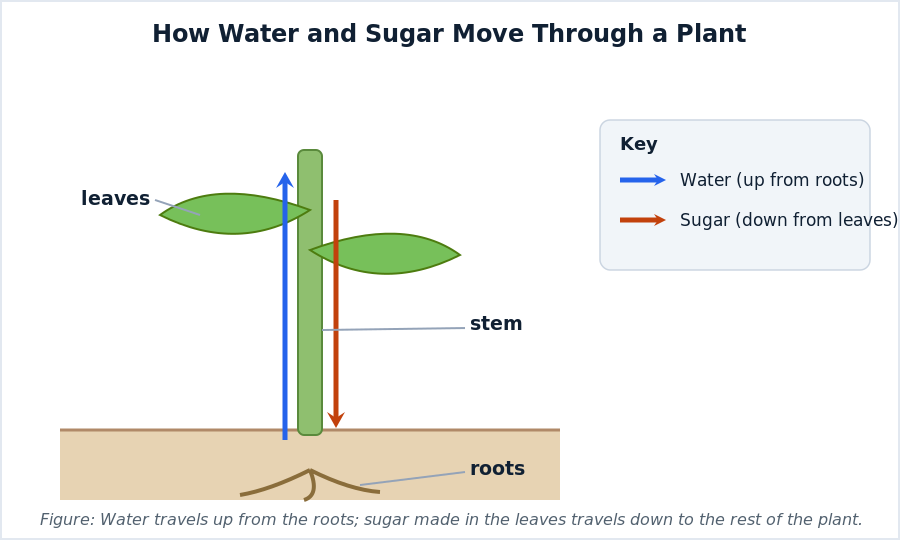
Read it the way we practiced. The title tells you the subject: how water and sugar move. The labels name the parts — roots, stem, leaves. The key explains the two arrow colors, so you are not guessing. And the arrows carry the real information: the blue arrow points up (water rising from the roots), while the orange arrow points down (sugar sinking from the leaves). If a question asked “Which direction does sugar move?”, you would not need any outside knowledge — the orange arrow and the caption answer it directly.
What Diagrams Quietly Tell You
Figures carry information in ways that are easy to overlook:
- Arrows show direction or sequence — the flow of energy, the steps of a cycle, the path of blood.
- Size and position can show scale or order — which layer is on top, which object is larger.
- A key or legend explains any colors or symbols. Always check it before trusting your read of the figure.
- Repeated shapes in a cycle tell you the process loops back to the start.
When a diagram has arrows in a loop, that is a strong hint the question is about a cycle — the water cycle, a food web, the rock cycle — where the end feeds back into the beginning.
Watch: A Short Video Lesson
IXL walks through this skill clearly in a few minutes. It is a helpful companion to the reading above:
A Routine for Text-and-Figure Questions
- Read the caption to learn what the figure is and why it is included.
- Read the labels and any key or legend before interpreting the picture.
- Read the passage, then point from each key sentence to the matching part of the figure.
- Return to the exact label, arrow, or value the question asks about — the answer lives at that spot.
Practice
Use the plant figure shown earlier in this lesson to answer these questions.
- What is the job of a caption on a science figure?
- In the diagram described, which way do the water arrows point?
- Where is sugar made, according to the caption?
- If a legend uses two colors of arrows, what should you do before reading them?
- What does a loop of arrows in a diagram usually signal?
- Why is it risky to answer a question from the passage alone when a figure is provided?
Answers
- It tells you what the figure shows and why it is included.
- Upward, from the roots toward the leaves.
- In the leaves.
- Check the key or legend to learn what each color means.
- A cycle — a process that repeats and feeds back to the start.
- Because the answer may depend on a label, arrow, or value found only in the figure.
Where This Fits in Your Science Prep
Reading text with diagrams rounds out the core reading skills: finding the main idea, sorting ideas from details, and reading science words from context. When you are ready for charts and graphs with real data, move on to the data-reading topics on the Science Topics Hub.

Related to This Article
More math articles
- 7 Best Digital Pen Tablets for Online Math Teaching in 2026
- How to Help Your 3rd Grade Student Prepare for the Texas STAAR Math Test
- How to Unlock the Path to Success: “TExES Core Subjects Math for Beginners” In-Depth Solution Manual
- How to Use the Associative and Commutative Properties to Multiply
- 8th Grade SBAC Math Practice Test Questions
- The Best Grade 8 ELA Practice Tests for Minnesota Students
- The Best Grade 4 Math Book for Washington Students
- Free Grade 3 English Worksheets for Delaware Students
- Free Common Core (CCSS) Grade 5 Math Worksheets: 49 Printable Skill Pages with Step-by-Step Answer Keys
- Free Grade 7 English Worksheets for Missouri Students





















What people say about "Reading Scientific Diagrams and Captions"?
No one replied yet.