Free Grade 8 English Worksheets for Oklahoma Students
Ask an Oklahoma eighth grader what a passage is about and you will probably get a solid answer. Ask them how they know, which line, and why that line and not the one beside it, and you have arrived at the actual challenge of Grade 8. This is the year reading turns into something a student has to argue for, with evidence chosen on purpose, not the first quote that looks close enough.
The writing changes in step. By eighth grade, an argument that simply mentions the other side is unfinished work. The standard now expects students to answer the counterclaim, to take the opposing view seriously and respond to it. They also start reading the way careful adults read: noticing how an author handles evidence that pushes against the author’s own position, and deciding whether that author handled it honestly. Grammar gets more precise too, with verbals, active and passive voice, and the moods of a verb, tools for building sentences deliberately rather than by ear.
That is a real jump, and it is the same jump in Oklahoma City, Tulsa, Norman, Broken Arrow, and every small district across the plains and the Ozark foothills. These worksheets are built for it, one skill at a time, with nothing skipped.
What’s on this page
Forty-six single-skill PDFs, each aligned to the Oklahoma Academic Standards (OAS) for ELA at Grade 8. Each worksheet covers exactly one standard, so practice stays focused instead of scattered. Page one is a Quick Review, the skill explained plainly, with a worked example to anchor it. Then the practice items, sequenced to build. The last page is a student-facing answer key with short explanations, written so a student can check their own work and understand the misses without an adult sitting beside them.
For an Oklahoma family, that means a student can own the process: choose the weak skill, work the PDF, grade it, and move on. No login, no account, no waiting.
Reading: Literature
- Citing Strong Evidence and Making Inferences, [8.3.R.4] pick the strongest support and reason past what the text says outright
- Theme and Objective Summary, [8.3.R.2] name the lesson and retell it without sliding into opinion
- Dialogue, Incidents, and Character Decisions, [8.3.R.4] trace how a line of dialogue or one event turns a character
- Word Choice, Figurative Meaning, and Tone, [8.4.R.4] how a single word choice sets the mood and reveals attitude
- Comparing Literary Structure and Style, [8.3.R.5] two texts, two structures, and why each author built it that way
- Point of View, Suspense, and Humor, [8.3.R.5] how what the reader knows but a character doesn’t creates tension or comedy
- Evaluating Text and Film Versions, [8.7.R.2] what a director kept, cut, or changed, and the effect of each choice
- Modern Stories and Traditional Patterns, [8.3.R.5] spot the old myth or pattern living inside a new story
Reading: Informational Text
- Citing Evidence in Informational Text, [8.3.R.1] pull the strongest article evidence for both stated and inferred ideas
- Central Idea and Objective Summary, [8.3.R.3] find the main idea and summarize without leaking judgment
- Connections Among Ideas and Events, [8.3.R.4] how a text links people, events, and ideas through comparison and cause
- Technical, Figurative, and Connotative Meaning, [8.4.R.5] three different jobs one word can do in nonfiction
- Text Structure and the Role of Sentences, [8.3.R.6] how one sentence or paragraph holds up the author’s larger point
- Author Point of View and Conflicting Evidence, [8.3.R.7] find the author’s stance and how they handle evidence that disagrees
- Evaluating Mediums and Formats, [8.7.R.2] weigh print, video, and audio for what each does best
- Evaluating Arguments, Claims, and Evidence, [8.3.R.7] sort sound reasoning from weak, and relevant evidence from filler
- Conflicting Information Across Texts, [8.6.R.1] two texts disagree on fact or interpretation, figure out where and why
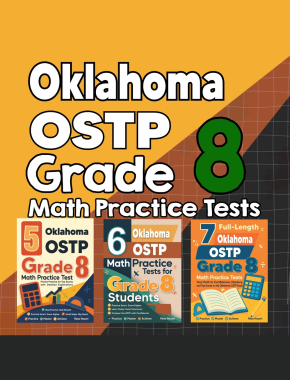
Working on Math Too? Try the Oklahoma OSTP Grade 8 Math Bundle
Many third graders are getting ready for the OSTP in both subjects. If your child also needs math practice that matches the same standards, this companion bundle is the shortest path, workbook, study guide, and full practice tests in one download.
Writing
- Argument Writing: Claims, Reasons, and Evidence, [8.3.W.4] Grade 8 is the year the counterclaim must be answered, not just named
- Informative and Explanatory Writing, [8.3.W.2] teach a reader with a thesis, ordered sections, and clean transitions
- Narrative Writing, [8.3.W.3] pacing, dialogue, sensory detail, and an ending that lands
- Writing for Task, Purpose, and Audience, [8.4.W.2] same idea, reshaped for three different readers and goals
- Planning, Revising, and Editing, [8.3.W.4] sometimes the real revision is starting the paragraph over
- Short Research Projects, [8.6.R.2] ask a focused question, then let the findings sharpen it
- Gathering, Evaluating, and Citing Sources, [8.6.R.3] judge a source’s credibility, then cite it the way a teacher expects
Speaking & Listening
- Collaborative Discussions, [8.1.R.1] come prepared, build on others, and disagree without dismissing
- Analyzing Media Purpose and Motive, [8.1.R.2] name what a piece of media wants from you and how it is trying to get it
- Evaluating a Speaker’s Argument, [8.1.R.3] find the claim, the reasoning, the evidence, and the soft spots
- Presenting Claims and Findings, [8.1.W.1] open with the point, preview the order, and stay in it
- Using Digital Media in Presentations, [8.7.W.1] make slides, audio, and visuals carry weight, not just decorate
- Adapting Speech to Context, [8.5.W.1] the register you use with friends is not the register a presentation needs
Grammar
- Verbals: Gerunds, Participles, and Infinitives, [8.5.W.2] verb forms doing the work of nouns, adjectives, and adverbs
- Active and Passive Voice, [8.5.W.2] choose the voice on purpose instead of by accident
- Verb Mood: Indicative, Imperative, Interrogative, Conditional, Subjunctive, [8.5.W.2] five moods and the meaning each one signals
- Correcting Shifts in Voice and Mood, [8.5.W.2] catch the sentence that changes voice or mood mid-thought
Conventions: Punctuation, Spelling
- Punctuation for Pauses and Breaks: Comma, Ellipsis, Dash, [8.5.W.3] the three marks that control how a sentence breathes
- Ellipses for Omitted Text, [8.5.W.3] trim a quotation honestly without changing what it meant
- Spelling Grade-Appropriate Words, [8.5.W.5] homophones, doubled letters, and the words eighth graders miss most
Knowledge of Language and Style
- Voice and Mood for Effect, [8.5.W.1] use active or passive voice and verb mood as deliberate style tools
Vocabulary and Word Study
- Using Context Clues, [8.4.R.2] name the kind of clue, then use it on purpose
- Greek and Latin Roots and Affixes, [8.4.R.1] one root unlocks ten unrelated words
- Using Reference Materials Effectively, [8.4.R.4] match the tool, dictionary, thesaurus, glossary, to the question
- Verifying Word Meaning, [8.4.R.4] confirm the guess in context before committing to it
- Figures of Speech: Verbal Irony and Puns, [8.4.R.4] catch the meaning that runs opposite the words
- Word Relationships and Nuance, [8.4.R.3] sort synonyms by the small differences that actually matter
- Connotation: Shades of Meaning, [8.4.R.3] same fact, different feeling, different word
- Academic and Domain-Specific Vocabulary, [8.4.R.5] words that travel across subjects and words tied to one field
How to use these worksheets at home
The thing that makes practice work is not intensity. It is return. A student who comes back to one PDF twice a week will outpace a student who does eight in a panicked Sunday. So set a small, repeatable plan: a reading worksheet midweek, a writing worksheet on the weekend. Each PDF runs about twelve to fifteen minutes, which fits between supper and homework in Norman, or in the quiet stretch of a long drive back from Tulsa.
Let the two halves talk to each other. The week your student works *Author Point of View and Conflicting Evidence*, pair it with *Evaluating Arguments, Claims, and Evidence*, or follow a reading PDF with the *Argument Writing* one. Reading sharpens the writing, and writing forces the reading to get specific. That loop is where eighth-grade ELA actually clicks.
Save the finished pages somewhere visible. A folder that fills up across the fall and winter becomes a quiet record of growth, and by the time spring testing arrives, your Oklahoma eighth grader can see exactly how far they have come.
A note about OSTP at Grade 8
The Oklahoma School Testing Program, or OSTP, is the state’s spring assessment, and the Grade 8 English language arts portion is given during the spring testing window. It is built on the Oklahoma Academic Standards (OAS) for ELA, the same standards these worksheets are aligned to, so the test measures exactly the skills your student is practicing here.
The Grade 8 ELA portion of the OSTP asks students to read both literary and informational passages and respond through multiple-choice and technology-stronger items along with writing tasks that require explaining and supporting an answer. The reading leans analytical: comparing how two writers structure the same subject, judging whether evidence genuinely supports a claim, and tracing how an author deals with information that complicates their own point.
The best preparation is not test-prep season. It is a year of steady, specific practice. A student who has spent the fall learning to choose the strongest evidence and answer a counterclaim is not cramming for the OSTP in spring. They are simply doing, on test day, what they have already done all year.
Want everything in one bundle?
If a single organized package suits your family better than a stack of separate PDFs, the full bundle gathers everything into one place, practice tests, complete coverage, and answer keys written to teach, not just to score.
Oklahoma Grade 8 ELA Preparation Bundle, four practice-test books, full-length practice tests, complete answer keys with explanations.
A short closing
Oklahoma weather teaches patience the hard way. You cannot rush a season, you can only keep showing up for it. Eighth-grade English works the same way. Bookmark this page, print one PDF this week, and let your student carry it all the way to the answer key. Then do it again next week. That steady return, more than anything else, is what builds a reader and a writer.
Best Bundle to Ace the Oklahoma OSTP Grade 8 ELA
Looking for the best resource to help your kid ace the Oklahoma OSTP? Try this bundle, four full practice-test books (5 + 6 + 7 + 8 tests) covering the same Grade 8 reading, writing, and language skills your child is already learning. Instant PDF download, answer keys included.


Related to This Article
More math articles
- Missing Numbers for 4th Grade
- Limits on Judicial Power: Checks, Cases and Examples
- Embargo, Impressment and the Road to War: Policy, Grievances and Dates
- Understanding Triangles: A Comprehensive Guide to Their Classification and Properties
- The Best Grade 3 Math Book for Connecticut Students
- Channels and Carriers: Facilitated Diffusion and Saturation
- CBEST Test Facts and FAQs
- Draft Needs a Boost? A Guide to the Best AI Essay Rewriters for Students
- Massachusetts MCAS Grade 6 Math Free Worksheets: Printable PDF Practice with Student-Friendly Keys
- The Muscular System







What people say about "Free Grade 8 English Worksheets for Oklahoma"?
No one replied yet.