Free Grade 5 English Worksheets for Nevada Students
Fifth grade is the year reading really shifts. Passages get longer, the questions ask for evidence, and writing moves from short responses to organized paragraphs with reasons. If you’re a Nevada parent or teacher trying to help, you don’t need a curriculum overhaul. You need steady single-skill practice on the things Nevada fifth graders are actually working on.
This page is a working stash for Nevada fifth graders. The worksheets line up with the Nevada Academic Content Standards for English Language Arts, the same skills your child’s teacher is hitting between August and May. They also happen to be the same skills SBAC leans on in the spring, but that’s not the point. The point is steady practice on the right things.
Everything here is a free PDF. Click the title, the file opens, you print it. No account, no email, no “sign up to unlock.” Hand the same worksheet to a tutor, photocopy it for two cousins, leave it folded in the glove compartment, whatever works.
What’s actually on this page
57 single-skill worksheets, grouped by what they’re actually doing. Each one is short on purpose. Fifth graders don’t need a 14-page packet. They need ten or fifteen minutes on one thing, a conversation about why an answer was wrong, and then dinner.
The Quick Review at the top of every PDF is the actual teaching part. Read it with your kid before they pick up the pencil. The answer key on the last page explains the *why*, not just the *what*, which is where most of the learning happens.
Reading: Literature
- Quoting Text Accurately to Support Inferences, [RL.5.1] quote the line that proves your point
- Theme and Summary in Stories, Drama, and Poetry, [RL.5.2] the big idea, in your own words
- Comparing and Contrasting Characters, Settings, and Events, [RL.5.3] what’s alike and what’s different, with details
- Figurative Language: Similes, Metaphors, and Word Meaning, [RL.5.4] what those vivid phrases really say
- How Chapters, Scenes, and Stanzas Fit Together, [RL.5.5] how each part builds on the last
- How a Narrator’s Point of View Shapes a Story, [RL.5.6] who is telling, and what that changes
- Visual and Multimedia Elements in Texts, [RL.5.7] what pictures, sound, and video add
- Comparing Stories in the Same Genre, [RL.5.9] two mysteries, two adventures, what’s the pattern?
Reading: Nonfiction
- Quoting Text to Support Inferences in Nonfiction, [RI.5.1] back up the inference with the article
- Two or More Main Ideas and Summary, [RI.5.2] long articles often have more than one
- Relationships Between People, Events, and Ideas, [RI.5.3] how facts and people connect
- Academic and Domain-Specific Vocabulary in Nonfiction, [RI.5.4] the strange words in science and history
- Comparing Text Structures Across Two Texts, [RI.5.5] how two writers organize the same topic
- Comparing Multiple Accounts of the Same Event, [RI.5.6] two angles on what happened
- Locating Answers Across Multiple Sources, [RI.5.7] where do I find that fact?
- Reasons and Evidence Supporting Specific Points, [RI.5.8] claim → reason → evidence
- Integrating Information from Several Texts on One Topic, [RI.5.9] synthesize, don’t just list
Foundational Reading Skills
- Decoding Multisyllable Words: Roots, Affixes, and Syllable Patterns, [RF.5.3] break the long ones into pieces
- Reading Fluency: Accuracy, Rate, and Expression, [RF.5.4] read aloud like talking, not robot
- Self-Correcting and Rereading While You Read, [RF.5.4] fix it when the sentence stops making sense
Writing
- Opinion Writing with Logically Ordered Reasons, [W.5.1] say what you think, and order your reasons
- Informative / Explanatory Writing with Concrete Details, [W.5.2] teach with specific facts, not vague hints
- Narrative Writing with Pacing, Dialogue, and Description, [W.5.3] tell a story with pacing and dialogue
- Producing Clear and Coherent Writing for Task and Audience, [W.5.4] different writing for different jobs
- Planning, Revising, Editing, and Rewriting, [W.5.5] make a draft better in passes
- Short Research Projects with Multiple Sources, [W.5.7] ask a question, find sources, write it up
- Summarizing, Paraphrasing, and Citing Sources, [W.5.8] say it in your own words, and credit the source
Listening and Speaking
- Engaging in Collaborative Discussions, [SL.5.1] how to be a useful voice in a group
- Summarizing What Was Read or Presented, [SL.5.2] say it back in your own words
- Evaluating a Speaker’s Reasons and Evidence, [SL.5.3] what did they claim, and what backed it up?
- Reporting on a Topic with a Logical Sequence, [SL.5.4] tell a class about something, in order
Grammar
- Pronoun, Antecedent Agreement and Pronoun Case, [L.5.1] the pronoun has to match the noun it stands for
- Sentence Types: Simple, Compound, and Complex, [L.5.1] all three sentence types
- Subject, Verb Agreement, [L.5.1] the dog barks; the dogs bark
- Conjunctions, Prepositions, and Interjections, [L.5.1a] and, but, of, with, wow, ouch
- Perfect Verb Tenses (Have/Had/Will Have), [L.5.1b] she has run; she had run; she will have run
- Verb Tenses to Convey Times, Sequences, and Conditions, [L.5.1c] switch tense on purpose, not by accident
- Recognizing and Correcting Inappropriate Shifts in Verb Tense, [L.5.1d] don’t slide from past to present in one paragraph
- Correlative Conjunctions (Either/Or, Neither/Nor, Both/And), [L.5.1e] the pairs that always travel together
Capitalization, Punctuation, and Spelling
- Using Reference Materials to Check Spelling, [L.5.2] look it up before you turn it in
- Commas in a Series and After Introductory Elements, [L.5.2a] where the commas go in lists and openers
- Commas to Set Off Yes/No, Tag Questions, and Direct Address, [L.5.2b] Yes, I think so. You can swim, right?
- Punctuating Titles: Underlining, Italics, and Quotation Marks, [L.5.2d] short works vs. Long works
- Spelling Grade-Level Words Correctly, [L.5.2e] the common words a fifth grader should know
Knowledge of Language
- Formal vs. Informal English, [L.5.3] school writing vs. How you talk to a friend
- Expanding, Combining, and Reducing Sentences for Style, [L.5.3a] build, merge, trim
- Comparing Varieties of English in Stories, Drama, and Poetry, [L.5.3b] how characters’ speech shows who they are
Vocabulary and Word Study
- Multiple-Meaning Words, [L.5.4] bark, light, run, which meaning fits HERE?
- Context Clues for Word Meaning, [L.5.4a] use surrounding words to find meaning
- Greek and Latin Roots and Affixes, [L.5.4b] tele-, photo-, port, dict, struct, anti-
- Dictionaries, Glossaries, Thesauruses, and Digital Tools, [L.5.4c] four reference tools that do different jobs
- Interpreting Figurative Language: Similes and Metaphors, [L.5.5a] what the comparison is really saying
- Idioms, Adages, and Proverbs, [L.5.5b] piece of cake; the early bird gets the worm
- Synonyms, Antonyms, and Homographs, [L.5.5c] near-meanings, opposites, and tricky same-spelled words
- Academic Words That Signal Contrast, Addition, and Logical Relationships, [L.5.6] however, moreover, therefore, read the connector
- Domain-Specific Vocabulary, [L.5.6] the technical words in science and social studies
- Pronunciation Keys and Syllable Stress, [L.5.6] read the squiggles in a dictionary entry
How to actually use these without burning your kid out
A small confession from years of watching well-meaning parents pile up the printouts: the trick isn’t more worksheets. It’s slower worksheets. Two suggestions that actually work:
Pick one. Sit with it. The temptation is to grab six and call it a study session. Resist that. One worksheet, with a real conversation about the wrong answers, will teach more than six speed-runs.
Talk about the misses, not the hits. When your kid gets one wrong, ask them to read the explanation in the answer key out loud. If they can re-explain why the right answer is right, that’s the moment the skill actually went in.
Wait a week before circling back. If something is shaky today, don’t drill it tonight. Try a different worksheet on the same skill in five or six days. The space between attempts is where retention lives.
A word about SBAC
Nevada families sometimes find pages like this because SBAC, the Nevada’s Grade 5 English assessment, is on the calendar in the spring, and they want to know what to do. The straight answer: the worksheets here aren’t a cram pack. They’re skill builders that happen to line up with what SBAC measures, because SBAC measures the same Nevada Academic Content Standards for English Language Arts skills your kid is already learning.
If you only have time to pick two to start with, make them Main Idea, Key Details, and Summary and Context Clues for Word Meaning. Both show up disproportionately on the reading sections, and most kids who lose points on SBAC reading lose them on one or the other.
Questions that come up a lot
Are these aligned to Nevada’s standards? Yes. Each worksheet targets a specific Grade 5 skill from the Nevada Academic Content Standards for English Language Arts.
Can I use these for homeschool? Yes, and plenty of Nevada homeschool families do. They work well as the practice piece after a longer lesson, or as a five-day rotation through the four big skill areas.
My kid reads above grade level, what should I pick? Try Comparing Themes and Patterns Across Cultures and Greek and Latin Roots and Affixes. Both stretch confident readers in ways that are still on grade.
My kid is behind on reading, where do I start? Don’t start with the long passages. Start with Greek and Latin Roots and Affixes and Context Clues for Word Meaning. They unlock a surprising amount of the rest.
Is there an answer key? Every PDF has one on the last page, written so the student can understand the explanation themselves.
Before you print
If the first worksheet doesn’t land, don’t take it personally. Some skills need a different angle on a different day. Try a shorter one. Try one in a different skill area. Try the same one again next Tuesday after school. Practice doesn’t have to be perfect to be useful. It just has to keep happening. Come back whenever you need a new one.
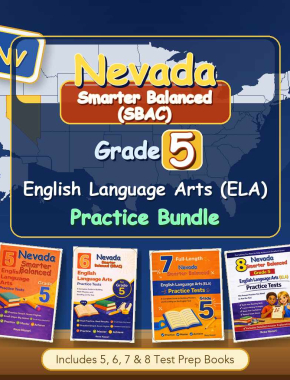
Best Bundle to Ace the Nevada SBAC Grade 5 ELA
Looking for the best resource to help your kid ace the Nevada SBAC? Try this bundle, four full practice-test books (5 + 6 + 7 + 8 tests) covering the same Grade 5 reading, writing, and language skills your child is already learning. Instant PDF download, answer keys included.

Related to This Article
More math articles
- Pendleton Civil Service Reform Act
- The AFL, Craft Unionism, Debs, and Industrial Unionism
- How to Multiply Decimals and Whole Numbers?
- Interpreting election returns
- 5 Awesome Tips to Boost Your Child’s Math Skills Easily!
- FREE TExES Core Subjects EC-6 Core Math Practice Test
- The Best Grade 5 ELA Practice Tests for Hawaii Students
- Top 5 Books for math teachers
- Open-Economy Macroeconomics and Exchange Rates
- ACCUPLACER Math – Test Day Tips









What people say about "Free Grade 5 English Worksheets for Nevada"?
No one replied yet.