Missouri Algebra 1 Free Worksheets: Printable Practice for Every Algebra 1 Topic
Most subjects in school keep adding new vocabulary year after year. Algebra 1 does something different. It takes the small set of operations a student has known since elementary school and gives them a new job. Addition stops being just addition and becomes a way to balance an equation. Multiplication stops being a product and becomes a slope. A subtraction sign in front of a parenthesis suddenly changes the personality of everything inside it. Same operations, completely new role.
That shift is what makes ninth-grade math feel either thrilling or impossible. A student who sees the structure can keep walking forward through linear functions, systems, exponents, and quadratics without ever feeling like the floor moved under them. A student who is still half-thinking in arithmetic will run into the same wall over and over again, in slightly different costumes. From Kansas City to St. Louis, from a tutoring table in Springfield to a quiet study hour in Columbia, the difference is rarely intelligence. It is almost always practice on the right small skill at the right moment.
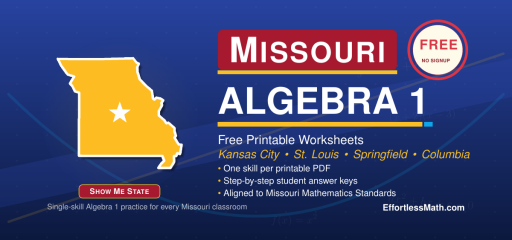
These 70 worksheets are built for those right small moments. One skill per page, one example, one answer key. That is the whole design.
What’s on this page
Seventy single-skill PDFs aligned to the Missouri Algebra 1 standards. The list reads like the table of contents of the course itself: equations and inequalities, lines and slope, functions, systems, exponents and radicals, factoring, and quadratic functions. A student stays on a single skill for a single sitting, no surprise topic shifts in the middle of a page.
Each PDF starts with a one-page Quick Review: the skill in everyday language and one full worked example. Then twelve practice problems climbing from comfortable to harder. The last page is a friendly, student-facing answer key, not just final answers but short explanations that read the way a patient older sibling would explain them.
Foundations of Algebra
This chapter lays the groundwork, moving from numbers to letters and putting properties and order-of-operations to work on real problems. It’s a frequent early hurdle for learners in Kansas City and across the state.
- Variables, Expressions, and Properties
- Order of Operations and Evaluating Expressions
- Simplifying Algebraic Expressions
- Introduction to Equations and Solutions
- Personal Financial Literacy
Solving Linear Equations
Now the central skill of the course: isolating a variable, from one clean step through multi-step solves and rearranging formulas. These worksheets give Missouri students focused, low-pressure practice.
- Solving One-Step Equations
- Solving Two-Step Equations
- Solving Multi-Step Equations
- Equations with Variables on Both Sides
- Literal Equations and Formulas
Inequalities and Absolute Value
Here a single answer becomes a set: solving and graphing inequalities, handling the sign-flip rule, and unpacking absolute value. For Missouri students, fluency here shows up directly on the Missouri Algebra 1 course.
- Solving One-Step Inequalities
- Solving Multi-Step Inequalities
- Compound Inequalities
- Absolute Value Equations
Relations, Functions, and Sequences
This unit introduces function thinking: notation, inputs and outputs, and the patterns that arithmetic and geometric sequences follow. Getting comfortable here pays off all the way through the Missouri Algebra 1 course.
- Function Notation and Evaluating Functions
- Domain and Range
- Graphing Functions and Transformations
- Arithmetic Sequences as Linear Functions
- Geometric Sequences
- Comparing Functions
- Piecewise Functions
- Combining Functions
- Inverse Functions
Linear Functions and Their Graphs
Linear graphs take focus: slope, intercepts, point-slope and slope-intercept forms, and special line relationships. Time spent here is time saved when the Missouri Algebra 1 course rolls around.
- Slope and Rate of Change
- Slope-Intercept Form
- Point-Slope Form
- Standard Form of a Linear Equation
- Writing Linear Equations from Graphs and Tables
- Parallel and Perpendicular Lines
- Inverse Variation
- Understanding Graphs as Solution Sets
Systems of Equations and Inequalities
Here several equations are solved together, and systems of inequalities mark out whole regions of valid solutions. Across Missouri, this is one of the skills that rewards regular reps.
- Solving Systems by Graphing
- Solving Systems by Substitution
- Solving Systems by Elimination
- Applications of Systems of Equations
- Systems of Linear Inequalities
- Solving Linear-Quadratic Systems
Exponents, Polynomials, and Real Numbers
The algebra of powers and polynomials: exponent rules, adding and multiplying polynomials, special products, and real numbers. It is worth the extra reps for Missouri learners aiming for a strong score on the Missouri Algebra 1 course.
- Properties of Exponents
- Adding and Subtracting Polynomials
- Multiplying Polynomials
- Special Products of Polynomials
Factoring
Students learn to rewrite polynomials as products: greatest common factor, trinomial factoring, and recognizable special forms. Kansas City families can use these pages to lock the skill in before it’s tested.
- Greatest Common Factor and GCF Factoring
- Factoring Trinomials: \(x^2 + bx + c\)
- Factoring Trinomials: \(ax^2 + bx + c\)
- Factoring Special Products
Quadratic Functions and Equations
The chapter covers parabolas and three solution paths for quadratics, plus what the discriminant reveals. In Kansas City classrooms it tends to separate confident students from hesitant ones.
- Graphing Quadratic Functions
- Characteristics of Quadratic Functions
- Solving Quadratics by Factoring
- Solving Quadratics by Completing the Square
- Solving Quadratics by Square Roots
- The Discriminant
- The Quadratic Formula
- Quadratic Applications and Modeling
Statistics and Probability
Data analysis and probability close out the core, from box plots and histograms to counting principles. Steady practice now makes the Missouri Algebra 1 course feel far more manageable later.
- Measures of Center and Spread
- Scatter Plots and Correlation
- Lines of Best Fit and Predictions
- Counting Principles
- Probability
- Two-Way Frequency Tables
Exponential Functions and Modeling
Here change compounds: exponential growth and decay, their graphs, and comparisons among model families. Master it early and the rest of the Missouri course leans on it with ease.
- Graphing Exponential Functions
- Comparing Linear, Quadratic, and Exponential Models
- Exponential Growth
- Interpreting Functions and Parameters
More Topics
- Absolute Value Inequalities
- Direct Variation
- Displaying Data with Box Plots
- Displaying Data with Histograms
- Exponential Decay
- Graphing Cube Root Functions
- Graphing Square Root Functions
How to use these worksheets at home
The trick is to think in pairs. Algebra 1 has a small number of natural “first one, then the next one” pairings, and reading the worksheets in those pairs is what makes the year click. Print “Solving One-Step Equations” before “Solving Two-Step Equations”, the second page is the first page plus exactly one more move. Print “Slope and Rate of Change” before “Slope-Intercept Form,” and the slope a student just found becomes the m of the line they are about to graph. Print “Factoring Trinomials” before “Solving Quadratics by Factoring,” and the connection between factoring and solving stops being a leap.
The right rhythm at home is not long sessions; it is short, frequent ones. Two pages a week, finished cleanly with a self-check on the answer key, will outperform a heroic two-hour Sunday review every time. Missouri schedules are crowded, sports, jobs, family, sleep, so use the worksheets the way an athlete uses drills: short, specific, repeated. Each page is roughly fifteen to twenty minutes of focused work, which fits in almost any evening.
One last piece of advice for parents and teachers: trust the answer key. A 14- or 15-year-old grading their own page and writing a one-sentence “what I missed” note is doing work that no amount of explanation from an adult can replicate. The first time a student finds their own mistake in a sign change or a forgotten distribution, the lesson sticks for good.
A note about Algebra 1 in Missouri
Missouri uses the state’s Algebra 1 course standards, aligned with the Common Core framework, as the foundation of the high-school year. Districts across the state typically end the course with a cumulative assessment in the spring window, sometimes a state-supported end-of-course exam, sometimes a district-built final, that pulls from the same set of standards these worksheets are aligned to. Whichever form your school uses, the expected skills are the same: solving linear equations and inequalities, working with linear and exponential functions, solving systems, factoring and solving quadratics, simplifying expressions with exponents, and interpreting data and key features of graphs.
Because every PDF here lines up with one standard, you can use the full set as a quiet checklist as the spring window approaches. Print a worksheet, see if it is solid, and decide on the basis of one page, not a whole study guide, whether to keep moving or pause. That is a much shorter path than re-reading the textbook from the beginning.
A short closing
Algebra 1 is a year a student builds skill by skill, page by page, and the pages do not have to be long to do their work. Bookmark this set, print one PDF tonight, and let your Missouri student start with whichever skill they almost have. By the time spring arrives, almost-have will quietly have become have, in a way neither of you really noticed happening.
New to Algebra? Start with the basics


Related to This Article
More math articles
- Free Energy and ATP Coupling: Worked Examples
- Reflection, Refraction, and Color
- How to Solve Multi-step Word Problems of Money
- The Circular Flow and Gross Domestic Product
- The Best Grade 3 ELA Practice Tests for Georgia Students
- Acids, Bases, and the pH Scale
- 10 Must-Have Elementary Classroom Math Supplies
- 5th Grade TCAP Math Worksheets: FREE & Printable
- 8th Grade NJSLA Math Worksheets: FREE & Printable
- How to Calculate Multiplication and Division of Decimals by Powers of Ten











What people say about "Missouri Algebra 1: Free Worksheets"?
No one replied yet.