Free Grade 6 English Worksheets for Georgia Students
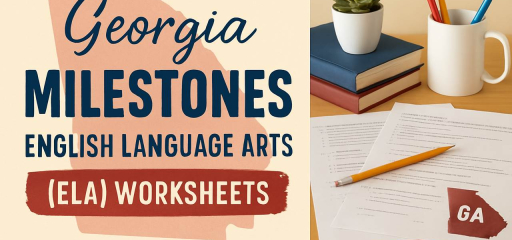
The growing stack on a sixth grader’s desk usually tells the story before the report card does. A novel from English class, two chapters dog-eared near the front. A social studies textbook that landed there in October and never quite moved. A composition notebook with a torn corner. A printout of the latest argumentative prompt from a Georgia teacher who knows exactly what spring is going to ask for. Anyone who has walked past that desk in Roswell or Macon or Savannah knows the shape of it.
What that stack does not show is the move sixth grade English actually demands, the move from reading to comprehend toward reading to argue. Georgia Milestones in April will not just ask whether your child understood the passage. It will ask them to write about it, defend a claim about it, and prove that claim with quoted lines. That is the work, and the stack on the desk is a means to it.
The worksheets below are designed to live inside that stack rather than replace it. Forty-six free PDFs, every one of them lined up with the Georgia Standards of Excellence for English Language Arts, single-skill and self-contained. Slide one between the chapters of the novel and your sixth grader picks up exactly the move they will need on test day.
What’s on this page
Each worksheet covers one Grade 6 standard from the GSE-ELA framework. The format is the same throughout, Quick Review on page one, practice items on page two, answer key with explanations on the last page. The explanations talk to the student, which matters in middle school, when the parent is no longer the homework boss.
No login walls, no email harvesting. Print, work, file.
Reading: Literature
- Citing Textual Evidence and Drawing Inferences, [RL.6.1] name the inference, quote the proof
- Theme and Objective Summary, [RL.6.2] what the whole story teaches, in one clean sentence
- Plot, Episodes, and Character Change, [RL.6.3] the moments that quietly turn a character into someone new
- Figurative Language, Connotation, and Tone, [RL.6.4] the weight a word carries beyond its definition
- Structure: How a Scene or Stanza Builds the Whole, [RL.6.5] each piece doing a job for the larger shape
- Developing the Narrator’s Point of View, [RL.6.6] how a writer makes the reader see through one set of eyes
- Reading vs. Watching: Comparing Versions, [RL.6.7] what the page does that the film cannot
- Comparing Stories Across Forms and Genres, [RL.6.9] same theme, different vessel
Reading: Informational Text
- Citing Evidence and Drawing Inferences in Nonfiction, [RI.6.1] point at the sentence that earns the conclusion
- Central Idea and Objective Summary in Nonfiction, [RI.6.2] the article’s argument in one sober sentence
- How Ideas and Events Are Developed, [RI.6.3] how a writer introduces a point and elaborates on it
- Word Meaning in Nonfiction: Figurative, Connotative, Technical, [RI.6.4] one word, three different jobs depending on context
- Text Structure: How Sections Fit Together, [RI.6.5] cause, effect, problem, solution, sequence
- Author’s Point of View and Purpose, [RI.6.6] the angle behind the article and the reason for it
- Integrating Information from Text, Visuals, and Data, [RI.6.7] read the prose, the chart, and the photo as one
- Evaluating Arguments and Claims, [RI.6.8] separate claim from support and grade the support
- Comparing Two Authors on the Same Topic, [RI.6.9] different angles on the same subject
Working on Math Too? Try the Georgia Milestones Grade 6 Math Bundle
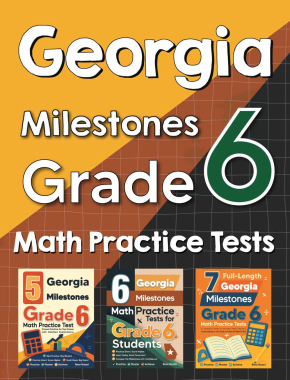
Many third graders are getting ready for the Milestones in both subjects. If your child also needs math practice that matches the same standards, this companion bundle is the shortest path, workbook, study guide, and full practice tests in one download.
Writing
- Argument Writing: Claim, Reasons, Evidence, [W.6.1] defend a position with reasons and quoted proof
- Informative and Explanatory Writing, [W.6.2] teach a reader something clearly and in order
- Narrative Writing, [W.6.3] hook, scene, dialogue, sensory detail, ending that lands
- Clear Writing for Task, Purpose, and Audience, [W.6.4] match the writing to its actual reader
- Planning, Revising, and Editing, [W.6.5] drafts in passes, not single shots
- Short Research Projects, [W.6.7] focused question, multiple sources, tidy report
- Gathering, Evaluating, and Citing Sources, [W.6.8] which sources to trust and how to credit them
Speaking & Listening
- Collaborative Discussions, [SL.6.1] arrive prepared, listen, build on what was said
- Interpreting Diverse Media, [SL.6.2] what each format does well and what it skips
- Analyzing a Speaker’s Argument, [SL.6.3] find the claim, the reasons, the weak links
- Presenting Claims and Findings, [SL.6.4] open with the point, walk the evidence, close cleanly
- Adapting Speech to Context, [SL.6.6] the talk you give a friend is not the talk you give a principal
Grammar
- Pronoun Case: Subjective, Objective, and Possessive, [L.6.1a] I, me, my, and when each belongs
- Intensive Pronouns, [L.6.1b] myself, themselves, and the emphasis they add
- Avoiding Shifts in Pronoun Number and Person, [L.6.1c] pick one person, one number, hold it
- Vague Pronouns and Unclear Antecedents, [L.6.1d] every it and they needs a noun the reader can point to
- Recognizing and Improving Non-Standard English, [L.6.1e] knowing when to code-switch into school English
Conventions: Punctuation, Spelling
- Punctuation: Commas, Parentheses, and Dashes, [L.6.2a] three ways to drop in extra information
- Spelling Grade-Appropriate Words, [L.6.2b] the homophones and trouble words sixth graders miss most
Knowledge of Language and Style
- Varying Sentence Patterns for Style, [L.6.3a] combine, expand, and rearrange to keep writing alive
- Consistency in Style and Tone, [L.6.3b] pick a register, hold it from first sentence to last
Vocabulary and Word Study
- Using Context Clues, [L.6.4a] slow at the unfamiliar word, look at the sentences around it
- Greek and Latin Roots and Affixes, [L.6.4b] port, dict, tele, photo, and a hundred doors
- Using Dictionaries and Thesauruses Effectively, [L.6.4c] match the tool to the question you actually have
- Verifying Word Meaning, [L.6.4d] check the guess instead of trusting it
- Figurative Language: Personification and More, [L.6.5a] the moves that bring writing to life
- Word Relationships: Cause-Effect, Part-Whole, Category, [L.6.5b] the patterns that link words together
- Connotation: Shades of Meaning, [L.6.5c] thin, slim, scrawny, same idea, different feeling
- Academic and Domain-Specific Vocabulary, [L.6.6] the words that show up across subjects and the ones locked to one field
How to use these worksheets at home
The worst place to keep these PDFs is in a folder labeled “test prep.” That framing turns a useful resource into a chore. Better: drop the worksheets into the daily homework rotation. One reading page Tuesday. One vocabulary or grammar page Thursday. A writing page on a Saturday afternoon, when there is time to draft and revise without rushing.
If your sixth grader is fast on a particular skill, do not push the next one immediately. Wait three or four days, then pull a different worksheet on the same skill. Spaced practice, even on small things like context clues or pronoun case, outperforms back-to-back drills by a wide margin. The space is the part that builds the memory.
When a worksheet stumps your child, do not jump to the answer key. Have them read the passage aloud first. Most sixth-grade mistakes on Georgia Milestones-style items are not skill failures; they are reading speed failures. Slowing the read down fixes more than half of them on the spot.
A note about Georgia Milestones ELA
Georgia Milestones for sixth grade English Language Arts is administered in the spring, usually April or early May, and is built directly on the Georgia Standards of Excellence. The test combines selected-response items (multiple choice, multi-select, evidence-based) with constructed-response writing tasks. Sixth graders write both a narrative response and an extended writing response, usually argumentative or informational, based on passages they read on the test.
That second kind of writing matters. The narrative task asks your child to extend, conclude, or revise a passage in a way that holds the voice and structure of the original. The extended writing task asks for an argument or explanation supported by quoted evidence from two or more texts. The argument-writing, narrative-writing, and citing-evidence worksheets on this page are designed for exactly those tasks, not as cram material, but as steady practice across the year.
Want everything in one bundle?
If a long page of single-skill PDFs is more than you need, the Grade 6 ELA Preparation Bundle gathers full-length practice tests, answer keys, and explanations into one package. It is the right tool when your sixth grader needs to rehearse the whole assessment in one sitting, the pacing, the question shifts, the writing tasks back-to-back with reading items.
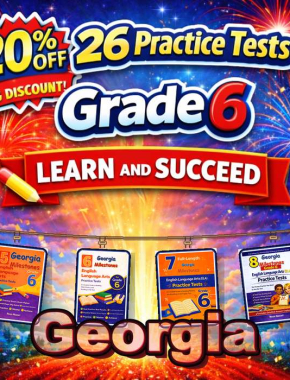
Georgia Grade 6 ELA Preparation Bundle, four practice-test books, 26 unique full-length tests, complete answer keys with explanations.
A short closing
The stack on the desk grows all year. A worksheet at a time, a paragraph drafted at a time, a quoted line underlined in pencil. That is how the writing piece of Georgia Milestones becomes routine instead of intimidating. Come back to this page when your sixth grader is ready for the next small thing.
Best Bundle to Ace the Georgia Milestones Grade 6 ELA
Looking for the best resource to help your kid ace the Georgia Milestones? Try this bundle, four full practice-test books (5 + 6 + 7 + 8 tests) covering the same Grade 6 reading, writing, and language skills your child is already learning. Instant PDF download, answer keys included.

Related to This Article
More math articles
- Classifying Quadrilaterals for 4th Grade
- Congressional control of the budget
- The Ultimate ISEE Upper Level Math Formula Cheat Sheet
- Weaknesses of the national government
- SSAT Middle Level Math FREE Sample Practice Questions
- The Best Worksheets for Florida Grade 2 Students
- North Carolina EOG Grade 6 Math Free Worksheets: Printable EOG-Ready Practice, Answers Included
- Crypto Casinos vs. Traditional Online Casinos: The Math Differences
- Top 10 3rd Grade MEAP Math Practice Questions
- A Comprehensive Guide to the Properties of Rhombuses





What people say about "Free Grade 6 English Worksheets for Georgia"?
No one replied yet.