The Best Grade 2 English Worksheets for Alaska Students
The Best Grade 2 English Worksheets for Alaska Students: a free, printable set you can download and use right away, with answer keys, organized by topic so students can practice one skill at a time and teachers can assign exactly what a lesson needs.
54 free, printable ELA practice pages that fit Alaska classrooms, homeschools, and kitchen tables.
Picture a second grader hunched over the word because. Buh.. Cuz.. They’ve stalled. Then a beat later, “because!”, and they keep going like nothing happened. If you’ve watched that little victory up close, you already know what second-grade reading actually looks like. It’s not smooth. It’s a hundred small wins, one tricky word at a time.
Second grade is the year reading turns a corner. Kids stop pouring every drop of effort into decoding and start doing something new: thinking about what the words add up to. Stories have lessons now. Articles have a point. It’s a wonderful, messy stretch.
These free Grade 2 English worksheets were gathered for Alaska families and teachers to make that stretch a little easier. Each one is a printable PDF with an answer key, and none of them ask you to sign up or hand over an email. Tap a title, the PDF opens, you print. Use them at home, in a classroom in Anchorage, or in a tiny school off the road system. They travel anywhere a printer does.
The skills here follow the Grade 2 English Language Arts standards Alaska has adopted, so they line up with the work your second grader is doing right now.
What you’ll find here, and how it’s grouped
The collection is split into eight strands, which is just a tidy way of covering everything second-grade English includes. There’s reading stories and reading true-fact texts. There’s the machinery of decoding words. There’s writing, speaking and listening, grammar, the rules of capital letters and punctuation, and vocabulary.
Each worksheet zeroes in on a single skill. A second grader who works carefully through one idea remembers it. A second grader who blasts through a ten-page packet usually doesn’t. So browse by strand, choose one page, and go.
Reading: Literature
- Asking and Answering Questions About Stories, answer who, what, where, when, and why about a story
- Central Message, Lesson, or Moral, uncover the lesson tucked inside a tale
- How Characters Respond to Events, watch how a character feels and acts when things change
- Rhythm and Meaning in Stories, Poems, and Songs, feel how a beat or a rhyme carries meaning
- The Structure of a Story, see how beginning, middle, and end work together
- Points of View of Characters, notice that different characters see things differently
- Using Illustrations to Understand Stories, let the pictures fill in the story
- Comparing Two Versions of the Same Story, see what shifts when a story gets retold
Reading: Nonfiction
- Asking and Answering Questions About Nonfiction, pull facts out of a true-information text
- Main Topic and Focus of Paragraphs, name what a paragraph is really about
- Connections Between Events, Ideas, and Steps, trace how one idea or step leads to another
- Nonfiction Vocabulary, get comfortable with the words science and history use
- Text Features, use headings, captions, and bold print to find things fast
- The Author’s Main Purpose, figure out why the author wrote it
- How Images Help a Text, read what a photo or diagram is explaining
- How Reasons Support the Author’s Points, match a writer’s reasons to the points being made
- Comparing Two Texts on the Same Topic, read two pieces on one topic and compare them
Foundational Reading Skills
- Long and Short Vowels, hear the difference between kit and kite
- Vowel Teams, read vowel pairs like oa, ee, and ai
- Decoding Two-Syllable Words, chop a long word into syllables you can say
- Prefixes and Suffixes, read add-ons like re- and -less
- Words with Tricky Spelling Patterns, handle spellings that bend the rules
- Irregularly Spelled Words (Sight Words), memorize the words that simply won’t sound out
- Reading Fluency: Accuracy, Rate, and Expression, read aloud smoothly and with feeling
- Self-Correcting While You Read, catch a mistake and back up to fix it
Writing
- Opinion Writing, state an opinion and back it with a reason
- Informative and Explanatory Writing, explain a topic clearly to a reader
- Narrative Writing, tell a story that moves in order
- Revising and Editing, go back and polish a draft
- Shared Research Projects, explore a topic as a team
- Gathering Information to Answer a Question, collect facts that answer a real question
Speaking and Listening
- Recounting Ideas from a Read-Aloud, retell the key ideas after listening
- Asking and Answering Questions About a Speaker, listen well and ask a thoughtful question
- Telling a Story or Sharing an Experience, speak so a listener can follow along
Grammar
- Collective Nouns, group words like herd, bunch, and crew
- Irregular Plural Nouns, plurals that don’t add -s, like children and geese
- Reflexive Pronouns, using myself, herself, and ourselves
- Past Tense of Irregular Verbs, run turns into ran, see turns into saw
- Adjectives and Adverbs, words that describe people, things, and actions
- Expanding and Rearranging Sentences, add to a sentence or shuffle its order
Capitalization, Punctuation, and Spelling
- Capitalizing Holidays, Products, and Place Names, capitalize the names that deserve it
- Commas in Greetings and Closings of Letters, place the comma right in a letter
- Apostrophes: Contractions and Possessives, sort out don’t and the dog’s bone
- Spelling Patterns, use familiar patterns to spell new words
- Using Reference Materials to Check Spelling, check a spelling instead of guessing it
Vocabulary and Word Study
- Formal and Informal English, knowing when to talk casual and when to talk careful
- Context Clues, use the sentence around a word to guess its meaning
- Prefixes, see how a starter like un- flips a word
- Root Words and Word Endings, spot the base word inside a bigger one
- Compound Words, two words joined up, like snowball or backpack
- Using Glossaries and Dictionaries, find a word’s meaning and use it
- Real-Life Word Connections, tie new words to everyday life
- Shades of Meaning, the difference between tired, sleepy, and exhausted
- Using Describing Words and New Vocabulary, bring lively new words into speaking and writing
Making these worksheets actually work
It’s tempting to print a whole pile at once. Don’t. A pile sits on the table and stares at you. A plan is better, and it’s a short one.
Start with a single worksheet. Just one skill at a time. Second graders run out of focus quickly, and you want to spend that focus deeply rather than spreading it thin.
Read the Quick Review at the top out loud, together. That box is a tiny lesson, not decoration. Walk through the example with your child, then let them take over the pencil.
When the page is done, open the answer key and check it side by side. The point isn’t the score. When something’s wrong, read the explanation together. That’s the moment the worksheet teaches twice.
If a skill is shaky, leave it alone for now. Come back in about a week with a fresh worksheet on the same idea. A little space between practice sessions helps things stick far better than doing it over and over in one sitting.
A few honest words about AK STAR
If you’re an Alaska parent looking up Grade 2 English practice, you may be thinking ahead to AK STAR, the Alaska System of Academic Readiness. Good news that’s worth saying plainly: AK STAR begins in third grade. Second graders don’t sit for it.
That makes Grade 2 the build-up year, the foundation year. There’s no test pressure on your child right now, just time to grow steady reading and writing skills at a calm pace. Every worksheet finished this year, every two-syllable word decoded, every main topic named, becomes part of the groundwork that makes the Grade 3 AK STAR feel ordinary instead of scary. Steady building beats last-minute cramming, and second grade is the perfect time to build.
Questions from Alaska families
Are these aligned to what’s taught in Alaska classrooms? Yes. The worksheets follow the Grade 2 English Language Arts standards Alaska has adopted, the same skills teachers across the state cover.
My child reads above grade level. What should I give them? Reach for Comparing Two Versions of the Same Story and Shades of Meaning. Both stretch a strong reader without leaving second grade behind.
Is there a good order to go through these? Foundational reading first, then literature and nonfiction, then writing, with grammar and vocabulary sprinkled in. But honestly, follow whatever your child needs this week.
Do I need anything besides a printer? Just a pencil and a few minutes. Everything else, the lesson, the practice, the answer key, is on the page.
One last thought
Some days your second grader will fly through a worksheet. Other days they’ll abandon it halfway and wander off to find a snack. Both are completely normal. The win isn’t a finished page. It’s the practice, the conversation, the small spark of “I get it now.” Print one whenever you’re ready, and come back for the next. They’re free, and they’ll be right here.
Ready for Grade 3 English? The Alaska AK STAR Grade 3 English Bundle
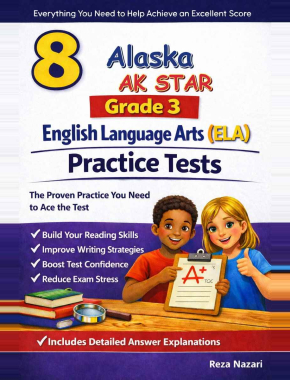
Second grade is the build-up year, and when your child is ready for what comes next, this bundle makes the jump to Grade 3 English feel easy. It includes four full practice-test books (5 + 6 + 7 + 8 tests) covering the Grade 3 reading, writing, and language skills just ahead, with explained answer keys and an instant PDF download.
Getting Ready for Grade 3 Math, Too? The Alaska AK STAR Grade 3 Math Bundle
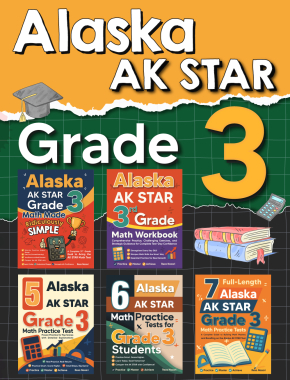
The same jump to Grade 3 happens in math. If your second grader could use a head start there as well, this Alaska AK STAR Grade 3 Math bundle is the shortest path, workbook, study guide, and full practice tests in one instant download, with answer keys throughout.

Related to This Article
More math articles
- How to Work with the Intermediate Value Theorem?
- Rounding Numbers Up to the Millions
- 8th Grade RICAS Math Worksheets: FREE & Printable
- The Best Grade 6 ELA Practice Tests for Kentucky Students
- Best Coronavirus Resources for Students
- The Best ASTB Math Worksheets: FREE & Printable
- The Best Grade 8 ELA Practice Tests for Ohio Students
- How to Solve and Graph One-Step Inequalities with Rational Numbers?
- The Fluid Mosaic Membrane
- The Best Grade 6 ELA Practice Tests for Alaska Students










What people say about "Alaska Grade 2 English Worksheets: Free PDFs"?
No one replied yet.