Ethnicity and Minority-Group Status
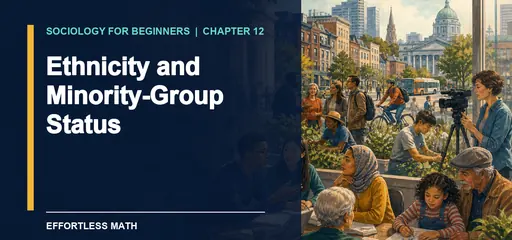
Chapter 12 of the Sociology for Beginners study guide on Effortless Math covers Ethnicity and Minority-Group Status: the key terms, the core ideas, and worked examples showing how this topic is tested on this course.
Sociology for Beginners · Chapter 12
Ethnicity and Minority-Group Status
Ethnicity refers to a shared cultural heritage, which may include ancestry, language, religion, regional origin, foodways, or historical memory. Ethnic identities can be multiple and can change in salience by situation. Race and ethnicity may overlap, but neither can be inferred reliably from appearance alone.
In sociology, a minority group is a category whose members experience systematic disadvantage and reduced power because of socially recognized traits. Population size does not determine the classification. A numerical majority can occupy a minority-group position, and a small group can be socially dominant.
Dominant group refers to a category with greater power and privilege. It may be numerically small. These definitions keep the analysis focused on social relations instead of head counts.
Ethnic identity can be maintained, revived, combined, or made less visible. A person may emphasize language and ancestry at a family celebration, nationality in an international setting, and occupation at work. Situational change does not make the identity false. It shows that people hold several memberships and that social settings make some of them more relevant.
Minority-group status can be measured through access and control. Researchers might compare voting rights, land ownership, school administration, occupational authority, exposure to sanctions, and the ability to define official language. Population share remains useful context, but power evidence determines the sociological classification.
Race, ethnicity, nationality, and religion can overlap without becoming synonyms. The question stem controls the classification. Shared cultural heritage points to ethnicity. Social meanings attached to perceived physical traits point to race. Unequal power identifies minority and dominant relations.
Ethnic boundaries can persist even when particular cultural practices change. Descendants of immigrants may no longer speak an ancestral language but may retain identity through family history, religion, celebrations, or symbolic foods. Others may revive practices that an earlier generation downplayed. Sociologists therefore treat ethnicity as a social identity connected to heritage, not a fixed package that every member displays in the same way.
Colonial and apartheid cases make the evidence plain because a smaller population may control land, law, and government while a larger population lacks political rights. Less explicit systems require the same relational test. Compare who sets institutional rules, who can challenge a decision, and whose practices are treated as the unmarked standard. Shared ancestry and cultural memory describe ethnicity. Unequal rule-making capacity describes dominance.
Dominance can be political, economic, or cultural, and the dimensions may reinforce each other. Control of schools and media can make one group’s practices appear neutral while others are marked as ethnic. Naming that asymmetry helps explain why the same custom is treated differently depending on who performs it.
Power can shift without erasing ethnicity. A group may gain voting rights or institutional representation while retaining language, religion, and historical memory. This is why ethnic assimilation and minority-group status require separate measures across time.
Numerical size, political power, and cultural visibility can point in different directions. In a province, Group A makes up 65 percent of residents and runs most neighborhood festivals, yet Group B controls the legislature, courts, major employers, and official school language. Group A is numerically larger and culturally visible but occupies the minority-group position in the sociological sense because it has less institutional power. Group B is numerically smaller but dominant. Counting residents or public celebrations alone would misclassify the relation.
The case can change across institutions. Group A may elect municipal councils while remaining excluded from national offices and senior corporate jobs. Researchers should therefore measure the level and arena of power: who writes rules, controls budgets, appoints officials, owns major assets, and can challenge sanctions. Cultural visibility may even coexist with political weakness when the dominant group celebrates food or music while denying the originating group decision authority. A comparison across local government, national law, schools, and employment prevents one visible custom or one election from standing in for the whole power relation.
Self-identification can also change by context without being false. A person may name a regional ethnicity at home and a broader national category on a census. Good research records the question wording and classification source because each measure can produce a different distribution.
Quick review: Build three columns for population share, rule-making control, and cultural visibility. They may point in different directions. Then record the institutional level and who supplied the identity label before judging the relationship.
Watch the lesson connection
Race and Ethnicity gives you a second explanation of the ideas surrounding this lesson. As you watch, pause when the lesson concept appears and explain how the example fits.
Try the idea yourself
Write one original example, one close nonexample, and one observation that would help you tell them apart. That small exercise turns a definition into a sociological tool you can use in daily life.

Related to This Article
More math articles
- The Best Algebra 1 Book for Ohio Students
- The Ultimate SAT Math Formula Cheat Sheet
- PSAT/NMSQT Math Flashcards (Free Online: Formulas, Terms & Concepts)
- Free Printable Grade 3 Math for Wisconsin FORWARD Students: 49 Single-Skill PDF Worksheets
- South Carolina SC READY Grade 6 Math Free Worksheets: 72 Free Printable Worksheets with Answer Keys
- Indiana Grade 2 English Worksheets — Free and Printable
- Scientific Reasoning in Chemistry: Observations, Models, and Fair Tests
- OAR Math Practice Test Questions
- How to Find the Domain and Range of Quadratic Functions
- 5th Grade ACT Aspire Math Worksheets: FREE & Printable



















What people say about "Ethnicity and Minority-Group Status"?
No one replied yet.