Cultural Lag, Modernization, and Globalization
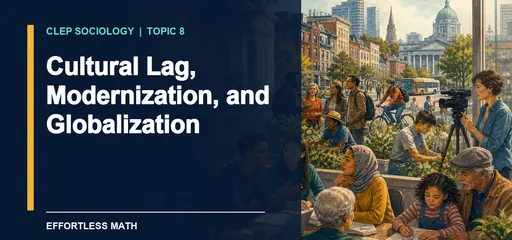
Chapter 8 of the CLEP Sociology study guide on Effortless Math covers Cultural Lag, Modernization, and Globalization: the key terms, the core ideas, and worked examples showing how this topic is tested on the exam.

CLEP Sociology – Chapter 8
Cultural Lag, Modernization, and Globalization
CLEP Introductory Sociology · Chapter 8
William F. Ogburn used cultural lag for the delay that occurs when one part of culture changes faster than another. Material culture and technology may change quickly, while laws, norms, ethics, and organizations adjust more slowly. The concept describes a timing mismatch, not a judgment that one culture is backward.
Detailed personal-data systems can spread before privacy law, workplace rules, and shared expectations catch up. That sequence shows cultural lag. A new device by itself shows technological change, and a disagreement by itself shows cultural conflict. Lag requires connected elements moving at different speeds.
The faster element is not always material. Public values about disability access can change before buildings, transit systems, and organizational procedures respond. Researchers test lag by dating each change and tracing the connection between them. Adoption records, court cases, complaints, budgets, and professional rules can reveal the delay.
Adjustment is social and unequal. A school can buy an automated platform in one budget cycle, while teacher training, family internet access, appeal procedures, and disability accommodation take years. Companies, courts, unions, families, and regulators can accelerate or resist different responses. Cultural lag names the timing problem. Conflict analysis asks whose preferred timetable wins.
Modernization refers to linked transformations associated with industrialization, urbanization, formal education, bureaucracy, and technological development. A factory economy may draw people toward cities, increase demand for specialized schooling, and expand agencies that coordinate dense populations. The concept identifies an institutional cluster rather than one new machine.
Classic modernization theory sometimes treated Western industrial history as a universal route from tradition to modernity. That claim is too narrow. Societies enter change with different histories, colonial relationships, policies, and cultural arrangements. Industrial growth can improve health or mobility for some groups while displacing communities or deepening inequality for others.
Globalization is the growing intensity of cross-border economic, political, cultural, technological, and social connections. A phone can be designed in one country, assembled from parts made in several others, financed through global markets, and promoted through worldwide media. The mechanism is a transnational flow rather than domestic institutional change alone.
Global connection does not erase local culture. People adapt imported products, music, food, or political ideas to local meanings, then may send the altered form elsewhere. States, corporations, workers, and communities also enter these networks with unequal bargaining power.
Modernization and globalization can occur together without becoming synonyms. Modernization asks how institutions such as work, cities, schools, and bureaucracies change in linked ways. Globalization asks how goods, people, money, information, and culture move across borders with greater speed or reach.
Dependency perspectives press the distribution question. They ask whether global relationships channel labor, profit, and resources from less powerful regions toward more powerful ones. The point is to test who controls exchange and who receives gains or risks, not to deny that connection can bring new knowledge, markets, or alliances.
Quick review: Cultural lag is uneven timing between connected parts of culture. Modernization describes linked changes such as industrialization, urbanization, education, and bureaucracy. Globalization describes intensifying cross-border flows. Neither modernization nor globalization guarantees equal gains, one path, or automatic progress.
| Question | First distinction | Evidence that decides |
|---|---|---|
| How did temporary action form? | Routine, prior tendency, spread, or emergent norm | Existing procedure, prior views, transmission sequence, or a new rule formed in interaction |
| What kind of collective form is present? | Crowd, public, mass, or movement | Proximity, discussion, common exposure, or sustained organization for change |
| Why did a movement mobilize? | Grievance, resources, opportunity, or frame | Unjust comparison, organizational capacity, external opening, or problem-solution-call meaning |
| What happened to the movement? | Stage, decline path, or outcome | Leadership, staff, procedures, repression, co-optation, implementation, and cultural effects |
| What kind of social change occurred? | Source, cultural lag, modernization, or globalization | Creation, recognition, spread, timing mismatch, linked institutions, or cross-border flow |
The train blackout began with strangers making a rule in the dark. That small scene contains the chapter’s larger lesson. Shared conduct grows through communication, networks, resources, institutions, and unequal power. Some temporary rules vanish when the doors open. Others become organizations, policies, technologies, and cultural expectations whose benefits and costs are distributed unevenly. Chapter the related chapter follows that distribution by asking how class, status, power, and mobility shape people’s positions and life chances.
Watch the chapter connection
How Societies Change gives you a second explanation of the chapter ideas surrounding this lesson. As you watch, pause when the lesson concept appears and explain how the example fits.
Use this lesson for CLEP practice
Write one original example, one close nonexample, and one observation that would help you choose between them. This turns vocabulary recognition into the kind of applied reasoning the exam expects.

Related to This Article
More math articles
- The Ultimate ATI TEAS 7 Math Course (FREE Worksheets)
- How to Divide Fractions: The Keep-Change-Flip Method Explained
- Oklahoma OSTP Grade 7 Math Worksheets: 95 Free Printable PDFs Aligned to Every Skill
- 5th Grade KAP Math Worksheets: FREE & Printable
- CBEST Math FREE Sample Practice Questions
- FTCE Test Facts and FAQs
- Adding Money Amounts for 4th Grade
- Estimate Differences for 4th Grade
- Word Problems That Use Algebra: 15 Examples Solved Step by Step
- Top 10 Tips You MUST Know to Retake the ATI TEAS Math



















What people say about "Cultural Lag, Modernization | CLEP Sociology"?
No one replied yet.