Invention, Discovery, Diffusion, and Cultural Change
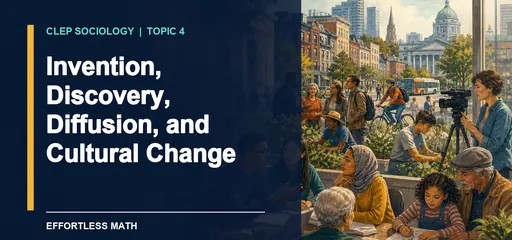
Chapter 4 of the CLEP Sociology study guide on Effortless Math covers Invention, Discovery, Diffusion, and Cultural Change: the key terms, the core ideas, and worked examples showing how this topic is tested on the exam.

CLEP Sociology – Chapter 4
Invention, Discovery, Diffusion, and Cultural Change
CLEP Introductory Sociology · Chapter 4
Culture changes when people create new combinations, recognize previously unknown features, borrow across groups, and adjust rules to new conditions. Several processes may appear in one sequence, so the central question is what happens at each step.
Invention combines existing cultural elements into a new object or practice. An engineer who builds a low-cost water sensor from known electronic components has invented a device. The parts existed, but their arrangement and use are new. Social arrangements can also be invented, such as a new voting procedure or form of cooperative ownership.
Discovery is the recognition of something that already exists. If the new sensor reveals contamination in an underground water source, the contamination is discovered rather than invented. The distinction depends on whether people created the thing or newly recognized it.
Diffusion is the spread of a cultural trait from one group or setting to another. When other towns adopt the sensor, its use diffuses. Trade, migration, conquest, tourism, education, media, and digital communication can carry food, music, words, technologies, and institutional practices.
Diffusion rarely produces an exact copy. Recipients select, translate, combine, or resist what arrives. A musical style may travel through migration, be played on local instruments, and gain a political meaning absent from its earlier setting. This adaptation is evidence that people actively interpret borrowed culture.
Cultural lag, associated with William Ogburn, occurs when connected parts of culture change at different speeds, often when material technology changes before laws, norms, or organizations adjust. Facial recognition can spread before rules settle consent, bias, data ownership, and appeals. The delay between linked parts is the evidence for lag. A new tool by itself is only an invention.
Material culture does not always move first. A new value or legal rule can encourage engineers to create safer tools, and communities may reject an available technology. Cultural lag is a possible mismatch, not a law that technology inevitably leads and society follows.
Globalization increases social, economic, political, and cultural connections across long distances. It can speed diffusion, expand shared references, and concentrate the influence of organizations with global reach. It does not make all cultures identical. People localize imported forms, defend boundaries, create hybrids, and use global media to strengthen local identities.
Change also involves power. A platform can spread a format because it controls distribution, while smaller groups may struggle to circulate alternatives. An employer may adopt tracking software faster than workers can negotiate privacy rules. Asking who controls the technology, channel, or law explains why some innovations travel and whose concerns wait.
Diffusion is selective. A community may adopt a tool while changing its design, meaning, or acceptable use. Pizza spread widely, but ingredients and meal customs changed across places. The borrowed trait is therefore neither an untouched copy nor proof that cultures are becoming identical. On an exam, look for movement between groups. Creation within a group is invention, and recognition of something that already existed is discovery.
Quick review: Invention creates a new combination. Discovery recognizes what already existed. Diffusion carries a trait between groups. Cultural lag is delayed adjustment between connected parts of culture. Globalization can speed contact without producing simple sameness.
| Process | First question | Deciding evidence |
|---|---|---|
| Invention | What did people newly create? | A new object, practice, or combination |
| Discovery | What existing feature became known? | Recognition rather than creation |
| Diffusion | What moved between groups? | Adoption, borrowing, or adaptation |
| Cultural lag | Which connected parts changed at different speeds? | A delay between material and nonmaterial adjustment |
| Globalization | How did distant connections intensify? | Cross-border flows shaped by organizations and local response |
Culture is not a list of colorful customs. It is the learned system through which objects become meaningful, language directs attention, ideals become rules, institutions privilege some standards, and groups interpret change. The bakery line from the opening works because people have learned a symbol, a norm, and a sanctioning response. Chapter the related chapter now asks how people learn such expectations, take the roles of others, and build a social self able to participate in them.
Watch the chapter connection
Symbols, Values, and Norms gives you a second explanation of the chapter ideas surrounding this lesson. As you watch, pause when the lesson concept appears and explain how the example fits.
Use this lesson for CLEP practice
Write one original example, one close nonexample, and one observation that would help you choose between them. This turns vocabulary recognition into the kind of applied reasoning the exam expects.

Related to This Article
More math articles
- Grade 3 Math: Adding 3-Digit Numbers
- Free Printable Grade 5 Math for Vermont SBAC Students: 49 Single-Skill PDF Worksheets
- How to Master the Pythagorean Theorem and Right Triangles
- How to Read Scientific Diagrams, Tables, and Graphs
- FREE 8th Grade FSA Math Practice Test
- A Deep Dive into the nth Term Test for Divergence
- The Best Grade 4 ELA Practice Tests for Louisiana Students
- Basic Blackjack Strategy: How Decisions Move the House Edge
- Top 10 TSI Math Test-taking Tips
- The Ultimate 6th Grade MCAP Math Course (+FREE Worksheets)












What people say about "Invention, Discovery, Diffusion | CLEP Sociology"?
No one replied yet.