Why do AAA or SSA Not Prove Congruence?
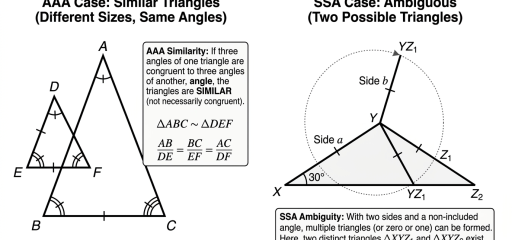
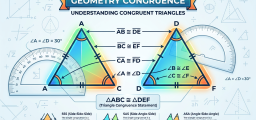
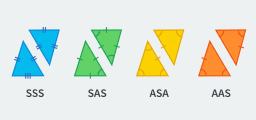
In geometry, proving that two triangles are congruent means showing they have exactly the same size and shape. While SSS, SAS, ASA, AAS, and HL all work as valid congruence criteria, two combinations—AAA and SSA—do not prove congruence. Understanding why helps you avoid common proof errors, strengthens your geometric reasoning, and prepares you for more advanced math.
The Absolute Best Book to Ace Your Math Test
Our Top Picks for This Month
Why AAA (Angle-Angle-Angle) Does Not Prove Congruence
The Key Idea: Same Shape, Different Size
If two triangles have three pairs of equal angles, they are similar—same shape—but not necessarily congruent. Similar triangles can have different sizes. For example, a small equilateral triangle with side length 2 and a large equilateral triangle with side length 10 both have 60°-60°-60° angles, but their side lengths differ. AAA proves similarity, not congruence. For more practice with triangle proofs, explore our geometry worksheets.
Why We Need at Least One Side
Congruence requires matching both angles and sides. With only angles, we know the shape but not the scale. Think of it like two photographs of the same object—one might be a thumbnail, the other a poster. They look the same (similar) but aren’t identical (congruent). Adding one pair of equal sides (as in ASA, AAS, or SAS) “locks in” the size, making the triangles congruent.
Real-World Analogy
Imagine two triangles drawn on different scales. If they have the same angles, they’re like a map and the actual terrain—proportional but not the same size. Congruence means the triangles could be placed on top of each other and match perfectly.
Why SSA (Side-Side-Angle) Does Not Prove Congruence
The Ambiguous Case
SSA is often called the “ambiguous case” because given two sides and a non-included angle, you can sometimes construct two different triangles that both satisfy the conditions. Imagine drawing a side of fixed length, then an angle at one endpoint, then swinging the second side like a hinge. In some cases, that second side can intersect the base in two places, creating two distinct triangles—one acute and one obtuse. For more geometry resources, visit Effortless Math.
When SSA Works: The Special HL Case
The only exception is when the angle is the right angle. Hypotenuse-Leg (HL) is a valid congruence theorem for right triangles. Here, the right angle is “between” the hypotenuse and leg in a sense that removes the ambiguity. The right angle constrains the triangle uniquely, so knowing the hypotenuse and one leg is enough.
Visualizing the Ambiguity
Suppose you’re given side a = 5, side b = 7, and angle A = 30° (opposite side a). Depending on the exact values, you might get zero, one, or two possible triangles. This unpredictability is why SSA cannot be a general congruence criterion.
Summary: Valid vs. Invalid Criteria
- Valid: SSS, SAS, ASA, AAS, HL
- Invalid: AAA (proves similarity only), SSA (ambiguous)
Common Mistakes to Avoid
Don’t assume that “three pieces of information” always determine a triangle uniquely. The type of information matters. Also, avoid confusing AAS with SSA—the order of the letters is critical. In AAS, the side is not between the two angles, which makes it work. In SSA, the angle is not between the two sides, which causes the ambiguity.
Frequently Asked Questions
Recommended Resources
Can AAA ever prove congruence?
No. AAA only proves similarity. You need at least one pair of equal sides for congruence.
Why is SSA called the ambiguous case?
Because with two sides and a non-included angle, you can sometimes draw two different triangles that fit the given information.
What about SAA? Is that valid?
SAA is the same as AAS (just different order of letters). Both are valid because knowing two angles determines the third, so you effectively have ASA.
How do I remember which criteria work?
Think: you need enough information to uniquely determine the triangle. Three sides (SSS) or two sides with the angle between them (SAS) work. Two angles with a side work (ASA, AAS). Two sides with a non-included angle (SSA) can be ambiguous.

Related to This Article
More math articles
- Geometry Puzzle – Critical Thinking 18
- 10 Most Common CHSPE Math Questions
- How to Be A Great SAT/ACT Math Tutor?
- FREE TASC Math Practice Test
- How to Pay for College: Understanding College Payments
- How to Teach Math in Elementary Grades
- Word Problems Involving Area of Quadrilaterals and Triangles
- Top 10 Tips to Overcome PSAT Math Anxiety
- Limits: What is the Neighborhood of a Point
- Top 10 4th Grade OST Math Practice Questions

What people say about "Why do AAA or SSA Not Prove Congruence? - Effortless Math: We Help Students Learn to LOVE Mathematics"?
No one replied yet.