What are the 5 Ways to Prove Congruence?
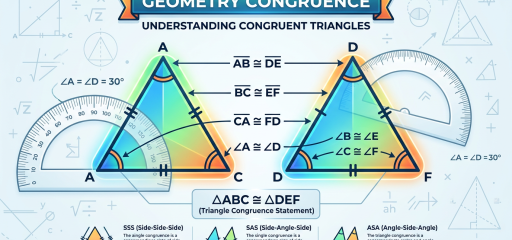
Understanding how to prove congruence is a fundamental skill in geometry. When two geometric figures are congruent, they have exactly the same size and shape—every side and angle matches. For triangles specifically, there are five standard methods (often taught as four, with the fifth as a special case) that mathematicians use to prove that two triangles are congruent. Mastering these opens the door to more advanced proofs and geometric reasoning.
The Absolute Best Book to Ace Your Math Test
Our Best Seller Books
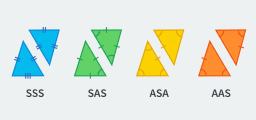
The Five Ways to Prove Triangle Congruence
1. SSS (Side-Side-Side)
If all three sides of one triangle are equal to the corresponding three sides of another triangle, the triangles are congruent. No need to measure angles—when the sides match, the angles automatically match too. This follows from the fact that three side lengths uniquely determine a triangle (up to reflection). SSS is one of the most straightforward methods and is often used when you’re given or can show that all three pairs of sides are equal. For more practice with geometric proofs, explore our free math worksheets.
2. SAS (Side-Angle-Side)
If two sides and the included angle (the angle between those two sides) of one triangle are equal to two sides and the included angle of another triangle, the triangles are congruent. The key is that the angle must be between the two sides—not an angle at the end. For example, if sides AB and AC and angle A are given, that’s SAS. If you had sides AB and BC and angle A (not between AB and BC), that would be SSA, which does not work.
3. ASA (Angle-Side-Angle)
If two angles and the included side (the side between those two angles) of one triangle are equal to two angles and the included side of another triangle, the triangles are congruent. This method is especially useful when you have parallel lines or transversals creating angle relationships—vertical angles, corresponding angles, and alternate interior angles often give you the angle pairs you need.
4. AAS (Angle-Angle-Side)
If two angles and a non-included side of one triangle are equal to two angles and the corresponding non-included side of another triangle, the triangles are congruent. Note: AAS works because if you know two angles, you automatically know the third (angles in a triangle sum to 180°), so it effectively becomes ASA. The side can be opposite either of the two given angles, as long as it corresponds correctly between the two triangles.
5. HL (Hypotenuse-Leg) – Right Triangles Only
For right triangles specifically: if the hypotenuse and one leg of one right triangle are equal to the hypotenuse and one leg of another right triangle, the triangles are congruent. This is a special case that only applies when you have a 90° angle. HL is sometimes considered the fifth method or a special case of SSS. It’s particularly useful in coordinate geometry when you’re working with the Pythagorean theorem.
How to Choose the Right Method
Start by listing what you know: which sides and angles are marked as equal? If you have three sides, use SSS. If you have two sides with the angle between them, use SAS. If you have two angles with the side between them, use ASA. If you have two angles and a side not between them, use AAS. For right triangles with hypotenuse and leg, use HL. Check out our math resources for more geometry practice.
Step-by-Step Proof Strategy
- Mark the given information on your diagram using tick marks for equal sides and arc marks for equal angles.
- Identify which congruence criterion applies based on what’s given.
- Write a two-column or paragraph proof, stating the given, the congruence criterion, and the conclusion.
- Be careful with correspondence—vertex A in one triangle must match vertex A in the other when you write ΔABC ≅ ΔDEF.
Common Mistakes to Avoid
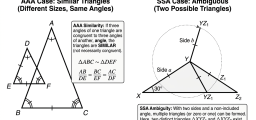
Don’t use SSA or AAA—these do not prove congruence. SSA (Side-Side-Angle) can produce two different triangles. AAA (Angle-Angle-Angle) only proves similarity, not congruence. Also, ensure the angle in SAS is the included angle, and the side in ASA is the included side. Always verify you’re using one of the five valid methods above.
Frequently Asked Questions
Recommended Resources
What is the difference between congruence and similarity?
Congruent figures are identical in size and shape. Similar figures have the same shape but may differ in size. Congruence implies similarity, but not vice versa.
Can you use more than one method to prove the same triangles congruent?
Yes! Often multiple methods apply. Choose the one that uses the information given most directly. For example, if you’re given three sides, SSS is the obvious choice.
Do I need to prove all three sides and all three angles?
No. That’s the power of these criteria—you only need three specific pieces of information (in the right combination) to conclude that all six parts (three sides, three angles) are equal.
When would I use HL instead of SSS?
Use HL when you have a right triangle and know the hypotenuse and one leg. It’s often easier than showing all three sides, especially when the Pythagorean theorem is involved.

Related to This Article
More math articles
- The Ultimate 7th Grade PEAKS Math Course (+FREE Worksheets)
- HSPT Math Practice Test Questions
- Mastering the Art of Teaching Pre-Algebra with “Pre-Algebra for Beginners”
- Top 10 CHSPE Math Practice Questions
- PSAT Math Formulas
- The Binomial Theorem
- 10 Most Common 6th Grade FSA Math Questions
- How to Find the Area of Composite Shapes?
- ISEE Middle-Level Math Worksheets: FREE & Printable
- Stand-Up Desks for Teachers and Students

What people say about "What are the 5 Ways to Prove Congruence? - Effortless Math: We Help Students Learn to LOVE Mathematics"?
No one replied yet.