The Ultimate PSAT Math Formula Cheat Sheet
TL;DR: The digital PSAT gives you the same 12-formula reference sheet as the SAT. This cheat sheet covers those plus everything else you need for the test.
Key takeaways:
- The PSAT Math section is 70 minutes total in two adaptive modules of 22 questions each.
- Desmos is the on-screen calculator, available throughout the math section.
- The built-in reference sheet covers 12 geometry formulas.
- Memorize quadratic, slope, midpoint, and exponent rules — they are NOT on the sheet.
- PSAT Math scores 160 to 760 and feeds into National Merit qualifying.
The PSAT is a test most students take in sophomore or junior year, and it sits in a useful spot — it previews the SAT, qualifies juniors for the National Merit Scholarship, and gives you a real, official-feeling result without the pressure of college admissions on the line. The Math section is the part students worry about most, and most of that worry comes from one source: not knowing the formulas well enough.
This page is the formula sheet I give my PSAT students at the start of prep. Every formula below is one you’ll genuinely use, written in the same notation the College Board uses on the real test.
How to work through it: read through the whole sheet first. Anywhere your eyes slow down, that’s a formula you don’t truly know yet. Pull those into a notebook and practice them daily for a week. Within two weeks, almost everyone has the full list locked in.
The PSAT Math Formula Cheat Sheet
Decimals
Is a fraction written in a special form? For example, instead of writing \(\frac{1}{2}\) you can write \(0.5\).
Mixed Numbers
A number is composed of a whole number and a fraction. Example: \(2 \frac{2}{ 3}\) Converting between improper fractions and mixed numbers: \(a \frac{c}{b}=a+\frac{c}{b}= \frac{ab+ c}{b}\)
Factoring Numbers
Factor a number means breaking it up into numbers that can be multiplied together to get the original number. Example:\(12=2×2×3\)
Integers
\( \{…,-3,-2,-1,0,1,2,3,…\} \)
Includes: zero, counting numbers, and the negative of the counting numbers
Real Numbers
All numbers that are on a number line. Integers plus fractions, decimals, and irrationals, etc.) (\(\sqrt{2},\sqrt{3},π\), etc.)
Order of Operations
PEMDAS
(parentheses/ exponents/ multiply/ divide/ add/ subtract)
Absolute Value
Refers to the distance of a number from \(0\) on the number line. the distances are positive as the absolute value of a number cannot be negative. \(|-22|=22\)
or \(|x| =\begin{cases}x \ for \ x≥0 \\x \ for \ x < 0\end{cases} \)
\(|x|<n⇒-n<x<n\)
\(|x|>n⇒x<-n or x>n\)
Ratios
A ratio is a comparison of two numbers by division.
Example: \(3: 5\), or \(\frac{3}{5}\)
Percentages
Use the following formula to find part, whole, or percent
part \(=\frac{percent}{100}×whole\)
Proportional Ratios
A proportion means that two ratios are equal. It can be written in two ways:
\(\frac{a}{b}=\frac{c}{d}\), \(a: b = c: d \)
Percent of Change
\(\frac{New \ Value \ – \ Old \ Value}{Old Value}×100\%\)
Expressions and Variables
A variable is a letter that represents unspecified numbers. One may use a variable in the same manner as all other numbers: Addition: \(2+a\): \(2\) plus a
Subtraction: \(y-3\) : \(y\) minus \(3\)
Division: \(\frac{4}{x}\) : 4 divided by x
Multiplication: \(5a\) : \(5\) times a
Distributive Property
\(a(b+c)=ab+ac\)
Equations
The values of the two mathematical expressions are equal.
\(ax+b=c\)
Distance from A to B:
\(\sqrt{(x_{1}-x_{2})^2+(y_{1}-y_{2})^2 }\)
Parallel and Perpendicular lines:
Have equal slopes. Perpendicular lines (i.e., those that make a \(90^° \) angle where they intersect) have negative reciprocal slopes: \(m_{1}\).\(m_{2}=-1\).
Parallel Lines (l \(\parallel\) m)
Mid-point of the segment AB:
M (\(\frac{x_{1}+x_{2}}{2}, \frac{y_{1}+y_{2}}{2}\))
Slope of the line:
\(\frac{y_{2}- y_{1}}{x_{2} – x_{1} }=\frac{rise}{run}\)
Point-slope form:
Given the slope m and a point \((x_{1},y_{1})\) on the line, the equation of the line is
\((y-y_{1})=m \ (x-x_{1})\).
Slope-intercept form:
given the slope m and the y-intercept b, then the equation of the line is:
\(y=mx+b\).
Factoring:
“FOIL”
\((x+a)(x+b)\)
\(=x^2+(b+a)x +ab\) “Difference of Squares”
\(a^2-b^2= (a+b)(a-b)\)
\(a^2+2ab+b^2=(a+b)(a+b) \)
\(a^2-2ab+b^2=(a-b)(a-b)\) “Reverse FOIL”
\(x^2+(b+a)x+ab=\) \((x+a)(x+b)\)
You can use Reverse FOIL to factor a polynomial by thinking about two numbers a and b which add to the number in front of the x, and which multiply to give the constant. For example, to factor \(x^2+5x+6\), the numbers add to 5 and multiply to 6, i.e.: \(a=2\) and \(b=3\), so that \(x^2+5x+6=(x+2)(x+3)\). To solve a quadratic such as \(x^2+bx+c=0\), first factor the left side to get \((x+a)(x+b)=0\), then set each part in parentheses equal to zero. For example, \(x^2+4x+3= (x+3)(x+1)=0\) so that \(x=-3\) or \(x=-1\).
To solve two linear equations in x and y: use the first equation to substitute for a variable in the second. E.g., suppose \(x+y=3\) and \(4x-y=2\). The first equation gives y=3-x, so the second equation becomes \(4x-(3-x)=2 ⇒ 5x-3=2\) \(⇒ x=1,y=2\).
Exponents:
Refers to the number of times a number is multiplied by itself.
\(8 = 2 × 2 × 2 = 2^3\)
Scientific Notation:
It is a way of expressing numbers that are too big or too small to be conveniently written in decimal form.
In scientific notation all numbers are written in this form: \(m \times 10^n\)
Decimal notation:
5
\(-25,000\)
0.5
2,122.456
Scientific notation:
\(5×10^0\)
\(-2.5×10^4\)
\(5×10^{-1}\)
\(2,122456×10^3\)
Square:
The number we get after multiplying an integer (not a fraction) by itself. Example: \(2×2=4,2^2=4\)
Square Roots:
A square root of \(x\) is a number r whose square is \(x: r^2=x\)
\(r\) is a square root of \(x\)
Pythagorean Theorem:
For any right triangle with legs \(a\) and \(b\) and hypotenuse \(c\): \(a^2+b^2=c^2\)
Solving for the hypotenuse: \(c=\sqrt{a^2+b^2}\)
Solving for a leg: \(a=\sqrt{c^2-b^2}\)
Common Pythagorean triples: \(3,4,5\); \(5,12,13\); \(8,15,17\); \(7,24,25\)
Triangles
Area: \(A=\frac{1}{2}bh\) where \(b\) is the base and \(h\) is the height.
Perimeter: \(P=a+b+c\) (sum of all three sides).
Pythagorean Theorem (right triangles): \(a^2+b^2=c^2\) where \(c\) is the hypotenuse.
Sum of interior angles: \(180°\)
All triangles:
Area \(=\frac{1}{2}\) b. h
Angles on the inside of any triangle add up to \(180^\circ\).
The length of one side of any triangle is always less than the sum and more than the difference between the lengths of the other two sides.
An exterior angle of any triangle is equal to the sum of the two remote interior angles. Other important triangles:
Equilateral:
These triangles have three equal sides, and all three angles are \(60^\circ\).
Isosceles:
An isosceles triangle has two equal sides. The “base” angles (the ones opposite the two sides) are equal (see the \(45^\circ\) triangle above).
Circles

Area \(=πr^2\)
Circumference \(=2πr\)
Full circle \(=360^\circ\)
Rectangles
(Square if l=w)
Area=lw
Parallelogram
(Rhombus if l=w)
Area=lh
Regular polygons are n-sided figures with all sides equal and all angles equal.
The sum of the inside angles of an n-sided regular polygon is
\((n-2).180^\circ\).
Area of a trapezoid:
\(A =\frac{1}{2} h (b_{1}+b_{2})\)
Surface Area and Volume of a Rectangular/right prism:
\(SA=ph+2B\)
\(V=Bh\)
Surface Area and Volume of a Cylinder:
\(SA =2πrh+2πr^2\)
\(V =πr^2 h \)
Surface Area and Volume of a Cone
\(SA =πrs+πr^2\)
\(V=\frac{1}{3} \ πr^2 \ h\)
Surface Area and Volume of a Sphere
\(SA =4πr^2\)
\(V =\frac{4}{3} \ πr^3\)
(p \(=\) perimeter of base B; \(π ~ 3.14 \))

Simple interest:
\(I=prt\)
(I = interest, p = principal, r = rate, t = time)
mean:
mean: \(\frac{sum \ of \ the \ data}{of \ data \ entires}\)
mode:
value in the list that appears most often
range:
largest value \(-\) smallest value
Median
The middle value in the list (which must be sorted)
Example: median of
\( \{3,10,9,27,50\} = 10\)
Example: median of
\( \{3,9,10,27\}=\frac{(9+10)}{2}=9.5 \)
Average
\( \frac{sum \ of \ terms}{number \ of \ terms}\)
Average speed
\(\frac{total \ distance}{total \ time}\)
Probability
\(\frac{number \ of \ desired \ outcomes}{number \ of \ total \ outcomes}\)
The probability of two different events A and B both happening is:
P(A and B)=p(A).p(B)
as long as the events are independent (not mutually exclusive).
Powers, Exponents, Roots
\(x^a.x^b=x^{a+b}\)
\(\frac{x^a}{x^b} = x^{a-b}\)
\(\frac{1}{x^b }= x^{-b}\)
\((x^a)^b=x^{a.b}\)
\((xy)^a= x^a.y^a\)
\(x^0=1\)
\(\sqrt{xy}=\sqrt{x}.\sqrt{y}\)
\((-1)^n=-1\), if n is odd.
\((-1)^n=+1\), if n is even.
If \(0<x<1\), then
\(0<x^3<x^2<x<\sqrt{x}<\sqrt{3x}<1\).
Simple Interest
The charge for borrowing money or the return for lending it.
Interest = principal \(×\) rate \(×\) time
OR
\(I=prt\)
Powers/ Exponents
\(x^a×x^b=x^{a+b}\)
\(\frac{x^a}{x^b}=x^{a-b}\)
\((x^a)^b=x^{ab}\)
\(x^0=1\)
\(x^{-a}=\frac{1}{x^a}\)
\(x^{\frac{1}{n}}=\sqrt[n]{x}\)
Positive Exponents
An exponent is simply shorthand for multiplying that number of identical factors. So \(4^3\) is the same as (4)(4)(4), three identical factors of 4. And \(x^3\) is just three factors of x, \((x)(x)(x)\).
Negative Exponents
A negative exponent means to divide by that number of factors instead of multiplying.
So \(4^{-3}\) is the same as \( \frac{1}{4^3}\) and
\(x^{-3}=\frac{1}{x^3}\)
Factorials
Factorial- the product of a number and all counting numbers below it.
8 factorial \(=8!=\)
\(8×7×6×5×4×3×2×1=40,320\)
5 factorial \(=5!=\)
\(5×4×3×2×1=120\)
2 factorial \(=2!=2× 1=2\)
Multiplying Two Powers of the SAME Base
When the bases are the same, you find the new power by just adding the exponents
\(x^a.x^b=x^{a+b }\)
Powers of Powers
For the power of power: you multiply the exponents.
\((x^a)^b=x^{(ab)}\)
Dividing Powers
\(\frac{x^a}{x^b} =x^a x^{-b}= x^{a-b}\)
The Zero Exponent
Anything to the 0 power is 1.
\(x^0= 1\)
College Entrance Tests
The Best Books to Ace the PSAT Math Test
How the PSAT Math Compares to the SAT
Here’s the useful overlap: the PSAT and SAT share almost the entire Math content domain. If you prep well for the PSAT, you’ve already done about 80% of the SAT Math prep work. The only real difference is depth — the SAT pushes a little further into harder algebra and a few more challenging functions questions.
That overlap is why I tell juniors: take the PSAT seriously even if the National Merit cutoff feels out of reach. The score report tells you exactly which topics you missed, which is the most useful diagnostic any test gives you for SAT prep. Walk out of the PSAT, look at the report, and that becomes your SAT study plan.
Books That Pair With This Cheat Sheet
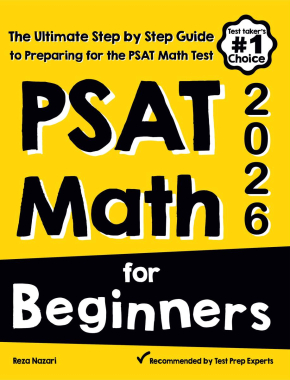
If you want every formula on this sheet explained step by step with worked examples, PSAT Math for Beginners is what I’d hand you. It’s written for the student who wants the “why” behind each formula, not just the “what.”
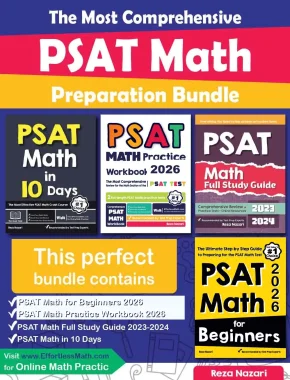
For a complete prep package — book, workbook, and full-length practice tests — the Comprehensive PSAT Math Preparation Bundle has everything in one set, organized into a structured study plan.
Frequently Asked Questions About PSAT Math Formulas
Does the PSAT give you a formula sheet?
Yes — same as the SAT. At the start of the Math section, you’ll see a reference page with about 12 formulas (area, circumference, the Pythagorean theorem, special right triangles, common volumes). Everything else — slope, the quadratic formula, exponent rules, all of trig and statistics — you have to know.
What’s the difference between the PSAT and PSAT/NMSQT?
The PSAT/NMSQT is the version taken by juniors in October — and it’s the one that qualifies students for the National Merit Scholarship competition. The PSAT 10 is given to sophomores in the spring; it’s the same test in content but doesn’t count for National Merit. The Math formulas you need are identical for both.
Can I use a calculator on the PSAT?
Yes — and since the PSAT is now digital, every student gets the built-in Desmos graphing calculator on every Math question. That’s worth knowing. Knowing your formulas still matters, but Desmos can speed up graphing problems, systems of equations, and anything quadratic.
How much algebra is on the PSAT?
About 35 to 40% of the Math section. Linear equations, inequalities, and systems are the biggest single category. Another 30% covers what the College Board calls “Advanced Math” — quadratics, exponents, and functions. The rest is data analysis and a small slice of geometry and trig.
Do I need to know trig for the PSAT?
You need to know the basics — SOH-CAH-TOA, the relationship between sine and cosine of complementary angles, and the standard unit circle values for the common angles. Trig only makes up a handful of questions, but they’re easy points if you’ve memorized the basics ahead of time.
How long does PSAT Math prep take?
For most students, four to six weeks of focused prep is enough — about 30 minutes a day on content review plus one full-length practice test per week. Start with the formula list above; once those feel automatic, shift to timed practice on real PSAT problems.
What’s the quadratic formula?
For \(ax^2 + bx + c = 0\), the quadratic formula gives \(x = \frac{-b \pm \sqrt{b^2 – 4ac}}{2a}\). On the digital PSAT, you can also solve quadratics by graphing them with Desmos — but knowing the formula by heart keeps you fast on word problems.
What are the special right triangles on the PSAT?
The 45-45-90 triangle has side ratios \(1 : 1 : \sqrt{2}\), and the 30-60-90 triangle has side ratios \(1 : \sqrt{3} : 2\). Both appear on the PSAT’s reference sheet — but you’ll save time if you don’t have to look them up.
What trig identities do I need for the PSAT?
Three: \(\sin^2\theta + \cos^2\theta = 1\), \(\sin(\theta) = \cos(90° – \theta)\), and \(\tan(\theta) = \sin(\theta)/\cos(\theta)\). Trig appears on just a few PSAT questions, but those are easy points if you’ve memorized the basics.
What’s the equation of a circle on the PSAT?
A circle centered at \((h, k)\) with radius \(r\) has the equation \((x – h)^2 + (y – k)^2 = r^2\). The PSAT sometimes gives you the expanded form and asks you to convert to standard form by completing the square.
Related EffortlessMath Lessons
- How to use the quadratic formula
- How to find the slope of a line
- How to use the Pythagorean theorem
- Rules of exponents
- Equations of circles
For the Student Reading This With a Test Date on the Calendar
If you’re sitting with a calendar reminder pinging at you and a knot in your stomach, breathe. The PSAT is the practice round — every formula above is a tool you can practice with, and every practice question you answer (right or wrong) makes test day quieter. Print the cheat sheet, tape it where you’ll see it, and walk past it five times a day. Repetition is what builds confidence — not cramming.

Related to This Article
More math articles
- Cooley’s Looking-Glass Self
- Exponential and logarithmic integrals Simplified
- 5th Grade NDSA Math Worksheets: FREE & Printable
- 4th Grade PSSA Math Worksheets: FREE & Printable
- Reliability, Validity, and Bias
- Absolute Value Definition
- 10 Most Common 6th Grade Georgia Milestones Assessment System Math Questions
- Culture, Material Life, and Learned Meaning
- Utah RISE Grade 8 Math Free Worksheets: Printable Grade 8 Math Practice, Answers Included
- How to Evaluate Polls, Charts, and Political Data





What people say about "The Ultimate PSAT Math Formula Cheat Sheet - Effortless Math"?
No one replied yet.