Subtracting Money Amounts for 4th Grade
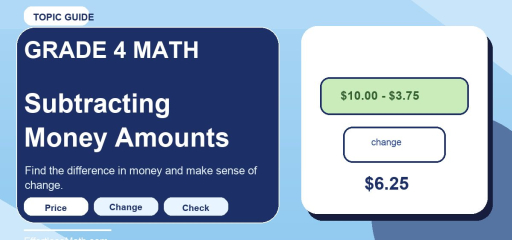
Subtracting Money Amounts for 4th Grade: this Effortless Math guide explains the topic in plain language, shows how it works through solved examples, and gives you free practice to try immediately, so the idea sticks instead of staying abstract.
Subtracting money amounts helps students solve everyday problems such as making change, comparing prices, and tracking spending.
Just like with decimal addition, students line up decimal points so dollars and cents stay in the correct places.
Key Ideas to Remember
- Keep place value lined up so dollars stay with dollars and tenths stay with tenths.
- Regroup carefully whenever a column totals more than ten or needs borrowing.
- Estimate first so you can tell whether the final decimal answer makes sense.
Detailed Explanation
Subtract cents from cents and dollars from dollars. If there are not enough cents in the top number, regroup 1 dollar as 100 cents.
This regrouping step is the same idea students use when subtracting whole numbers with borrowing.
Worked Example
Problem: Subtract $10.00 – $3.75.
- Write the numbers vertically and line up the decimal points.
- Regroup $10.00 as $9.100 so there are enough cents to subtract 75 cents.
- Subtract the cents and dollars.
Answer: $10.00 – $3.75 = $6.25.
Practice Tip
After subtracting, ask students to add the difference back to the smaller amount to check the result.
Common Mistakes
Students usually improve faster in subtracting money amounts when they slow down and watch for a few repeated mistakes. These are the ones worth checking first:
- Not lining up decimal points before adding or subtracting.
- Forgetting that 100 cents equals 1 dollar when regrouping money amounts.
- Dropping zeros that help hold the correct place value.
Practice Strategy
A short but consistent review routine helps students build confidence with subtracting money amounts without getting overwhelmed.
- Solve one vertical-form problem and one word problem involving money or decimals.
- Say the answer aloud in place-value language so each digit keeps its meaning.
- Estimate the result before solving and compare the estimate to the exact answer.
Frequently Asked Questions
How do you subtract money?
Write the amounts in a column with the decimal points lined up, then subtract the cents first and the dollars next. If the top number does not have enough cents, regroup 1 dollar as 100 cents. For example, in $8.20 − $3.65, regroup to get 7 dollars and 120 cents; 120 − 65 = 55 cents and 7 − 3 = 4 dollars, so the answer is $4.55.
What is an example of subtracting money?
Making change is the most common example. If you pay with a $10 bill for a book that costs $3.75, subtract $10.00 − $3.75 = $6.25, so you get $6.25 back. Check by adding: $6.25 + $3.75 = $10.00. Other everyday examples include finding how much more one toy costs than another, or how much is left in a piggy bank after buying a snack.
How do you add and subtract money amounts?
Both work the same way: line up the decimal points, work from cents to dollars, and regroup 100 cents as 1 dollar when needed. In word problems, decide the operation first. Totals call for adding, while change and amounts left call for subtracting. For example, Maya has $15.00 and buys a $4.30 snack and a $6.50 book: $4.30 + $6.50 = $10.80, and $15.00 − $10.80 = $4.20 left.
How do you subtract a percentage from a dollar amount?
Find the percentage of the amount first, then subtract it. For 20% off $15.00, find 20% of $15: 15 × 0.20 = $3.00. Then subtract: $15.00 − $3.00 = $12.00. Percents are usually taught after 4th grade, but the last step is the same money subtraction fourth graders practice. A handy shortcut: 10% of $15.00 is $1.50, found by moving the decimal point one place left.
Are there subtracting money amounts worksheets?
Yes, subtracting money amounts worksheets are easy to find, and the practice with this lesson gives more problems on the same skill. Good sheets for 4th grade mix problems with and without regrouping and include making-change word problems. After each answer, have your child add the difference back to the smaller amount; if the result matches the starting amount, the subtraction is correct.
Keep Practicing
After finishing this lesson on subtracting money amounts, spend a few minutes on mixed review so the skill stays connected to the rest of Grade 4 math.
Need more Grade 4 review? Explore the Grade 4 Mathematics Worksheets hub for extra guided practice, review sets, and printable support.

Related to This Article
More math articles
- 8th Grade SOL Math Worksheets: FREE & Printable
- How to Find GCF and LCM: Methods, Examples, and Word Problems for 2026
- 6th Grade Math Worksheets for Montana (MAST): 72 Free Printable PDFs
- Functionalist, Conflict, and Interactionist Views of Education
- Free Grade 8 English Worksheets for Maryland Students
- Free Grade 4 English Worksheets for Ohio Students
- How to Master the Pythagorean Theorem and Right Triangles
- Top 10 6th Grade FSA Math Practice Questions
- Alaska Algebra 1 Free Worksheets: Standards-Aligned Algebra 1 Practice PDFs, No Signup
- Grade 7 Vocabulary and Word Study: Roots, Context Clues, and Academic Language That Sticks





















What people say about "Subtracting Money Amounts for 4th Grade"?
No one replied yet.