How do You Simplify Radicals with Fractions?
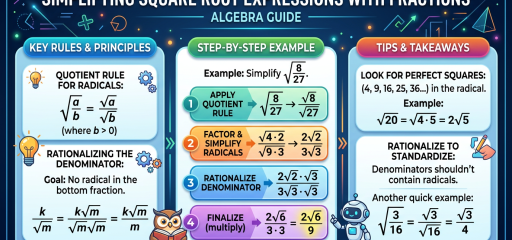
Simplifying radicals with fractions combines two key skills: simplifying square roots and working with rational expressions. Whether the radical is in the numerator, denominator, or both, the goal is to express the result in simplest form with a rationalized denominator. This skill appears in algebra, geometry (e.g., the distance formula), and standardized tests.
The Absolute Best Book to Ace Your Math Test
Recommended Math Resources
Simplifying a Fraction Under a Radical
Use the Quotient Rule
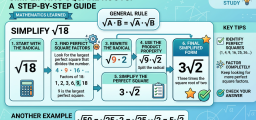
√(a/b) = √a/√b (for a, b > 0). Apply this to split the radical, then simplify each part. Example: √(18/50) = √18/√50. Simplify each: √18 = √(9×2) = 3√2, √50 = √(25×2) = 5√2. So √18/√50 = 3√2/(5√2) = 3/5. The result is 3/5. Alternatively, simplify the fraction first: 18/50 = 9/25, so √(9/25) = 3/5. For more practice, see our math worksheets.
When to Simplify First
If the fraction under the radical reduces to a perfect square, simplify first: √(50/2) = √25 = 5. If not, use the quotient rule and simplify each radical separately.
Simplifying Radicals in the Numerator or Denominator
Radical in the Numerator
If you have (√12)/4, simplify √12 = 2√3 first: (2√3)/4 = √3/2. Reduce the fraction if possible.
Radical in the Denominator (Rationalizing)
Standard form requires no radical in the denominator. Multiply top and bottom by the radical: 6/√8 = 6/√8 × √8/√8 = 6√8/8 = 3√8/4. Then simplify √8 = 2√2: 3(2√2)/4 = 3√2/2. The key: multiplying by √8/√8 (= 1) doesn’t change the value but clears the denominator.
When the Fraction Has Radicals in Both
Example: √6/√15. Option 1: Combine under one radical: √6/√15 = √(6/15) = √(2/5). Then rationalize: √(2/5) = √2/√5 × √5/√5 = √10/5. Option 2: Simplify first—√6/√15 = √(6/15) = √(2/5), same result. Always reduce the fraction under the radical before rationalizing when possible. Explore Effortless Math for algebra help.
Binomial Denominators (Advanced)
Popular Math Books

Recommended Math Practice Resource
If the denominator is a sum or difference involving a radical, like 1/(√3 + 1), multiply by the conjugate: (√3 − 1)/(√3 − 1). The denominator becomes (√3)² − (1)² = 3 − 1 = 2, so the result is (√3 − 1)/2. Conjugates use the opposite sign between the terms.
Common Patterns
- √(a²/b) = a/√b → rationalize to a√b/b
- √a/√b = √(a/b) → simplify the fraction under the radical, then rationalize if needed
- Always reduce fractions and simplify radicals before finalizing
- Check that your final answer has no radical in the denominator (unless the problem allows it)
Step-by-Step Checklist
- Simplify any fraction under the radical.
- Simplify each radical (factor out perfect squares).
- Rationalize the denominator if it contains a radical.
- Reduce the final fraction to lowest terms.
Frequently Asked Questions
Recommended Resources
Can you leave a radical in the denominator?
Technically yes, but standard form requires a rationalized denominator for clarity and consistency. Most textbooks and tests expect it.
How do you simplify √(3/7)?
√(3/7) = √3/√7. Rationalize: √3/√7 × √7/√7 = √21/7.
What about √(4/9)?
√(4/9) = √4/√9 = 2/3. No need to rationalize—the denominator is already rational.
Why do we rationalize the denominator?
Historical convention and ease of comparison. It’s easier to compare √10/5 and √11/5 than 1/√(5/2) and 1/√(5/2.2). Also, rationalized form often simplifies further calculations.

Related to This Article
More math articles
- 5th Grade TNReady Math Worksheets: FREE & Printable
- How to Solve Powers of Products and Quotients? (+FREE Worksheet!)
- The Ultimate 6th Grade NHSAS Math Course (+FREE Worksheets)
- How to Teach Math in Elementary Grades
- How to Solve Compound Interest Problems?
- How to Graph Transformation on the Coordinate Plane: Rotation?
- Full-Length 6th Grade IAR Math Practice Test
- Top 10 Tips to Overcome CHSPE Math Anxiety
- Growth Result As A Function of Time
- How to Find Vector Components?


What people say about "How do You Simplify Radicals with Fractions? - Effortless Math: We Help Students Learn to LOVE Mathematics"?
No one replied yet.