Counting Outcomes and Compound Probability
Some questions ask about more than one event at once: flip a coin and roll a die, or pick a shirt and pick pants. To handle these, you first need to count all the possible outcomes, and then you can find the probability of a combined (compound) event. Two simple tools make this easy: the counting principle and the tree diagram.
This lesson shows you both, so multi-step probability stops feeling like guesswork.
The Counting Principle
To count the outcomes of two or more steps, multiply the number of choices at each step. If you flip a coin (\(2\) outcomes) and then roll for odd or even (\(2\) outcomes), the total number of combined outcomes is \[ 2 \times 2 = 4. \] If you have \(3\) shirts and \(4\) pants, you can make \(3 \times 4 = 12\) outfits. This multiplication rule is the fastest way to count possibilities.
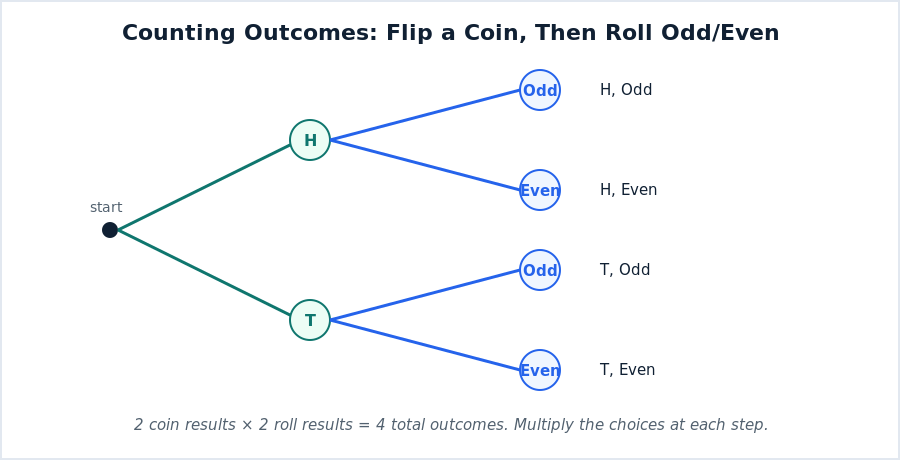
The tree diagram above shows the same idea as a picture. Each branch is a choice, and following the branches to their ends lists every possible outcome. Tree diagrams are handy when you want to see all the outcomes, not just count them.
Probability of a Compound Event
Once you can list the outcomes, a compound probability is just favorable over total. In the coin-and-roll example, there are \(4\) equally likely outcomes. The chance of getting “Heads and Odd” is \[ \dfrac{1}{4}, \] because only one of the four outcomes matches. For independent events, you can also multiply the separate probabilities: \(P(\text{Heads}) \times P(\text{Odd}) = \dfrac{1}{2} \times \dfrac{1}{2} = \dfrac{1}{4}\).
Independent Events
Two events are independent when one does not affect the other — a coin flip does not change a die roll. For independent events, the probability that both happen is the product of their probabilities. This multiplication shortcut matches what the tree diagram shows, and it is often faster than listing every outcome.
Watch: A Short Video Lesson
Khan Academy walks through this skill clearly in a few minutes. It is a helpful companion to the reading above:
A Routine for Counting and Compound Questions
- To count outcomes, multiply the choices at each step.
- Draw a tree diagram when you want to see every outcome.
- For a compound probability, use favorable over total.
- For independent events, multiply the individual probabilities.
Practice
- You have \(2\) hats and \(5\) scarves. How many hat-and-scarf combinations are there?
- Flip two coins. How many total outcomes are there?
- What is the probability of flipping two coins and getting two heads?
- What does it mean for two events to be independent?
- For independent events, how do you find the probability that both happen?
- A tree diagram has \(3\) branches, each splitting into \(2\). How many outcomes total?
Answers
- \(2 \times 5 = 10\).
- \(2 \times 2 = 4\).
- \(\dfrac{1}{2} \times \dfrac{1}{2} = \dfrac{1}{4}\).
- One event does not affect the outcome of the other.
- Multiply their individual probabilities.
- \(3 \times 2 = 6\).
Where This Fits in Your Science Prep
Counting outcomes builds on basic probability and shows up in genetics, where Punnett squares are really a compact way of counting outcomes. See all topics on the Science Topics Hub.

Related to This Article
More math articles
- Best Blue Light Glasses for Teachers and Students
- Ford, Carter, Human Rights, Camp David, and the Hostage Crisis
- Alaska AK STAR Grade 7 Math Worksheets: 95 Printable PDFs with Worked Examples & Answer Keys
- 8th Grade SBAC Math FREE Sample Practice Questions
- Black Codes and the Civil Rights Act of 1866
- Grade 2 English Worksheets for Washington, D.C. Students
- FREE 6th Grade OST Math Practice Test
- 8th Grade ISASP Math Worksheets: FREE & Printable
- Choose the quantity at the margin
- 10 Most Common PSAT 10 Math Questions



















What people say about "Counting Outcomes and Compound Probability"?
No one replied yet.