Geometry Puzzle – Critical Thinking 19
If N and P are distinct primes, how many positive divisors does N^2 times P^4 have? The slick way: for any positive integer factored as p1^a * p2^b *.. * pk^z, the divisor count is (a+1)(b+1)..(z+1). Plug in: (2+1)(4+1) = 15.
Key takeaways:
- Divisor count formula: if \( n = p_1^{a_1} p_2^{a_2} \cdots p_k^{a_k} \), then \( d(n) = (a_1+1)(a_2+1) \cdots (a_k+1) \).
- For \( N^2 \cdot P^4 \) with distinct primes \( N, P \): \( d = (2+1)(4+1) = 15 \).
- This works because every divisor picks an exponent for each prime between 0 and the prime\'s exponent in the factorization.
- If \( N = P \), the expression collapses to \( P^6 \) with \( d = 7 \).
- Number theory gives short answers to questions that look much harder than they are.
Critical thinking involves mindful communication. To develop your creative thinking, use this kind of math puzzle. The solution is also provided.
Challenge:
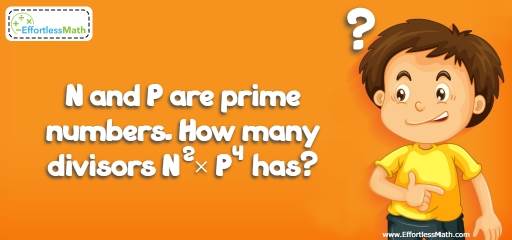
N and P are prime numbers. How many divisors N\(^2\) × P\(^4\) has?
The Absolute Best Book to Challenge Your Smart Student!

The correct answer is 15.
Original price was: $27.99.$17.99Current price is: $17.99.
If p and q are prime numbers, then for p\(^m\)Q\(^n\), the number of divisors is (m+1)(n+1).
Thus the number of divisors for N\(^2\) × P\(^4\) is (2+1)(4+1) = 15
Another way to solve this problem is by providing numbers for N and P. Let’s put 2 for N and 3 for P. Then, the value of N\(^2\) × P\(^4\) is 2\(^2\) × 3\(^4\) = 324
Now, find the factors of 324.
324: 1, 2, 3, 4, 6, 9, 12, 18, 27, 36, 54, 81, 108, 162, 324
324 have 15 factors.
The Absolute Best Books to Ace Algebra
Frequently Asked Questions
Why does the divisor formula multiply (exponent + 1) terms?
Each divisor of \( p_1^{a_1} \cdots p_k^{a_k} \) is uniquely determined by picking an exponent for each prime: \( 0, 1, 2, \ldots, a_i \) for \( p_i \). That is \( a_i + 1 \) choices for each prime. Multiplying gives the total.
What if N equals P in the puzzle?
Then \( N^2 \cdot P^4 = P^2 \cdot P^4 = P^6 \), a single prime raised to the sixth power. The divisor count becomes \( 6 + 1 = 7 \), half the previous answer. The puzzle assumes distinct primes for the clean 15-divisor answer.
Can I see the 15 divisors written out for a concrete example?
Take \( N = 2 \), \( P = 3 \): \( 2^2 \cdot 3^4 = 4 \cdot 81 = 324 \). Its divisors are 1, 2, 3, 4, 6, 9, 12, 18, 27, 36, 54, 81, 108, 162, 324. That is exactly 15.
What is prime factorization?
Writing a positive integer as a product of prime numbers raised to powers. Every integer greater than 1 has exactly one prime factorization (Fundamental Theorem of Arithmetic). For example, \( 72 = 2^3 \cdot 3^2 \).
Why must N and P be prime for the formula to give a single answer?
Composite numbers themselves split into smaller primes. If N or P were composite, the factorization of \( N^2 \cdot P^4 \) would involve more than two primes, and the divisor count would change. Primes lock down the count of distinct prime factors.
How is divisor counting used outside puzzles?
In number theory: studying perfect numbers, abundant/deficient numbers, and the divisor function are core topics. In cryptography: RSA security depends on the difficulty of factoring large integers, and divisor structure plays a role in choosing prime parameters.
How many divisors does N^2 * P^3 * Q^2 have, with three distinct primes?
Apply the same formula: \( (2+1)(3+1)(2+1) = 3 \cdot 4 \cdot 3 = 36 \) divisors. The formula extends to any number of distinct prime factors.
What is a divisor versus a factor?
They are the same thing in this context, a positive integer that divides the original number with no remainder. Both 1 and the number itself count as divisors.
How do I find the prime factorization of a number quickly?
Trial division by the smallest primes (2, 3, 5, 7, 11..) until you reach 1. For 360: \( 360 = 2 \cdot 180 = 2^2 \cdot 90 = 2^3 \cdot 45 = 2^3 \cdot 3^2 \cdot 5 \). Stop checking primes once \( p^2 \) exceeds what is left.
Where does this puzzle fit in middle school math?
It sits naturally with units on factors, multiples, prime factorization, GCF/LCM, and exponent rules, typically Grades 6 through 8 in Common Core. Strong upper-elementary students can grasp the divisor count via examples.
Related Lessons You May Like
- How to find prime and composite numbers (resource currently unavailable)
- How to find the greatest common factor
- How to apply divisibility rules (resource currently unavailable)
- How to solve permutations and combinations
- How to solve multi-step word problems
If your student enjoys puzzles like this, Geometry for Beginners works the same relationships inside a full curriculum. For the number-theory side, Pre-Algebra for Beginners covers primes, factors, and divisibility from the ground up.

Related to This Article
More math articles
- Distinguishing Angles: Acute, Right, Obtuse, and Straight
- The Best Grade 5 Math Book for New York Students
- How to Find the Area Enclosed by Curves Using Any Axes
- Top 10 Tips to Create the SSAT Math Study Plan
- Ratification of the U.S. Constitution
- How Is the CLEP College Mathematics Test Scored?
- How to Ace the GRE Quant Section?
- How to Graph Solutions to Linear Inequalities?
- Free Printable Grade 3 Math for Wisconsin FORWARD Students: 49 Single-Skill PDF Worksheets
- Grade 3 Math: Subtracting 3-Digit Numbers







What people say about "Counting Divisors of N squared times P to the Fourth"?
No one replied yet.