Geometry Puzzle – Critical Thinking 16
Two sides of a triangle are 10 and 5. What areas are possible? The triangle inequality forces the third side strictly between 5 and 15. The area is at its largest when the included angle between the two given sides is 90 degrees, giving a maximum area of (1/2)(10)(5) = 25 square units.
Key takeaways:
- Triangle inequality: each side must be less than the sum of the other two — so the third side here is strictly between 5 and 15.
- Area of a triangle with two known sides \( a, b \) and the included angle \( \theta \) is \( \frac{1}{2} ab \sin\theta \).
- Sine peaks at \( \theta = 90^\circ \), so the maximum area is \( \frac{1}{2}(10)(5) = 25 \).
- As \( \theta \) approaches 0 or 180 degrees, the triangle degenerates and area shrinks toward 0.
- So the possible area range for this triangle is \( 0 < A \leq 25 \) (exclusive of 0, inclusive of 25 at the right angle).
This is a creative Puzzle to challenge the Brain! This is for 5th graders and older. A detailed solution is also provided
Challenge:
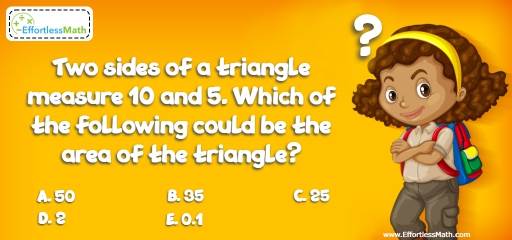
Two sides of a triangle measure 10 and 5. Which of the following could be the area of the triangle?
A- 50
B- 35
C- 25
D- 2
E- 0.1
The Absolute Best Book to Challenge Your Smart Student!

The correct answer is C , D and E.
Original price was: $27.99.$17.99Current price is: $17.99.
We can find the maximum area of the triangle only when the given sides are placed at right angles. Why?
Let’s put 10 as the base and 5 as the height. Then, the area of the triangle is: \(\frac{10×5}{2}= 25\)
The angle less or more than 90 degrees between the sides reduce the area. (Draw it out for yourself). Hence, the area can be anything between 0 and 25.
The Absolute Best Books to Ace Algebra
Frequently Asked Questions
What is the triangle inequality?
For any triangle with sides \( a, b, c \): each side must be strictly less than the sum of the other two. So \( c < a + b \), \( a < b + c \), and \( b < a + c \). When any of these fails or becomes an equality, the \"triangle\" collapses to a line segment.
What is the formula for area using two sides and an included angle?
\( A = \frac{1}{2} ab \sin\theta \), where \( a \) and \( b \) are the two sides and \( \theta \) is the angle BETWEEN them. This is the SAS area formula and generalizes the familiar \( A = \frac{1}{2} b h \) once you note the height is \( a \sin\theta \).
Why is the area maximum at \( \theta = 90^\circ \)?
\( \sin\theta \) hits its maximum value of 1 at \( \theta = 90^\circ \). Since \( A = \frac{1}{2}(10)(5)\sin\theta \) and the constant part is 25, the maximum area is \( 25 \cdot 1 = 25 \).
What happens to the area as the angle gets very small or very large?
As \( \theta \to 0 \) or \( \theta \to 180^\circ \), \( \sin\theta \to 0 \), and the triangle squashes flat into a line segment with zero area. The triangle is most \”open\” at a right angle.
What is the length range for the third side of a triangle with sides 10 and 5?
By the triangle inequality, the third side \( c \) must satisfy \( |10 – 5| < c < 10 + 5 \), so \( 5 < c < 15 \). The endpoints are excluded because either would create a degenerate triangle (a line segment).
Is the area always at least some minimum value?
No. The area can be arbitrarily small, approaching 0 as the included angle approaches 0 or 180 degrees. The lower bound is open: \( A > 0 \), but there is no positive minimum value.
Can I confirm the max with Heron formula?
Yes. With sides 10, 5, and a third side, Heron formula gives the area in terms of the three sides. Maximizing over the allowed range of the third side leads back to the right-triangle configuration with hypotenuse \( \sqrt{125} \) and area 25 — same answer.
Why is this puzzle valuable for students?
It blends three concepts — triangle inequality, area formulas, and the behavior of sine — into one short question. That kind of integration is exactly what state tests reward, and it builds the habit of thinking across topics rather than within a single chapter.
What grade level is appropriate for this puzzle?
The triangle inequality and basic area appear in middle school (Grades 6-8). The full \( \frac{1}{2} ab \sin\theta \) formula belongs to Geometry or Algebra II/Trigonometry. Strong middle schoolers can reason through the maximum case using just right-triangle area.
How is this useful outside math class?
Engineers and architects routinely use SAS area arguments when designing trusses, roofs, and any structure whose strength depends on the included angle between two known members. The geometry-physics interface is full of this idea.
Related Lessons You May Like
- How to classify triangles
- How to find the area of triangles
- How to use the Pythagorean Theorem
- How to find similar figures
- How to solve multi-step word problems
If your student enjoys puzzles like this, Geometry for Beginners works the same relationships inside a full curriculum. For the number-theory side, Pre-Algebra for Beginners covers primes, factors, and divisibility from the ground up.

Related to This Article
More math articles
- Attire, Hand Hygiene, and Personnel Practices
- The Best Grade 4 ELA Practice Tests for Idaho Students
- The Ultimate 7th Grade NDSA Math Course (+FREE Worksheets)
- Slope-Intercept Form Worksheet with Answers
- Apportionment and reapportionment
- Misinformation, Media Literacy, and Technological Change
- Readiness Diagnostics and Three Study Plans
- Civil Rights Movement
- Derivatives Demystified: Everything You Need to Know
- Classify evidence, not labels






What people say about "Geometry Puzzle – Critical Thinking 16 - Effortless Math"?
No one replied yet.