

LEARN · PRACTICE · EXPLORE
California Grade 2 Math
California Grade 2 math learning references for number sense, operations, measurement, and shapes. Use the curriculum source and classroom targets to plan practice.
Focused lessons · Useful practice · Clear next steps
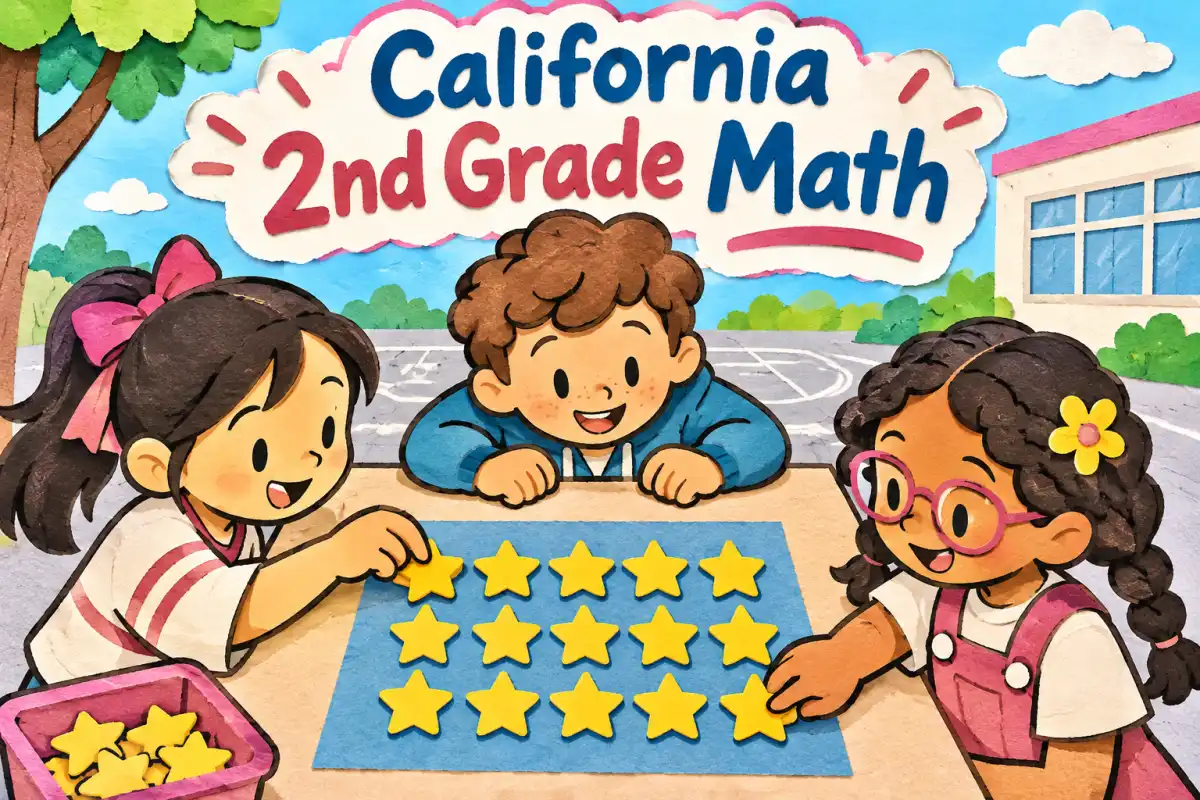
What do California 2nd graders learn in math?
In 2nd grade, California math centers on adding and subtracting within 100, place value to 1,000, money, telling time to five minutes, and simple data. This page pairs each skill with short lessons, skill quizzes and printable worksheets.
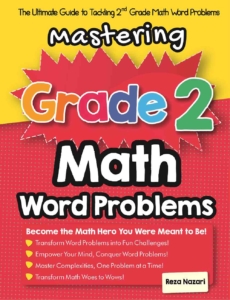
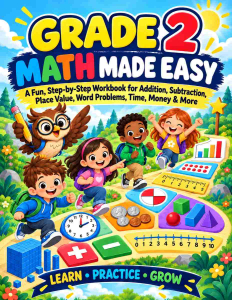
Printable California grade 2 math books:
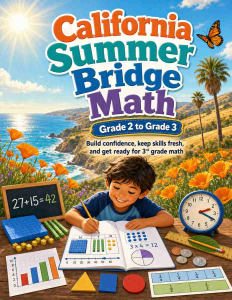
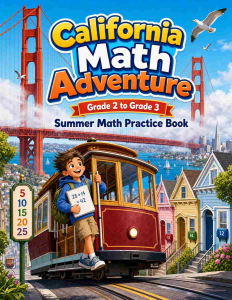
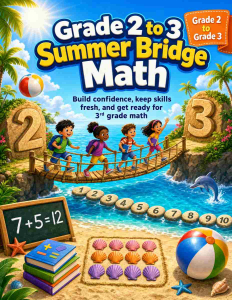
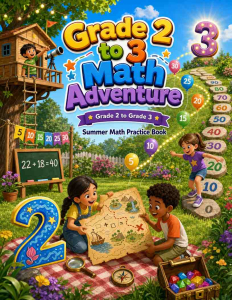
Is There a State Test in Grade 2? California Testing Facts
No. California does not give the CAASPP to 2nd graders. The Smarter Balanced math test starts in Grade 3. Grade 2 is the time to build the foundations that test measures, using the standards and practice on this page.
| State test in Grade 2 | None |
|---|---|
| Optional for Grade 2 | Grade Two Diagnostic Assessments, which schools may use to check progress (not a state summative test) |
| First state test | Smarter Balanced Mathematics in Grade 3 (CAASPP), with score levels from Standard Not Met to Standard Exceeded |
| Get a preview | Official CAASPP practice tests show the Grade 3 question types |
Practice on this page: California standards
Facts from the California Department of Education, checked November 23, 2026: CDE: California Assessment System chart (last reviewed Sept 24, 2026); CAASPP: Smarter Balanced ELA and math; CDE: Grade Two Diagnostic Assessments.
All 27 California Grade 2 Math Standards
Every Grade 2 mathematics standard in the California Common Core State Standards, grouped by domain, with a one-line explanation of what each one asks. Open a group to see its standards.
Operations & Algebraic Thinking (4)
| 2.OA.1 | Use addition and subtraction within 100 to solve one- and two-step word problems. |
|---|---|
| 2.OA.2 | Fluently add and subtract within 20 using mental strategies, and know all sums of two one-digit numbers from memory by the end of Grade 2. |
| 2.OA.3 | Decide whether a group of up to 20 objects has an odd or even number of members, and write an even number as a sum of two equal addends. |
| 2.OA.4 | Use addition to find the total number of objects in a rectangular array with up to 5 rows and 5 columns. |
Number & Operations in Base Ten (10)
| 2.NBT.1 | Understand that the three digits of a three-digit number stand for hundreds, tens and ones, and that 100 is a bundle of ten tens. |
|---|---|
| 2.NBT.2 | Count within 1000, and skip-count by 2s, 5s, 10s and 100s (California wording). |
| 2.NBT.3 | Read and write numbers to 1000 using numerals, number names and expanded form. |
| 2.NBT.4 | Compare two three-digit numbers using >, = and <, based on place value. |
| 2.NBT.5 | Fluently add and subtract within 100 using place value, properties of operations and the relationship between addition and subtraction. |
| 2.NBT.6 | Add up to four two-digit numbers using place value strategies. |
| 2.NBT.7 | Add and subtract within 1000 using models, drawings and place value, including composing and decomposing tens and hundreds. |
| 2.NBT.7.1 | Use estimation strategies to make reasonable estimates in problem solving (California addition). |
| 2.NBT.8 | Mentally add or subtract 10 or 100 to or from a number between 100 and 900. |
| 2.NBT.9 | Explain why addition and subtraction strategies work, using place value and properties of operations. |
Measurement & Data (10)
| 2.MD.1 | Measure length with rulers, yardsticks, meter sticks and measuring tapes. |
|---|---|
| 2.MD.2 | Measure the same length with two different units and describe how the measurements relate to the unit size. |
| 2.MD.3 | Estimate lengths in inches, feet, centimeters and meters. |
| 2.MD.4 | Measure to find how much longer one object is than another, in a standard unit. |
| 2.MD.5 | Solve addition and subtraction word problems within 100 involving lengths in the same units. |
| 2.MD.6 | Represent whole numbers as lengths on a number line and show sums and differences within 100 on it. |
| 2.MD.7 | Tell and write time to the nearest five minutes using a.m. and p.m., and know relationships of time such as minutes in an hour and days in a week (California wording). |
| 2.MD.8 | Solve word problems with dollar bills, quarters, dimes, nickels and pennies, using the dollar and cent symbols. |
| 2.MD.9 | Measure several objects to the nearest whole unit and show the measurements on a line plot. |
| 2.MD.10 | Draw picture graphs and bar graphs for data with up to four categories and solve problems using them. |
Geometry (3)
| 2.G.1 | Recognize and draw shapes with given attributes, and identify triangles, quadrilaterals, pentagons, hexagons and cubes. |
|---|---|
| 2.G.2 | Partition a rectangle into rows and columns of same-size squares and count to find the total. |
| 2.G.3 | Partition circles and rectangles into two, three or four equal shares, described as halves, thirds and fourths. |
Standards marked as California wording or additions differ from the national Common Core.
Codes as published by the California Department of Education; descriptions are our plain-English summaries, not the official wording. Checked November 23, 2026: California Common Core State Standards: Mathematics (CDE).
Standards source: Content Standards, California Department of Education.
California Grade 2 math is where students build addition and subtraction fluency, place-value understanding, early measurement, shapes, and clear math explanations. This California Common Core guide gives California families and educators a standards map that feels practical instead of overwhelming: 27 student-friendly expectations across 4 math strands, with emphasis on measurement, time, data, area, perimeter, and graphing, place value, rounding, comparing numbers, and multi-digit computation, operations, equations, patterns, and problem solving. Whether the next checkpoint is classroom progress, intervention, homeschool planning, or CAASPP review, the best preparation uses practice that asks students to model, solve, and explain rather than only choose an answer.
Use this California Grade 2 page for teacher planning, parent support, after-school tutoring, and independent practice. The wording, examples, and practice notes are tailored to California Common Core, so the page works as a grade-specific planning tool rather than a copied standards list.
Free Grade 2 Math Checklist + Practice Plan
Use this California Grade 2 math guide as a printable standards checklist. Start with the overview, mark the skills your student already handles, then choose one weak area for focused review before CAASPP or classroom assessments.
California Grade 2 Math Standards Overview
For California, Grade 2 is a turning point: students build addition and subtraction fluency, place-value understanding, early measurement, shapes, and clear math explanations. This overview organizes California Common Core into plain-language strands so you can quickly identify what to teach, review, or reteach.
Learning reference group 1
Example learning reference: Recognize and draw shapes having specified attributes, such as a given number of angles or a given number of equal faces. Identify triangles, quadrilaterals, pentagons, hexagons, and cubes. Read the individual expectations below and check the current classroom target.
Learning reference group 2
Example learning reference: Measure the length of an object by selecting and using appropriate tools such as rulers, yardsticks, meter sticks, and measuring tapes. Read the individual expectations below and check the current classroom target.
Learning reference group 3
Example learning reference: Understand that the three digits of a three-digit number represent amounts of hundreds, tens, and ones. Read the individual expectations below and check the current classroom target.
Learning reference group 4
Example learning reference: Use addition and subtraction within 100 to solve one- and two-step word problems involving situations of adding to, taking from, putting together, taking apart, and comparing, with unknowns in all positions,. Read the individual expectations below and check the current classroom target.
Grade 2 CAASPP Practice Plan
A useful California Grade 2 plan should not race through all 27 expectations at once. Start with a few classroom targets, rotate in quick review, and ask students to explain how they know. Begin with an expectation the student can explain partly, then revisit earlier skills as understanding grows.
For California Grade 2 students, a strong weekly rhythm is simple: one fluency warm-up, one visual model, one word problem, one written explanation, and one quick check tied back to California Common Core. That routine keeps CAASPP practice connected to real Grade 2 standards instead of random worksheets.
California Grade 2 Math Learning References
The codes below follow the California Grade 2 source standards structure. The wording is intentionally rewritten in original, family-friendly language for learning and planning.
Learning reference group 1
Read the learning reference, choose a model or text that makes the idea clear, and compare the code with your current classroom target.
Use these Grade 2 expectations as learning references. Common Core-style codes refer to the Common Core standards; they do not certify a complete match to California’s current curriculum. State-specific references also need to be checked against the current official document. Follow your teacher’s assigned targets when wording, codes, or grade placement differ.
| Code | Learning reference |
|---|---|
| 2.G.1 | Recognize and draw shapes having specified attributes, such as a given number of angles or a given number of equal faces. Identify triangles, quadrilaterals, pentagons, hexagons, and cubes |
| 2.G.2 | Partition a rectangle into rows and columns of same-size squares and count to find the total number of them |
| 2.G.3 | Partition circles and rectangles into two, three, or four equal shares, describe the shares using the wordshalves,thirds,half of,a third of, etc., and describe the whole as two halves, three thirds, four fourths. Recognize that equal shares of identical wholes need not have the same shape |
Learning reference group 2
Read the learning reference, choose a model or text that makes the idea clear, and compare the code with your current classroom target.
| Code | Learning reference |
|---|---|
| 2.MD.1 | Measure the length of an object by selecting and using appropriate tools such as rulers, yardsticks, meter sticks, and measuring tapes |
| 2.MD.2 | Measure the length of an object twice, using length units of different lengths for the two measurements; describe how the two measurements relate to the size of the unit chosen |
| 2.MD.3 | Estimate lengths using units of inches, feet, centimeters, and meters |
| 2.MD.4 | Measure to determine how much longer one object is than another, expressing the length difference in terms of a standard length unit |
| 2.MD.5 | Use addition and subtraction within 100 to solve word problems involving lengths that are given in the same units, |
| 2.MD.6 | Represent whole numbers as lengths from 0 on a number line diagram with equally spaced points corresponding to the numbers 0, 1, 2,…, and represent whole-number sums and differences within 100 on a number line diagram |
| 2.MD.7 | Tell and write time from analog and digital clocks to the nearest five minutes, using a.m. and p.m. Know relationships of time (e.g., minutes in an hour, days in a month, weeks in a year) |
| 2.MD.8 | Solve word problems involving dollar bills, quarters, dimes, nickels, and pennies, using $ and ¢ symbols appropriately |
| 2.MD.9 | Generate measurement data by measuring lengths of several objects to the nearest whole unit, or by making repeated measurements of the same object. Show the measurements by making a line plot, where the horizontal scale is marked off in whole-number units |
| 2.MD.10 | Draw a picture graph and a bar graph (with single-unit scale) to represent a data set with up to four categories. Solve simple put-together, take-apart, and compare problems using information presented in a bar graph |
Learning reference group 3
Read the learning reference, choose a model or text that makes the idea clear, and compare the code with your current classroom target.
| Code | Learning reference |
|---|---|
| 2.NBT.1 | Understand that the three digits of a three-digit number represent amounts of hundreds, tens, and ones |
| 2.NBT.2 | Count within 1000; skip-count by 2s, 5s, 10s, and 100s |
| 2.NBT.3 | Read and write numbers to 1000 using base-ten numerals, number names, and expanded form |
| 2.NBT.4 | Compare two three-digit numbers based on meanings of the hundreds, tens, and ones digits, using >, =, and < symbols to record the results of comparisons |
| 2.NBT.5 | Fluently add and subtract within 100 using strategies based on place value, properties of operations, and/or the relationship between addition and subtraction |
| 2.NBT.6 | Add up to four two-digit numbers using strategies based on place value and properties of operations |
| 2.NBT.7 | Add and subtract within 1000, using concrete models or drawings and strategies based on place value, properties of operations, and/or the relationship between addition and subtraction; relate the strategy to a written method. Understand that in adding or subtracting three-digit numbers, one adds or subtracts hundreds and hundreds, tens and tens, ones and ones; and sometimes it is necessary to compose or decompose tens or hundreds |
| 2.NBT.7.1 | Use estimation strategies to make reasonable estimates in problem solving |
| 2.NBT.8 | Mentally add 10 or 100 to a given number 100–900, and mentally subtract 10 or 100 from a given number 100–900 |
| 2.NBT.9 | Explain why addition and subtraction strategies work, using place value and the properties of operations |
Learning reference group 4
Read the learning reference, choose a model or text that makes the idea clear, and compare the code with your current classroom target.
| Code | Learning reference |
|---|---|
| 2.OA.1 | Use addition and subtraction within 100 to solve one- and two-step word problems involving situations of adding to, taking from, putting together, taking apart, and comparing, with unknowns in all positions, |
| 2.OA.2 | Fluently add and subtract within 20 using mental strategies. By end of Grade 2, know from memory all sums of two one-digit numbers |
| 2.OA.3 | Determine whether a group of objects (up to 20) has an odd or even number of members, |
| 2.OA.4 | Use addition to find the total number of objects arranged in rectangular arrays with up to 5 rows and up to 5 columns; write an equation to express the total as a sum of equal addends |
How to Use This California Grade 2 Math Checklist
- Choose one California Grade 2 strand. Start with a domain that matches the current lesson, a recent quiz, or the student's biggest need in this grade.
- Teach the California Common Core Grade 2 idea with a model. Use arrays, number lines, strip diagrams, area models, tables, or real objects before shortcuts.
- Add California Grade 2-ready context. Include word problems so students learn when to use the skill, how to calculate.
- Ask for California Grade 2 reasoning. Students should explain why the answer works, whether it is reasonable, and how the model connects to the standard code.
- Spiral review for California CAASPP review in Grade 2. Revisit older standards each week so skills stay ready for classroom assessments and longer review cycles.
California Grade 2 Math Standards FAQ
What standards does this page explain?
This page provides Grade 2 math learning references alongside California Common Core in clear, original language for families, teachers, tutors, and homeschool planners.
Is this official standards wording?
No. This California Grade 2 page is an independent, learning-reference guide designed for planning and practice. Use the official standards source for formal policy wording.
How should students practice these skills?
For California Grade 2 review, students should practice with a mix of fluency, visual models, word problems, and short explanations. That balance helps them transfer the skill instead of memorizing one problem type.
How does this connect to testing?
The Grade 2 standards describe what students learn; CAASPP is the assessment context students may encounter in California. Strong preparation comes from understanding the standards deeply, modeling problems clearly, and explaining answers with precise math language.
Source Note
This independent California guide paraphrases Grade 2 mathematics expectations for readability and learning support. It is not official wording and is not affiliated with the state education agency. Always consult official standards documents for formal language, updates, and compliance decisions.
For more California Grade 2 support, visit the Grade 2 Math Online Center or browse Grade 2 math worksheets.
California Grade 2 Math: 10-Question Challenge
Ten fresh questions on the skills California 2nd graders work on most. Pick an answer, check it, and read the explanation either way.
Add ones, tens and hundreds, regrouping when needed: 288 + 351 = 639.
Subtract, regrouping when needed: 889 − 249 = 640. Check: 640 + 249 = 889.
Quarters: 50. Dimes: 30. Nickels: 10. Total: 50 + 30 + 10 = 90 cents.
Each number on the clock is 5 minutes. The minute hand on 1 means 5 minutes. The time is 4:05.
There are 2 equal parts in all, and 1 is shaded. The fraction is \(\frac{1}{2}\).
An even number ends in 0, 2, 4, 6 or 8. 46 ends in 6, so it is even.
Choose another state
Grade 2 Math in Every State
Select a state on the map to open its Grade 2 Math page. You are viewing California.
All states A–Z
A USEFUL NEXT STEP
California Grade 2 Math: study questions
How should I choose a Grade 2 math study target?
Choose a current classroom target, find the matching learning reference, and use a lesson or available practice resource to check understanding. State documents control local wording and placement; shared reference codes are not a certified crosswalk.
Official source ↗Are these activities official state assessments?
These are independently published learning resources. A practice score does not predict or replace an official state score. Use the directions in each activity and consult your school for official testing and accommodation rules.
Resources from Effortless Math · Editorial standards