7th Grade English Worksheets for Virginia (SOL): 43 Free Printable PDFs
Looking for 7th grade English practice for Virginia? Here are 43 free PDF worksheets lined up with the Virginia SOL Grade 7 reading test, covering reading literature, informational text, writing, grammar, punctuation and vocabulary. Every worksheet focuses on a single skill and includes an answer key.
In a Shenandoah Valley farmhouse outside Harrisonburg, the family dog is a thirteen-year-old black Lab named Ranger who has chosen, for reasons of his own, the rag rug in front of the bookcase as the only acceptable place to nap. The seventh grader who is doing her ELA practice on the rug beside him does not mind. She is on her stomach, her elbows propped on a corduroy cushion, a printed page in front of her and a green felt-tip pen in her hand. The bookcase next to the rug holds the family’s reading library, paperback fiction the seventh grader has been working her way through since fourth grade, a beat-up dictionary, a thesaurus her grandmother gave her in fifth grade, and three years’ worth of the school’s spring literary magazine. The seventh grader is reading a passage that compares two short articles about the Blue Ridge Parkway. She underlines as she reads. Ranger snores. It takes her fourteen minutes to finish the page and another three to check her answers against the key.
That rug-and-bookcase quiet fits the Virginia SOL the way no last-minute review evening ever could. Virginia administers the Standards of Learning (SOL) assessments in the spring at Grade 7, and the ELA portion is built on the Virginia Standards of Learning, English. SOL Reading at Grade 7 is, distinctively among state ELA tests, a READING-ONLY assessment. There is no separate writing prompt scored alongside the reading items. Instead, the test uses a deep bank of technology-stronger items (TEI), drag-and-drop, hot-text, multi-select, table completion, and short text-entry, to measure reading comprehension, vocabulary, and analysis with no extended composition attached. The seventh grader on the rag rug beside Ranger is rehearsing exactly the careful, on-paper, evidence-tracking work the SOL Reading TEI items reward.
The Virginia Standards of Learning organize Grade 7 English across reading, writing, research, and communication. SOL Reading at Grade 7 samples broadly across reading and vocabulary; writing is taught and assessed in the classroom but is not part of the SOL Reading test itself.
This page gathers forty-three free printable Grade 7 ELA worksheets, every one mapped to a Grade 7 strand in the Virginia Standards of Learning, English, every one printable at home, no signup.
What’s on this page
Each PDF opens with a Quick Review a seventh grader can read alone. The practice items mirror SOL on-screen formats, multiple choice, multi-select, evidence-based selected response, drag-and-drop, hot-text highlighting, table completion, and short text-entry. Because SOL Reading at Grade 7 is reading-only, the literature, informational, and vocabulary PDFs carry the most weight for testing-day rehearsal, but the writing and language PDFs still build the classroom skills the SOL Writing standards expect across the year.
Use the menu below to match the strand the English teacher is on this week. For SOL Reading, the literature and informational PDFs plus the vocabulary PDFs run together as a forty-five-minute mixed-item block come closest to the live test experience.
Reading: Literature
- Citing Several Pieces of Textual Evidence, [7.RL.1.A] stack two or three converging quotes behind one inference
- Theme and Its Development Over the Text, [7.RL.2.A] theme as a sentence the whole text earns
- How Setting, Character, and Plot Interact, [7.RL.1.B] setting bends character, character moves plot
- Word Choice, Figurative Language, and Tone, [7.RV.2.A] denotation, connotation, and the tone they build together
- How Form Shapes Meaning in Drama and Poetry, [7.RL.2.B] sonnet, soliloquy, stage direction, stanza
- Developing and Contrasting Points of View, [7.RL.3.A] two perspectives in deliberate tension
- Comparing a Story to Its Audio, Film, or Stage Version, [7.RL.3.B] what each medium can and cannot do
- Comparing Fictional and Historical Portrayals, [7.RL.3.C] sort real Virginia history from authorial invention
Reading: Informational Text
- Citing Several Pieces of Evidence in Nonfiction, [7.RI.1.A] pull several article details toward one conclusion
- Two or More Central Ideas and Their Development, [7.RI.1.B] track an article teaching two things at once
- How Individuals, Events, and Ideas Interact, [7.RI.1.C] a person shapes an idea, an idea reshapes a person
- Word Meaning in Nonfiction: Figurative, Connotative, Technical, [7.RV.1.A] three jobs one nonfiction word does
- How Text Structure Develops the Author’s Ideas, [7.RI.2.A] problem-solution, compare-contrast, chronological
- Author’s Point of View and How They Distinguish It, [7.RI.3.A] find the position and the moves that mark it
- Comparing a Text to Its Audio or Video Version, [7.RI.2.C] what print emphasizes vs. What broadcast emphasizes
- Evaluating an Argument: Reasoning and Evidence, [7.RI.3.A] strong evidence vs. Filler, and the logic in between
- How Two Authors Shape Their Presentation of the Same Topic, [7.RI.3.C] same subject, different facts emphasized
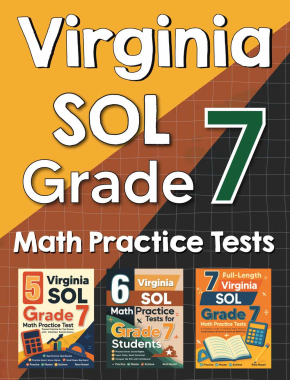
Working on Math Too? Try the Virginia SOL Grade 7 Math Bundle
Many third graders are getting ready for the SOL in both subjects. If your child also needs math practice that matches the same standards, this companion bundle is the shortest path, workbook, study guide, and full practice tests in one download.
Writing
- Argument Writing: Claims, Reasons, Evidence, and Counterclaims, [7.W.1.A] counterclaims for the classroom SOL Writing standards
- Informative and Explanatory Writing, [7.W.1.B] thesis, ordered sections, transitions
- Narrative Writing, [7.W.1.C] pacing, dialogue, sensory description, an ending that lands
- Coherent Writing for Task, Purpose, and Audience, [7.W.2.A] one idea, three audiences, three versions
- Planning, Revising, and Editing, [7.W.3.A] the move at the heart of strong classroom writing
- Short Research Projects: Question and Refocus, [7.RI.3.C] let early findings rewrite the question
- Gathering, Evaluating, and Citing Sources, [7.RI.3.C] author, date, publisher, citation the Virginia teacher expects
Speaking & Listening
- Collaborative Discussions, [7.C.1.A] come prepared, listen first, disagree without dismissing
- Analyzing Information in Diverse Media, [7.C.1.B] chart, clip, photo as one combined argument
- Evaluating a Speaker’s Argument, [7.RI.3.A] claim, reasons, evidence, gaps
- Presenting Claims with Focus and Coherence, [7.C.1.D] open with the point, preview the order, hold to it
- Adapting Speech to Context, [7.C.1.A] friend-talk and presentation-talk are different registers
Grammar
- Phrases and Clauses: Placement and Function, [7.FFW.1.A] what each piece is doing, where it belongs
- Sentence Structures: Simple, Compound, Complex, Compound-Complex, [7.FFW.1.A] count clauses, name the structure
- Avoiding Dangling and Misplaced Modifiers, [7.FFW.1.B] the small error that makes a paragraph absurd
Conventions: Punctuation, Spelling
- Commas with Coordinate Adjectives, [7.FFW.2.A] when two adjectives need a comma and when they do not
- Spelling Grade-Appropriate Words, [7.FFW.2.A] homophones, doubled letters, common Grade 7 misses
Knowledge of Language and Style
- Precise and Concise Language, [7.W.2.A] cut wordiness, replace vague verbs, pick the exact noun
Vocabulary and Word Study
- Using Context Clues, [7.RV.1.B] name the kind of clue and use it on purpose
- Greek and Latin Roots and Affixes, [7.RV.1.B] one root unlocks ten unrelated words
- Using Reference Materials Effectively, [7.RV.1.C] match the tool to the question
- Verifying Word Meaning, [7.RV.1.C] confirm the guess before committing
- Allusions and Figures of Speech, [7.RV.2.A] myth, Bible, literary references the Grade 7 reader now catches
- Word Relationships: Synonyms, Antonyms, Analogies, [7.RV.1.D] name the relationship before picking the answer
- Connotation and Denotation, [7.RV.1.D] same fact, different feeling, different word
- Academic and Domain-Specific Vocabulary, [7.RV.1.A] words that travel across subjects and words tied to one field
How to use these worksheets at home
Virginia is several regions stitched together, and a Tidewater family in Norfolk does not study the same way a Northern Virginia family in Fairfax does. A Richmond family might run a Sunday-evening session at the kitchen table after church. A Virginia Beach family might fit fifteen minutes between school pickup and a sibling’s swim practice. A Roanoke family might do practice on a porch in the cooler hour of the afternoon. A Charlottesville family might use the half hour before a violin lesson. A Williamsburg family might run Saturday work after a morning visit to colonial-history reenactments at the historic district. The unit is one PDF, the work is twelve to fifteen minutes, and the page travels, to a rag rug by the bookcase, to the kitchen table, to a passenger seat on I-64.
Because SOL Reading at Grade 7 is reading-only, the at-home rotation tilts toward reading: two literature PDFs, two informational PDFs, and one vocabulary PDF per week, with the writing and language PDFs added in support of the classroom SOL Writing standards. Once a week, run a forty-five-minute mixed reading-and-vocabulary block, two passages, one literature and one informational, with the L.7.4 context-clue, root, and verification PDFs interleaved as if they were embedded TEI items in a reading test. That mixed block mirrors the live SOL Reading experience.
The L.7.5a allusions PDF and the L.7.3a precise-and-concise PDF deserve extra reps because the SOL Reading vocabulary items reward exact word meaning and recognizable references. The L.7.5b synonyms-antonyms-analogies PDF and the L.7.5c connotation-and-denotation PDF are also high-value for the vocabulary items the SOL reads heavily.
A note about SOL Reading at Grade 7
The Virginia Standards of Learning (SOL) assessment in Grade 7 English is administered in the spring on a computer (with paper accommodations available). Crucially, the Grade 7 SOL English assessment is a READING-ONLY test. There is no separate writing prompt on the SOL at Grade 7. The test uses a wide bank of technology-improved items (TEI), including drag-and-drop, hot-text highlighting, multi-select, table completion, and short text-entry, in addition to standard multiple choice. TEI items let the test measure reading comprehension and vocabulary analysis without an extended composition.
The Grade 7 SOL Reading test is built on the Virginia Standards of Learning, English and samples literature and informational passages along with vocabulary items. Reporting categories cover use of word analysis strategies and word reference materials, demonstrate comprehension of fictional texts, narrative nonfiction, and poetry, and demonstrate comprehension of nonfiction texts. The classroom SOL Writing standards still cover argument, informative, and narrative writing as well as research, but those classroom standards are taught and assessed locally rather than on the Grade 7 SOL Reading test.
Two pre-window weeks of one weekly forty-five-minute mixed reading-and-vocabulary block, paired with daily short reading PDFs and vocabulary work, cover most of the rehearsal a Grade 7 student needs for the SOL Reading test.
Want everything in one bundle?
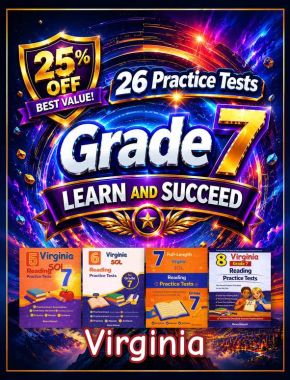
Some Virginia families prefer one organized book to a list of standalone PDFs. The Grade 7 ELA Preparation Bundle organizes practice across the SOL Reading test, TEI rehearsal, literature and informational passages, vocabulary drills, and full-length practice tests, with answer keys that explain every choice and unpack the TEI trap on every item.
Virginia Grade 7 ELA Preparation Bundle, four practice-test books, 26 unique full-length tests, complete answer keys with explanations.
A short closing
Ranger the black Lab will keep snoring on the rag rug in front of the bookcase, the seventh grader on her stomach beside him will keep underlining passages with her green felt-tip pen, and the careful, on-paper, evidence-tracking habit that the rug-and-bookcase quiet builds will carry directly across to the SOL Reading TEI items. Bookmark this page, print one PDF before the next quiet afternoon, and let the small bookcase-and-rug discipline carry a Virginia seventh grader cleanly into the spring SOL Reading window.
Best Bundle to Ace the Virginia SOL Grade 7 ELA
Looking for the best resource to help your kid ace the Virginia SOL? Try this bundle, four full practice-test books (5 + 6 + 7 + 8 tests) covering the same Grade 7 reading, writing, and language skills your child is already learning. Instant PDF download, answer keys included.

Related to This Article
More math articles
- Alabama ACAP Grade 8 Math Free Worksheets: 72 Printable PDFs with Step-by-Step Answer Keys
- Top 10 3rd Grade MAP Math Practice Questions
- Why Math is a Difficult Subject?
- Why Math Matters in Your Future IT Career?
- The Best Grade 8 ELA Practice Tests for Pennsylvania Students
- The Best Grade 7 ELA Practice Tests for Georgia Students
- The Best Grade 7 ELA Practice Tests for Tennessee Students
- 4th Grade SBAC Math Practice Test Questions
- Retracting and Exposing Instruments
- TASC Math FREE Sample Practice Questions





What people say about "7th Grade English Worksheets: Virginia SOL (43 Free PDFs)"?
No one replied yet.