


How to Help Your Child Prepare for the Texas Grade 6 STAAR Math Test

A five-pound bag of rice costs $9 and a three-pound bag costs $6. Which costs less per pound? Let your sixth grader think before giving them an operation. If they point to the $6 bag, ask what one pound from each bag would cost. Once the quantities match, the comparison gets easier. You can practice that kind of reasoning in a few minutes at the kitchen table.
What to expect on the Grade 6 STAAR math test
The Texas Education Agency calendar sets April 19–30, 2027 as the statewide Grades 3–8 math window. Your school will confirm the date for your child. This is the final spring STAAR administration for Grade 6. Texas will use the Student Success Tool beginning in 2027–28.
The test is usually online. It measures selected Grade 6 Texas Essential Knowledge and Skills, or TEKS. Students may choose an answer, enter a value, or work with an interactive item. Schools and families can use results alongside classwork to decide what a student is ready for and what still needs practice.
The testing guidance gives an expected completion time of three to four hours. Students who need extra time can generally continue within the regular school day for up to seven hours of work. Standard Grade 6 STAAR math is taken without a calculator. Ask your school about any approved accommodations, testing tools, and how students request a break.
Quick Texas Grade 6 STAAR Math Check
Use a pencil and scrap paper for these ten questions. Have your child write down one question they want to revisit. The quiz shows one question at a time, with the score and worked explanations after the tenth answer. Each correct answer is worth ten points.
Question 1 of 10
Quiz results
Each correct answer earns 10 points. An 80/100, for example, means eight out of ten correct. Ask your child to explain one solution. If they missed any questions, choose one to work through together. Check the official STAAR report for the state performance level.
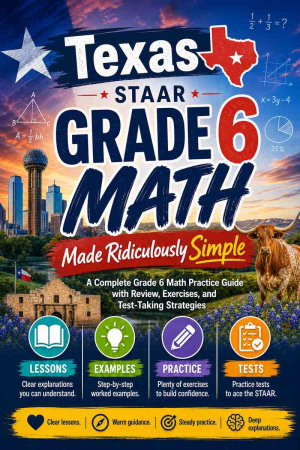
Help your child feel ready for STAAR math. Texas STAAR Grade 6 Math Made Ridiculously Simple walks through Grade 6 skills one step at a time. Open to a skill your child found tricky. Work through one example together and ask them to show you the first step on a new problem.
Answers and explanations
1. Which number is farthest from zero?
Your answer:
Correct answer: A. −8
The distance from −8 to zero is 8 units. The distances for −2, 0, and 6 are 2, 0, and 6, so −8 is farthest.
2. A student has read 18 pages of a 60-page booklet. What percent of the booklet has the student read?
Your answer:
Correct answer: C. 30%
Divide 18 by 60 to get 0.30. Thirty hundredths is 30%.
3. A hiker starts at 3 meters above a river and descends 11 meters. What is the hiker’s elevation relative to the river?
Your answer:
Correct answer: B. −8 meters
Descending moves the hiker 11 meters down from 3. Compute 3 − 11 = −8, so the hiker is 8 meters below the river level.
4. A jug contains liter of juice. Each serving is liter. How many full servings can you pour?
Your answer:
Correct answer: D. 2
One third is . Two servings use , leaving . That is too little for another full serving.
5. A pack of 8 markers costs $6.40. What is the price per marker?
Your answer:
Correct answer: A. $0.80
Divide $6.40 by 8 to find the price for one marker. Check that 8 × $0.80 = $6.40.
6. A club needs at least 24 volunteers. It has 17 signed up. Which inequality represents the number v of additional volunteers the club needs?
Your answer:
Correct answer: C. v ≥ 7
The club needs 7 more to reach 24. Any number greater than 7 also meets the minimum, so v ≥ 7.
7. A triangle has a base of 14 centimeters and a perpendicular height of 5 centimeters. What is its area?
Your answer:
Correct answer: B. 35 square centimeters
A parallelogram with the same base and height has area 14 × 5 = 70. The triangle has half that area, or 35 square centimeters.
8. Which point is in Quadrant II?
Your answer:
Correct answer: D. (−4, 3)
Quadrant II is left of the vertical axis and above the horizontal axis. Its x-coordinate is negative and its y-coordinate is positive.
9. Five students finished a puzzle in 5, 7, 7, 11, and 15 minutes. What is the median time?
Your answer:
Correct answer: A. 7 minutes
The five times are already in order. Two values come before the middle value and two after it. The middle value is 7 minutes.
10. A checking account has $48. A student deposits $25 and then withdraws $16. What balance should the register show?
Your answer:
Correct answer: C. $57
The deposit raises the balance to $73. Subtract the $16 withdrawal to get $57.
For a broader review, compare fractions and decimals, interpret a box plot, and explain when the median is helpful.
If this quiz does not load, you can still take a Grade 6 math practice test in the Online Center.
Grade 6 math topics to review
The assessed Grade 6 curriculum organizes the tested skills into four categories. Use the quiz and your child’s classwork to choose a first topic.
Numerical representations and relationships
Draw zero and put temperatures or elevations on both sides. Ask which number is greater and which is farther from zero. These are different questions. For percent work, use a 100-square grid to show why one fourth, 0.25, and 25% name the same amount.
Computations and algebraic relationships
Compare rates using the same units. For an inequality, ask your child to try a number that works and one that falls just short. They can also compare two rules in a table, such as multiplying by 3 and adding 3. The difference becomes clear once they try several inputs.
Geometry and measurement
Cut a paper parallelogram along its diagonal to see where the triangle area formula comes from. When using a trapezoid formula, have your child show which sides are parallel and which segment is the perpendicular height. Review plots in all four quadrants and conversions within a measurement system.
Data analysis and personal financial literacy
Compare how two sets of numbers are spread out, then find one measure of center. Ask when one unusually large value would change the mean more than the median. Review dot plots, box plots, and histograms. For financial literacy, try balancing a pretend register or comparing what happens when someone pays by debit versus credit.
| Weight | Total | Per pound |
|---|---|---|
| 5 pounds | $9.00 | $1.80 |
| 3 pounds | $6.00 | $2.00 |
Compare the price for one pound from each bag.
The distance to zero is the absolute value. Both numbers have absolute value 2.
Try it together: Compare prices per pound
Write the rice prices and weights on two slips of paper, or use two packages from your kitchen. Make a small table with each package’s total price and weight. Ask your child to add a column showing what one pound would cost. Let them explain why the lower total price can still have the higher price per pound.
Show the answer
The five-pound bag costs $9 ÷ 5 = $1.80 per pound. The three-pound bag costs $6 ÷ 3 = $2.00 per pound. The larger bag costs 20¢ less per pound. If your family only needs three pounds, ask which option costs less at the register. That question compares total prices instead.
For a short warm-up before unit-rate practice, try the Multiplication Product Game. The Texas Grade 6 Math Online Center has topic lessons, skill quizzes, and worksheets where available.
Choose a study timeline that fits
Use your child’s classwork and the teacher’s advice to choose where to start. These plans fit around regular schoolwork. If your child is tired, stop after one problem they can explain.
Six months of steady practice
If the school’s test date is six months away, try two short sessions a week. Start with the study guide and Online Center worksheets on skills your child has studied. As spring approaches, bring in the five- and six-test books for mixed practice. Keep unused questions in the seven-test book for a later check. If you are starting now for April 2027, choose a shorter plan below.
Six weeks of focused review
Pick two skills from classwork and a few Online Center questions. Try two or three 15-minute sessions a week. For a difficult step, ask your child to read a worked example with you and tell you where the numbers came from. In the final two weeks, choose a fresh set from the five-test book. Review one or two answers on the next day.
30 days to prepare
Pair Made Ridiculously Simple with the seven-test book if you have them. In week one, use a short mixed set to select a skill. In weeks two and three, practice in short sessions and use a fresh question to check each worked example. Use a new set from the seven-test book or Online Center for week four. Talk through one answer and end the session there.
One week for a calm review
Pick one familiar topic and one topic that still needs a quick look. Read an example from the guide, or use an Online Center lesson if that is easier to open. Try a few questions early in the week. Leave the last evening free for your normal routine.
Before, during, and after testing
In the weeks before
Ask the teacher about the date, the computer setup, and any supports your child uses. When practicing at home, give enough time to read the whole question. Ask, “What are you trying to find?” before asking for a calculation.
On test day
Keep the morning familiar. If your child feels rushed, remind them to take a breath and look for one part they recognize. Your child can ask staff for help with the computer or directions. Ask your school how breaks work before test day.
After each session and when results arrive
Start by asking what strategy helped your child get through a difficult question. When the report arrives, ask the teacher how it fits with the work they see in class. Choose one next step small enough to try the following week.
Books and practice resources
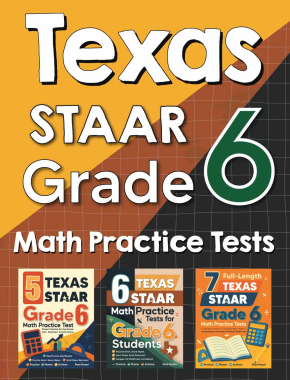
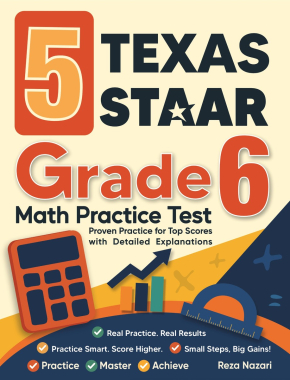
The Texas STAAR Grade 6 practice-test bundle groups the five-, six-, and seven-test collections. The Made Ridiculously Simple study guide is sold separately. For practice between worked examples and mixed tests, use the Online Center’s worksheets and topic quizzes.
Work through a lesson
 Original price was: $29.99.$19.99Current price is: $19.99.
Ask your child to explain why one step is needed.
Start mixing topics
Original price was: $26.99.$17.99Current price is: $17.99.Use the five-test book to practice shifting between skills.
Check an earlier skill
Original price was: $28.99.$18.99Current price is: $18.99.Choose a few questions and talk through a missed answer.
Try a fresh checkpoint
Original price was: $26.99.$19.99Current price is: $19.99.Revisit the study guide after a mixed set.
Texas sources and Effortless Math practice
Open the Texas Grade 6 Math Online Center to try Effortless Math practice. Follow up with a lesson or an available worksheet for the skill you want to revisit. You can also pick a short activity from the Effortless Math games collection.
For the state’s rules, see TEA’s math resources and calculator policy.
Common questions
Can my sixth grader use a calculator?
The regular Grade 6 STAAR math test is taken without a calculator. Ask the school about calculator accommodations for eligible students.
What does an mean?
Your child answered eight of the ten practice questions correctly. Choose a skill to practice next and use the official STAAR report for state performance information.
Which skill should we review first?
Pick one problem your child can almost do independently. Ask them to show the step where they hesitate, then work on a second problem with that step.
Leave a comment
Leave a comment for another parent. Which example helped your sixth grader understand a skill that had felt confusing? Share how you tried it together.

Related to This Article
More math articles
- Word Problems That Use Algebra: 15 Examples Solved Step by Step
- QTc Calculator (Bazett, Fridericia)
- Second Amendment
- Graph Paper Generator
- How to Solve Word Problems on Dividing Whole Numbers by Unit Fractions
- The Best Grade 6 ELA Practice Tests for Florida Students
- Full-Length ISEE Lower Level Math Practice Test-Answers and Explanations
- A Comprehensive Collection of FREE ACT Math Practice Tests
- The Best Grade 8 Math Book for Oklahoma Students
- Multiplying Fractions for 5th Grade: Numerators and Denominators


What people say about "How to Help Your Child Prepare for the Texas Grade 6 STAAR Math Test - Effortless Math"?
No one replied yet.