


How to Help Your Child Prepare for the Texas Grade 5 STAAR Math Test

Put a small box and a few identical cubes on the table. Ask your fifth grader how they could tell how many cubes fit without filling the whole box. They may count the cubes in one layer first. Once they see that each layer holds the same number, the volume formula has a reason behind it. That’s the kind of thinking this guide helps you practice together.
What to expect on the Grade 5 STAAR math test
Texas gives Grade 5 STAAR Math in spring 2027 during the statewide April 19–30 window. Check the Texas Education Agency calendar for the state dates and ask your school which day your child will test. This is the last Grade 5 STAAR administration. The Student Success Tool begins in the 2027–28 school year.
The test is usually online and measures skills in the Grade 5 Texas Essential Knowledge and Skills, or TEKS. Children may select, enter, or interact with answers on screen. STAAR scores help schools and families see where students need support. Use your child’s report alongside classwork and what the teacher sees day to day.
The state expects students to finish in three to four hours. Students who need longer can generally continue during the regular school day, up to seven hours of work. The standard test is taken without a calculator. Ask your school about testing tools, any approved supports, and what your child should do if they need a break.
Quick Texas Grade 5 STAAR Math Check
Try the ten questions with paper and pencil. Encourage a sketch when a question is hard to picture. The quiz shows one question at a time and provides a score and explanations after the tenth answer. Keep a note of any question your child wants to return to.
Question 1 of 10
Quiz results
Each correct answer earns 10 points. An 80/100, for example, means eight out of ten correct. Ask your child to explain one solution. If they missed any questions, choose one to work through together. Check the official STAAR report for the state performance level.
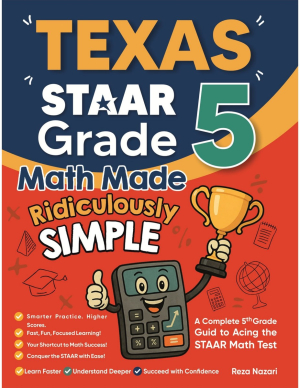
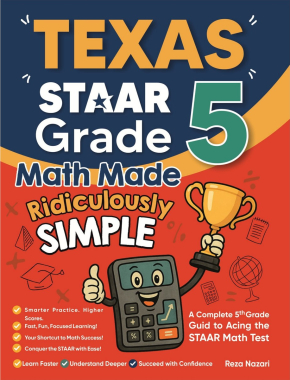
Help your child feel ready for STAAR math. Texas STAAR Grade 5 Math Made Ridiculously Simple walks through Grade 5 skills one step at a time. Open to a skill your child found tricky. Work through one example together and ask them to show you the first step on a new problem.
Answers and explanations
1. Which number is greatest?
Your answer:
Correct answer: B. 6.7
Write the numbers to three decimal places: 6.070, 6.700, 6.007, and 6.170. They all have 6 ones. The greatest digit in the tenths place is 7, so 6.7 is greatest.
2. Round 9.768 to the nearest hundredth.
Your answer:
Correct answer: D. 9.77
The 6 is in the hundredths place. The digit to its right is 8, so round up to 9.77.
3. What is the value of 24 ÷ (3 + 5) × 2?
Your answer:
Correct answer: A. 6
Add inside the parentheses to get 8. Then work left to right for division and multiplication: 24 ÷ 8 = 3, and 3 × 2 = 6.
4. A bike trail is 2.4 miles long. Jules rides the length of the trail one and a half times. How far does Jules ride?
Your answer:
Correct answer: C. 3.6 miles
One trip is 2.4 miles. Half a trip is 1.2 miles. Add them to get 3.6 miles.
5. A jug holds liter of water. Mei pours out liter. How much water is left?
Your answer:
Correct answer: B. liter
Rewrite both amounts in twentieths. Three fourths is , and two fifths is . Subtract to get liter.
6. A cook divides 3 pounds of dough into pieces that each weigh pound. How many pieces can the cook make?
Your answer:
Correct answer: D. 12
One pound gives four quarter-pound pieces. Three pounds give 3 × 4 = 12 pieces.
7. On a coordinate grid, Lia starts at the origin, moves 4 units right and then 2 units up. Where does she stop?
Your answer:
Correct answer: C. (4, 2)
The first number in the ordered pair tells you how far to move right. The second tells you how far to move up. Lia stops at (4, 2).
8. A rectangular storage bin is 4 feet long, 3 feet wide, and 5 feet high. What is its volume?
Your answer:
Correct answer: A. 60 cubic feet
One layer holds 4 × 3 = 12 one-foot cubes. Five layers hold 12 × 5 = 60 cubic feet.
9. The table shows how far students in a club walked. How many more students walked 1.5 miles than walked 1 mile?
| Distance | Number of students |
|---|---|
| 1 mile | 4 |
| 1.5 miles | 7 |
| 2 miles | 5 |
Your answer:
Correct answer: B. 3
Seven students walked 1.5 miles and four walked 1 mile. Subtract 4 from 7 to find the difference of 3 students.
10. Earning $45 this week, Ren plans to spend $18 on supplies and $12 on a game. How much money will Ren have left if those are the only expenses?
Your answer:
Correct answer: D. $15
Add the expenses first: $18 + $12 = $30. Then subtract $30 from $45 to get $15 left.
For a broader review, also try a problem about prime numbers, a decimal division problem, and a graph with several points.
If this quiz does not load, you can still take a Grade 5 math practice test in the Online Center.
Grade 5 math topics to review
TEA groups the assessed Grade 5 math skills into four reporting categories. Let your child move on when they can explain why their method works.
Numerical representations and relationships
Compare decimals through thousandths by lining up the decimal points. Practice rounding to tenths and hundredths. Ask your child to show why 17 is prime by listing its only whole-number factors, 1 and 17. When they see parentheses or brackets in an expression, ask which calculation those marks tell them to do first.
Computations and algebraic relationships
Estimate before multiplying or dividing decimals. If the answer for 3.1 × 1.9 is near 6, your child has a clue about where the decimal belongs. Use a drawing to show how many unit fractions fit in a whole number. For a multi-step story, have your child write an equation with a letter or box standing for what they need to find.
Geometry and measurement
Use unit cubes to show volume in layers and name the units. Compare area and perimeter when measuring a rectangular object, then talk about what changes when the object becomes a box. Plot a point in the first quadrant by moving right first and up second. Ask your child to explain why a square belongs to more than one shape group.
Data analysis and personal financial literacy
Use a dot plot, bar graph, or scatterplot to answer a question in a sentence. Try counting how many items meet a condition before comparing totals. For money, show a pretend budget and ask what changes when expenses exceed income. Talk about gross income as pay before deductions and net income as what remains after deductions.
| Layers filled | Total unit cubes |
|---|---|
| 1 | 6 |
| 2 | 12 |
| 3 | 18 |
Each layer has three cubes by two cubes, for six cubes. Three layers have eighteen.
Start at zero. Move three units right and two units up to find (3, 2).
Try it together: Build a box in layers
Place identical cubes in a rectangle three cubes long and two cubes wide. Ask your child how many cubes are in that layer. Build three layers, or sketch the other two if you have only six cubes. Have your child explain how the drawing predicts the total without counting each cube.
Show the answer
There are six cubes in a layer and three layers, so the model has 18 cubic units. Turn the model on its side and ask whether its volume changes. The cubes stay the same, so the volume stays 18 cubic units.
For something shorter, play the Multiplication Product Game and ask your child to explain one product they chose. The Texas Grade 5 Math Online Center also has short lessons and skill quizzes. Use a worksheet when one is available for the skill you are revisiting.
Choose a study timeline that fits
Use your child’s classwork and the teacher’s advice to choose where to start. These plans fit around regular schoolwork. If your child is tired, stop after one problem they can explain.
Six months of steady practice
If your child has six months before their school’s test date, use all five Grade 5 books. Start with the standalone guide and workbook in two short sessions a week. Let the five- and six-test books in the practice-test bundle supply mixed questions once your child knows the basics. Save unused questions in the seven-test book for a checkpoint near the end. If you are preparing now for April 2027, choose a shorter plan below and use the Online Center to pick a first topic.
Six weeks of focused review
Start with the study guide, workbook, and five-test book. Spend about 15 minutes a few times a week. Use classwork and a few Online Center questions to choose two skills. Work through one confusing step in the guide and then give your child a fresh workbook question to try alone. Near the end, choose a mixed set from the five-test book and leave time the following day to talk through the answers.
30 days to prepare
Use Made Ridiculously Simple and the seven-test book. Try an Online Center practice set or a short set from the book in the first week. Pick one or two topics for the middle weeks and work in sessions of about 15 minutes. In the final week, try an unused section of the seven-test book. If your child missed a question, work through it together and save a fresh problem for another day. If every answer was right, have them explain one solution before you put the book away.
One week for a calm review
Use the guide for one or two familiar examples and a few questions from the seven-test book or Online Center. Aim for two ten-minute sessions early in the week. Give your child time to explain one solution, then let them get back to their routine. Keep the last evening free.
Before, during, and after testing
In the weeks before
Ask the school for the test date and what to expect on the computer. If your child uses support in class, ask which tools or accommodations they can use during the test. At home, try the routine “Read the whole question, write a plan, and check the units” on one familiar problem.
On test day
Stick with a familiar morning if you can. A child who feels rushed can pause, look at one line at a time, and start with something they know. Remind them they can ask staff for help with the computer or testing directions. Find out how students should request a break at your school.
After each session and when results arrive
Ask what helped them get through a tricky question. Give them time to tell you what happened before asking about practice or scores. When the report comes in, talk about one next step with the teacher. It could be as simple as checking the decimal place with an estimate.
Books and practice resources
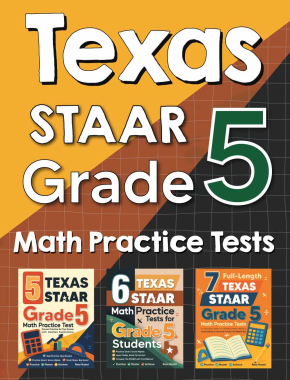
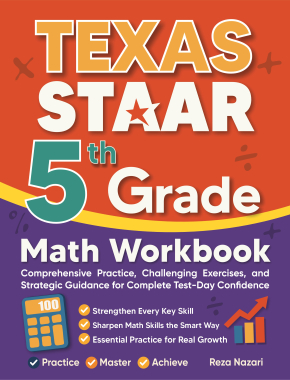
The Texas STAAR Grade 5 practice-test bundle includes the five-, six-, and seven-test practice books. The study guide and workbook are separate purchases. Reach for the guide when your child needs an explanation, the workbook when they need to try that same skill again, or a test collection when you want to mix topics.
Work through a lesson
 Original price was: $29.99.$19.99Current price is: $19.99.
Ask your child to explain why one step is needed.
Practice the same skill
Try a short workbook set while the example is fresh.
Start mixing topics
Original price was: $27.99.$17.99Current price is: $17.99.Use the five-test book to practice shifting between skills.
Check an earlier skill
Original price was: $28.99.$18.99Current price is: $18.99.Choose a few questions and talk through a missed answer.
Try a fresh checkpoint
Original price was: $29.99.$19.99Current price is: $19.99.Revisit the guide or workbook after a mixed set.
Texas sources and Effortless Math practice
To practice on screen, use the Texas Grade 5 Math Online Center. After a practice set, try the related lesson, quiz, or available printable worksheet. Browse Effortless Math games for short practice between longer sessions.
For official testing information, use the Texas Education Agency’s Grade 5 resources, calculator policy, and testing calendar.
Common questions
Can my fifth grader use a calculator on the regular STAAR math test?
The standard Grade 5 test is done without a calculator. Check with the school about a calculator accommodation if your child may qualify.
What does 80 out of 100 tell us?
Your child answered eight of these ten practice questions correctly. Find one answer they can talk you through and one they want to review. Use the state score report for your child’s official STAAR performance level.
Should we practice with a timer?
Start without a timer if your child is learning a method. If pacing is a concern, ask the teacher what to practice and use a short set so your child has time to check their work.
Leave a comment
Leave a comment for another Texas family. Which practice idea helped your fifth grader feel comfortable explaining their math? Share the example you tried and what made it work.

Related to This Article
More math articles
- Best Calculator for College Algebra
- Free Grade 6 English Worksheets for Arizona Students
- How to Support Grade 3 Reading at Home: 10 Strategies That Actually Work
- Application of the Bill of Rights to the states
- FREE SSAT Middle Level Math Practice Test
- How to Graph Quadratic Functions?
- FREE ATI TEAS 7 Math Practice Test
- Free Grade 8 English Worksheets for South Dakota Students
- Neighborhood of a Point: Definition, Examples and Limits
- 4th Grade SBAC Math Worksheets: 43 Free Printable PDFs


What people say about "How to Help Your Child Prepare for the Texas Grade 5 STAAR Math Test - Effortless Math"?
No one replied yet.