


How to Help Your Child Prepare for the Texas Grade 4 STAAR Math Test

Hand your fourth grader two strips of paper the same size. Ask them to show three fourths on one and five eighths on the other. If they say five eighths is bigger because five is bigger than three, ask them to line up the strips and take a closer look. Give them a moment to change their mind and say why. That kind of explanation is worth practicing for the Texas Grade 4 STAAR Math test.
What to expect on the Grade 4 STAAR math test
The Texas Education Agency’s 2026–27 calendar sets the statewide STAAR math window for April 19–30, 2027. Your school will tell you when fourth graders test. Spring 2027 is the final Grade 4 STAAR administration. The Student Success Tool replaces it beginning in the 2027–28 school year.
STAAR is usually taken online. It checks the math fourth graders are expected to learn in the Texas Essential Knowledge and Skills, or TEKS. Children may select an answer, type a number, or interact with something on screen. The results give families and schools one more piece of information to consider alongside classwork.
TEA expects students to finish in about three to four hours. Students who need more time can generally work until the end of the regular school day, up to seven working hours. Standard Grade 4 math is taken without a calculator, with exceptions for eligible students. Ask the school how your child can use any approved supports and what to do if they need a break.
Quick Texas Grade 4 STAAR Math Check
Try these ten questions with paper and pencil. Let your child draw, estimate, or work out a problem in a way that makes sense to them. The quiz opens one question at a time and shows the score and explanations after the final submission. It samples Grade 4 skills. Save a question number if you want to talk through it together later.
Question 1 of 10
Quiz results
An 80/100 means your child got eight of these ten practice questions right. Pick a problem your child found tricky and ask where they started. If every answer felt clear, invite them to teach you one solution.
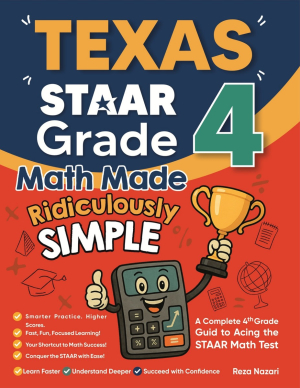
Help your child feel ready for STAAR math. Texas STAAR Grade 4 Math Made Ridiculously Simple walks through Grade 4 skills one step at a time. Open to a skill your child found tricky. Work through one example together and ask them to show you the first step on a new problem.
Answers and explanations
1. What is the value of the 7 in 8.73?
Your answer:
Correct answer: C. 0.7
The first place to the right of the decimal point is the tenths place. The 7 represents seven tenths, or 0.7.
2. Which fraction is equal to ?
Your answer:
Correct answer: A.
Divide the numerator and denominator by 2. Four sixths and two thirds name the same amount of a whole.
3. Sofia used of a roll of ribbon on Monday and on Tuesday. What fraction of the roll did she use altogether?
Your answer:
Correct answer: D.
Both amounts count tenths of the same roll. Add 3 tenths and 4 tenths to get 7 tenths, or .
4. A school orders 28 packs of folders. Each pack contains 16 folders. How many folders does the school order?
Your answer:
Correct answer: B. 448
Break 16 into 10 and 6. The school gets 28 × 10 = 280 folders and 28 × 6 = 168 more, for a total of 448.
5. The art teacher packs 157 tiles into boxes that hold 6 tiles each. How many full boxes can the teacher fill?
Your answer:
Correct answer: C. 26
Since 6 × 26 = 156, the teacher fills 26 boxes and has one tile left. The question asks for full boxes.
6. What is the cost of four signs if the sign shop charges the same amount for each sign?
| Number of signs | Cost |
|---|---|
| 2 | $14 |
| 3 | $21 |
| 5 | $35 |
Your answer:
Correct answer: A. $28
Two signs cost $14, so one costs $7. Four signs cost 4 × $7 = $28.
7. A 125-degree angle is divided into two smaller angles with no gap or overlap. One is 50 degrees. What is the measure of the other angle?
Your answer:
Correct answer: D. 75 degrees
The two angles add to 125 degrees. Subtract 50 degrees to find the other 75 degrees. Check that 50 + 75 = 125.
8. A rectangular mural covers 108 square feet. It is 12 feet wide. How tall is it?
Your answer:
Correct answer: B. 9 feet
Width times height gives the area. Since 12 × 9 = 108, the mural is 9 feet tall. The height is a length, measured in feet.
9. The table shows how many books students read. How many students read at least 2 books?
| Books read | Number of students |
|---|---|
| 1 | 3 |
| 2 | 5 |
| 3 | 4 |
Your answer:
Correct answer: C. 9
At least 2 means 2 or more. Add the 5 students who read 2 books and the 4 who read 3 books to get 9 students.
10. Scouts spend $19 on supplies and earn $47 selling the items they make. What is their profit?
Your answer:
Correct answer: D. $28
Profit is what remains after paying the cost. Subtract $19 from $47 to get $28.
For a broader review, also practice decimal addition and subtraction, measuring an angle with a protractor, and reading a stem-and-leaf plot.
If this quiz does not load, you can still take a Grade 4 math practice test in the Online Center.
Grade 4 math topics to review
TEA organizes the assessed Grade 4 math skills into four reporting categories. Start somewhere your child can explain an answer, then try a problem that makes them pause.
Numerical representations and relationships
Use a place-value chart to read large whole numbers and decimals to hundredths, compare them, and write them in expanded form. Ask which is greater, 0.7 or 0.65. Write 0.7 as 0.70 so your child can compare 70 hundredths with 65 hundredths. For fractions, use same-size wholes to show equivalence before comparing fractions with different denominators.
Computations and algebraic relationships
Practice taking apart a multi-digit multiplication problem and checking division with multiplication. For a word problem with a remainder, ask what the leftover amount means in the story. Grade 4 also includes adding and subtracting fractions with like denominators, decimal addition and subtraction, and using a table to see how one quantity changes with another.
Geometry and measurement
Look for parallel lines on a notebook and perpendicular lines at the corner of a page. Trace the corners of triangles to look for right, acute, or obtuse angles. When your child uses a protractor, have them predict whether the measure is above or below 90 degrees before reading a scale. Review area, perimeter, and conversions within one measurement system using a table of equivalent measures.
Data analysis and personal financial literacy
Have your child tell you what one dot means in a dot plot or what a leaf means in a stem-and-leaf plot. Then ask a question they can answer from the display. For money, compare a cost that stays fixed each month with one that changes. Try a pretend sale and ask what the seller keeps after paying for materials.
| Number | Tenths | Hundredths |
|---|---|---|
| 0.7 | 7 | 0 |
| 0.65 | 6 | 5 |
0.70 is 70 hundredths, which is greater than 65 hundredths.
Start at the shared ray and count each part once. Add 100 and 40 to get 140 degrees.
Try it together: Fold and compare
Cut two paper strips that are the same length and width. Mark four equal sections on one and eight equal sections on the other. Shade three sections of the first strip and five of the second. Line up the left ends. Ask your child to show which shaded length is greater and to explain how they know without measuring it with a ruler.
Show the answer
Split each fourth into two eighths. The first strip now shows six shaded eighths, and the second shows five. Three fourths is one eighth more than five eighths. Ask your child to point to the extra piece.
The Fraction Pizza Game gives children a chance to recognize fractions in a picture. After one round, ask your child what the whole pizza represents. The Texas Grade 4 Math Online Center has lessons, topic quizzes, and worksheets where available.
Choose a study timeline that fits
Use your child’s classwork and the teacher’s advice to choose where to start. These plans fit around regular schoolwork. If your child is tired, stop after one problem they can explain.
Six months of steady practice
If you have six months before your school’s test date, use all five Grade 4 books over that period. Families starting in late November 2026 have fewer than six months before the April test, so choose a shorter plan below. Start with the standalone study guide and workbook for 15 to 20 minutes twice a week. Try a few Online Center practice questions early to see which lessons deserve another look. In months three and four, bring in the five-test and six-test books from the practice-test bundle. Save the seven-test book for fresh questions in months five and six. Set aside a session to review mistakes and keep the last few days light.
Six weeks of focused review
Start with the study guide, workbook, and five-test book. Use three short sessions a week. In the first week, look at recent classwork and try a few Online Center questions. Spend the next three weeks on two priority skills. If a particular fraction idea is holding up the lesson, find another example in the guide and use fresh workbook problems to check it. In the last two weeks, choose unused mixed problems from the five-test book and review them on another day.
30 days to prepare
Use the study guide and seven-test book. In week one, try the Online Center test or a few unused questions from the book. For weeks two and three, set aside three 15-minute sessions a week. Pick a topic from the baseline, read a worked example together, and let your child attempt the next problem while you listen. Use an unused section of the seven-test book in week four. Talk through a missed step, then stop for the day.
One week for a calm review
Use the study guide and a few seven-test book questions or an Online Center set. Early in the week, try two 10-minute sessions on familiar topics. Ask your child to explain one thing they would check before submitting an answer. Leave the final evening free for regular routines and rest.
Before, during, and after testing
In the weeks before
Ask the teacher which two skills would be most helpful to revisit. If a support helps your child in class, ask how it works during testing. Use a short practice session to rehearse reading a question fully and deciding whether the answer should be a number, a measurement, or an amount of money.
On test day
Keep breakfast and arrival as familiar as possible. A useful reminder is “Read it once more and underline what it asks you to find.” If your child feels stuck, invite them to take one slow breath and work on the part they do understand. Ask the school which tools are available and how children can request help with the computer or directions.
After each session and when results arrive
Ask which problem felt familiar or which strategy helped. Listen before talking about the score. When results arrive, compare them with classwork and pick one goal with the teacher. For example, work on writing what a remainder means after solving a division problem.
Books and practice resources
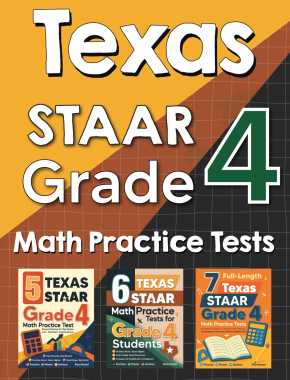
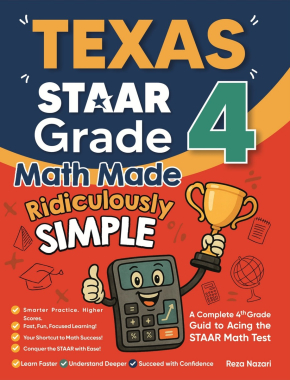
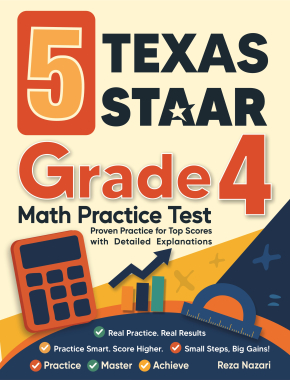
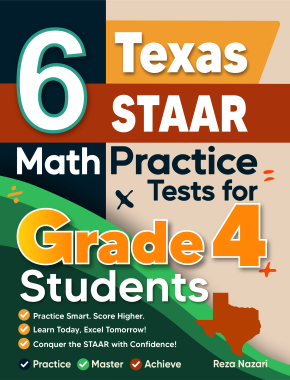
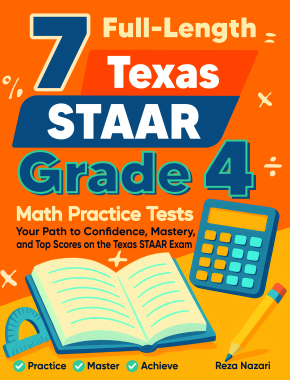
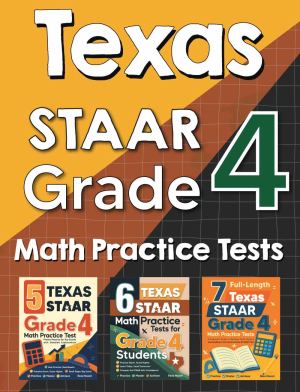
The Texas STAAR Grade 4 practice-test bundle contains the five-, six-, and seven-test collections. The study guide and workbook below are sold separately. Use the study guide when a concept needs explaining, the workbook when the concept needs repetition, and a practice-test volume when your child is ready to switch between skills.
Work through a lesson
 Original price was: $29.99.$19.99Current price is: $19.99.
Ask your child to explain why one step is needed.
Practice the same skill
Try a short workbook set while the example is fresh.
Start mixing topics
Original price was: $27.99.$17.99Current price is: $17.99.Use the five-test book to practice shifting between skills.
Check an earlier skill
Original price was: $28.99.$18.99Current price is: $18.99.Choose a few questions and talk through a missed answer.
Try a fresh checkpoint
Original price was: $29.99.$19.99Current price is: $19.99.Revisit the guide or workbook after a mixed set.

Texas sources and Effortless Math practice
The Texas Grade 4 Math Online Center has a free general Grade 4 practice test. Use the topic lessons, printable worksheets where available, and skill quizzes to follow up on a missed question. The Effortless Math games collection offers more short ways to work on individual skills.
For the state assessment itself, see the TEA Grade 4 STAAR math resources, calculator policy, and scheduling guidance. Confirm local details with your school.
Common questions
Can my fourth grader use a calculator on STAAR Math?
The usual Grade 4 rule is no calculator. The school can confirm whether your child qualifies for a calculator accommodation.
What does 80 out of 100 mean on this quiz?
Your child answered eight of the ten practice questions correctly. Ask about the reasoning on one missed question, then practice that skill in a new problem.
What can we do if the test is next week?
Pick one skill your child has already studied, spend ten minutes on it, and let your child end by showing you something they can do independently.
Leave a comment
Leave a comment for another Texas parent. What helped your fourth grader talk through a math problem they used to avoid? Share the example or the words you used so another family can try it.

Related to This Article
More math articles
- Free Grade 4 English Worksheets for Ohio Students
- Loyalty Programs, HUAC, McCarthyism and Civil Liberties
- How to Use Area Models to Factor Variable Expressions?
- Best Laptops for Teachers
- Demography, Population Size, Composition, and Distribution
- Illinois IAR Grade 8 Math Worksheets: 72 PDF Links
- What Kind of Math Is on the AFOQT Test?
- Grade 3 Math: Elapsed Time
- Types of Sequences and Series: Examples, Formulas & Practice
- 7th Grade Math: The Complete Parent’s Guide for 2027




What people say about "How to Help Your Child Prepare for the Texas Grade 4 STAAR Math Test - Effortless Math"?
No one replied yet.