Prepositions, Conjunctions, and Interjections
Nouns and verbs carry the meaning of a sentence, but three small parts of speech hold everything together: prepositions, conjunctions, and interjections. They are the connectors and the exclamations – the words that tell you where things are, how ideas relate, and (occasionally) how the writer feels about it all.
They are also the source of some very common test questions: choosing the right preposition, matching the right conjunction to the logic of a sentence, and punctuating an interjection. Here is everything you need, one family at a time.
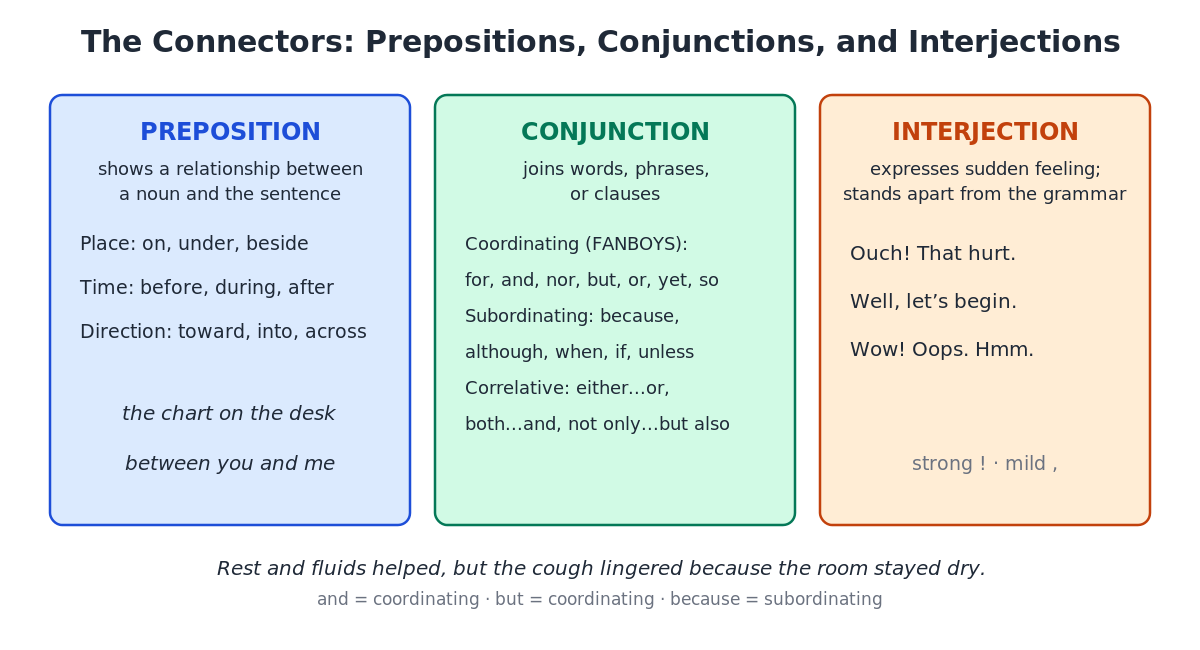
A preposition shows a relationship, usually of place, time, or direction, between a noun and the rest of the sentence: the chart on the desk. A conjunction joins words, phrases, or clauses: rest and fluids. An interjection expresses sudden feeling and stands apart grammatically: Ouch! Well, let’s begin.
What does a preposition do?
A preposition never works alone. It heads a prepositional phrase – preposition plus a noun or pronoun called its object:
- Place: The wheelchair is beside the bed.
- Time: Vitals are due before noon.
- Direction: She walked toward the elevator.
- Relationship: a letter from the surgeon, allergies except latex
Common prepositions include in, on, at, by, for, from, of, to, with, under, over, between, among, during, through, against, without. Two practical notes. First, the object of a preposition takes the object pronoun: between you and me, never between you and I. Second, a prepositional phrase never contains the subject of the sentence – in “The box of gloves is empty,” the subject is box, not gloves, which is why the verb is is.
What are the three kinds of conjunctions?
Coordinating conjunctions join equal partners – two nouns, two phrases, or two complete clauses. There are exactly seven, remembered as FANBOYS: for, and, nor, but, or, yet, so. When one joins two complete sentences, put a comma before it: The clinic was full, so we opened a second triage line.
Subordinating conjunctions attach a dependent clause to a main clause and spell out the logic – time, cause, contrast, condition: because, although, since, when, while, if, unless, until, after, before. “Although the fever dropped, the cough persisted.” A dependent clause first takes a comma after it; main clause first usually needs none: The cough persisted although the fever dropped.
Correlative conjunctions work in pairs: either…or, neither…nor, both…and, not only…but also. The rule they test most: keep the parts after each half parallel – The order is either oral or intravenous, not either is oral or intravenous.
| Coordinating | Subordinating | |
|---|---|---|
| Joins | Equal elements (clause + clause, noun + noun) | A dependent clause to a main clause |
| Members | Only seven: for, and, nor, but, or, yet, so | Many: because, although, when, if, since, unless… |
| Comma pattern | Comma before it when joining two complete sentences | Comma after the dependent clause when it comes first |
| Example | She knocked, but no one answered. | Because no one answered, she knocked again. |
What is an interjection, and how is it punctuated?
An interjection is a burst of feeling that sits outside the grammar of the sentence: oh, wow, ouch, hey, well, oops, hmm. It connects to nothing and modifies nothing – that independence is its defining feature.
- Strong emotion → exclamation point: Ouch! That splinter is deep.
- Mild emotion → comma: Well, the results are back.
In formal writing, interjections are rare; you will mostly meet them in dialogue and in questions that ask you to identify the part of speech. If a word expresses emotion and could be deleted without changing the sentence’s structure, it is an interjection.
Watch: A Short Video Lesson
Dynamic Earth Learning walks through this skill clearly in a few minutes. It is a helpful companion to the reading above:
How do I handle connector questions step by step?
- Label the small word. Does it head a noun phrase (preposition), join two elements (conjunction), or express emotion in isolation (interjection)?
- For prepositions, bracket the whole phrase and check the pronoun after it is an object form (with her, between you and me).
- For conjunctions, decide whether the joined parts are equal (coordinating) or one depends on the other (subordinating).
- Match the logic. Contrast wants but, yet, although; cause wants because, since, so; alternatives want or, either…or.
- Punctuate by pattern: comma before a FANBOYS word joining two sentences; comma after a leading dependent clause; comma or exclamation point after an interjection.
Practice: preposition, conjunction, or interjection?
- Identify the part of speech of the bolded word: The pharmacy is across the hall.
- Choose the conjunction that fits the logic: The patient was hungry, ____ the test required fasting. (and / but / so)
- Identify the bolded word: Oops, I grabbed the wrong chart.
- Fix the pronoun: Split the on-call shifts between Dr. Lee and I.
- Combine with a subordinating conjunction: The alarm sounded. Everyone stayed calm.
- Which sentence is punctuated correctly?
a) Although the lot was full she found a spot.
b) Although the lot was full, she found a spot.
Answers
- Preposition – across heads the phrase across the hall, showing place.
- but – the two clauses contrast, so a contrast conjunction fits.
- Interjection – it expresses feeling and stands apart from the sentence’s grammar.
- between Dr. Lee and me – the pronoun is the object of the preposition between.
- One good option: When the alarm sounded, everyone stayed calm. (Although or after also work with slightly different meanings.)
- b – a dependent clause that opens the sentence is followed by a comma.
Where this fits
Connectors are the bridge between single words and full sentence structure in our English and language usage study hub. Conjunctions are the raw material of simple, compound, complex, and compound-complex sentences, and choosing between them is the heart of coordination and subordination. Weak connections cause run-ons and comma splices, and their polished cousins appear in transitions and conjunctive adverbs.
Recommended Prep Books
These study guides and practice books help you keep building momentum as you prepare:

Related to This Article
More math articles
- Mootness
- Place Value (Through Hundred Thousands) for 4th Grade
- 5th Grade MAAP Math Worksheets: FREE & Printable
- Dollars and Sense: How to Tackle Money Word Problems with Confidence
- Digestive Organs and Absorption
- Acceleration and Free Fall
- Geometry Puzzle – Challenge 76
- 10 Most Common 4th Grade ACT Aspire Math Questions
- What is a Good ACCUPLACER Score?
- Math Skills for Business Careers: Percentages, Costs and Data



















What people say about "Prepositions, Conjunctions, and Interjections Guide"?
No one replied yet.