The Best Grade 2 Reading Worksheets for North Carolina Kids
The Best Grade 2 Reading Worksheets for North Carolina Kids: a free, printable set you can download and use right away, with answer keys, organized by topic so students can practice one skill at a time and teachers can assign exactly what a lesson needs.
54 free, printable reading and language PDFs aligned to North Carolina’s Grade 2 standards.
Here’s a small scene a lot of North Carolina parents will recognize. Your second grader is reading a story aloud, hits a word like adventure, slows down, sounds out each chunk, ad-ven-ture, and gets it. Then, two sentences later, they look up and ask why the character is scared. Two skills, one minute. That’s second grade in a nutshell.
This is the year reading gets steadier. First grade was all about decoding, pulling the words off the page. Second grade asks for more: read smoothly, and think about what the words mean. Kids dig into stories and true-fact books, they grow their vocabulary, they pick up grammar and punctuation, and they begin writing real pieces with a beginning, middle, and end. It’s a big jump, and it almost never happens evenly.
This page collects free Grade 2 English worksheets for North Carolina families and classrooms. Each one is a printable PDF, each one has an answer key, and there’s nothing to sign up for, no account, no email. Click a title, the file opens, you print it. Use one for homework, copy a few for a small group, or hand a stack to whoever’s helping with reading this week.
The worksheets follow the Grade 2 English Language Arts standards North Carolina has adopted, which means they cover the same skills your child’s teacher is working on right now, reading, decoding, writing, and the small rules that keep writing clear.
How this collection is laid out
The worksheets are grouped into eight strands, the natural sections of a second-grade English year: reading literature, reading nonfiction, the foundations of decoding, writing, speaking and listening, grammar, capitalization and punctuation, and vocabulary.
Each worksheet covers exactly one skill, and that’s a deliberate choice. A second grader who gives a quiet fifteen minutes to a single idea learns more than one who rushes through a packet of ten. Pick a strand, pick a page, and you’ve got a plan for the afternoon.
Reading: Literature
- Asking and Answering Questions About Stories, work the who, what, where, when, and why of a tale
- Central Message, Lesson, or Moral, find the lesson a story is quietly teaching
- How Characters Respond to Events, see how a character feels and acts when something happens
- Rhythm and Meaning in Stories, Poems, and Songs, hear how the beat of words adds to meaning
- The Structure of a Story, see how beginning, middle, and end fit together
- Points of View of Characters, notice that two characters can feel two different ways
- Using Illustrations to Understand Stories, read the picture, the sentences
- Comparing Two Versions of the Same Story, spot what changes when a tale gets retold
Reading: Nonfiction
- Asking and Answering Questions About Nonfiction, dig facts out of a true-information text
- Main Topic and Focus of Paragraphs, figure out what a paragraph is mostly about
- Connections Between Events, Ideas, and Steps, see how one fact or step leads to the next
- Nonfiction Vocabulary, meet the new words science and history books bring along
- Text Features, use headings, bold print, and captions to find your way
- The Author’s Main Purpose, ask why the writer wrote this in the first place
- How Images Help a Text, let pictures and diagrams do part of the explaining
- How Reasons Support the Author’s Points, match a writer’s reasons to the points they make
- Comparing Two Texts on the Same Topic, read two articles on one subject and notice the differences
Foundational Reading Skills
- Long and Short Vowels, tell the cap sound from the cape sound
- Vowel Teams, handle pairs like ea, oa, and ai
- Decoding Two-Syllable Words, break longer words into bite-sized pieces
- Prefixes and Suffixes, read word parts like un- and -ful
- Words with Tricky Spelling Patterns, tackle the spellings that don’t play fair
- Irregularly Spelled Words (Sight Words), lock in the words you just have to know by sight
- Reading Fluency: Accuracy, Rate, and Expression, read smoothly, at a comfy pace, with feeling
- Self-Correcting While You Read, notice when a sentence stops making sense and fix it
Writing
- Opinion Writing, say what you think and give a reason why
- Informative and Explanatory Writing, teach a reader something step by step
- Narrative Writing, tell a small story with a clear order
- Revising and Editing, make a first draft a little bit better
- Shared Research Projects, work together to learn about one topic
- Gathering Information to Answer a Question, find facts that answer a real question
Speaking and Listening
- Recounting Ideas from a Read-Aloud, retell what a read-aloud was about
- Asking and Answering Questions About a Speaker, listen closely and ask a good question back
- Telling a Story or Sharing an Experience, share something out loud so others can follow
Grammar
- Collective Nouns, words for groups, like team and flock
- Irregular Plural Nouns, the plurals that skip the -s, like mice and feet
- Reflexive Pronouns, using myself, yourself, and themselves
- Past Tense of Irregular Verbs, go becomes went, eat becomes ate
- Adjectives and Adverbs, words that describe things and actions
- Expanding and Rearranging Sentences, stretch and reshuffle a sentence to make it stronger
Capitalization, Punctuation, and Spelling
- Capitalizing Holidays, Products, and Place Names, give a capital letter to the names that earn one
- Commas in Greetings and Closings of Letters, put the comma in the right spot in a friendly letter
- Apostrophes: Contractions and Possessives, can’t and Sam’s dog, sorted out
- Spelling Patterns, spell new words by using patterns you already know
- Using Reference Materials to Check Spelling, look a word up instead of guessing
Vocabulary and Word Study
- Formal and Informal English, playground talk vs. Classroom talk
- Context Clues, use the rest of the sentence to figure out a new word
- Prefixes, how a beginning like re- changes a word
- Root Words and Word Endings, find the base word hiding inside a longer one
- Compound Words, two small words snapped into one, like sunflower
- Using Glossaries and Dictionaries, look up a word and trust what you find
- Real-Life Word Connections, link words to things kids see every day
- Shades of Meaning, the gap between warm, hot, and boiling
- Using Describing Words and New Vocabulary, put fresh, colorful words to work
Making these worksheets work for you
Here’s the honest catch with free worksheet pages: it’s easy to print a thick stack and call it a win. But a pile of paper on the counter doesn’t teach anyone anything. A simple routine is what changes that.
Print one worksheet at a time. Just one. Second graders have a short supply of focus, and you want it spent on a single skill rather than scattered across a fat packet.
Read the Quick Review box at the top together before the pencil moves. That box is the lesson, short on purpose. Read it out loud, talk through the example, then let your child take over.
Have your child work the page on their own, then check the answer key together, side by side. Don’t just stamp things right or wrong. When an answer misses, read the explanation as a pair and find out what tripped them up. That short conversation is where the real learning sticks.
When a skill comes out wobbly, don’t drill it into the ground tonight. Wait a week, then return with a different worksheet on the same idea. Spacing practice out beats cramming it together, every single time.
What about the EOG?
If you’re a North Carolina parent typing “Grade 2 English practice” into a search bar, the EOG, the End-of-Grade test, is probably tucked somewhere in your thoughts. Here’s the reassuring truth: the EOG in English Language Arts doesn’t start until third grade. Your second grader is not taking a state test this year.
That’s what makes second grade the foundation year, and it’s genuinely good news. It’s the season to build reading and writing skills calmly, with no clock running. Every page your child finishes now, decoding a two-syllable word, finding the main topic, landing the apostrophe correctly, becomes part of the base that holds up third grade. The kids who feel steady walking into the EOG later are nearly always the ones who built carefully in Grade 2. No cramming needed. Just regular, friendly practice.
Questions North Carolina parents ask
Are these worksheets aligned with what my child is learning at school? Yes. They’re built around the Grade 2 English Language Arts standards North Carolina has adopted, the same skill list classrooms across the state follow.
My second grader still reads in a slow, choppy way. Where should we start? Begin in the foundational strand. Vowel Teams and Reading Fluency are good first steps. As reading itself gets smoother, the thinking parts get easier.
How much should we do in a sitting? One worksheet. Most second graders finish a page in ten to fifteen minutes. If it’s dragging past twenty, stop, take a break, and call it done for the day.
My child is a confident reader already. What’s a good stretch? Try Comparing Two Versions of the Same Story and Using Describing Words and New Vocabulary. Both challenge a strong reader while staying right for the grade.
Will these help with writing too? Yes, the Writing strand covers opinion, informative, and narrative pieces, plus revising. Narrative Writing is a friendly place to start.
One last thing
If your child blows through a worksheet today and can’t remember it tomorrow, don’t sweat it. That’s just how seven-year-olds are wired. Finishing a stack was never the point. Practicing one skill, having one good conversation, and adding a little confidence was. Come back any time you need the next page. They’ll be here, free, for as long as you need them.
Ready for Grade 3 English? The North Carolina EOG Grade 3 English Bundle
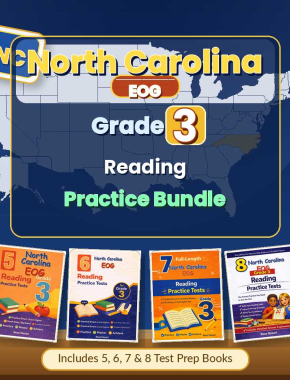
Second grade is the build-up year, and when your child is ready for what comes next, this bundle makes the jump to Grade 3 English feel easy. It includes four full practice-test books (5 + 6 + 7 + 8 tests) covering the Grade 3 reading, writing, and language skills just ahead, with explained answer keys and an instant PDF download.
Getting Ready for Grade 3 Math, Too? The North Carolina EOG Grade 3 Math Bundle
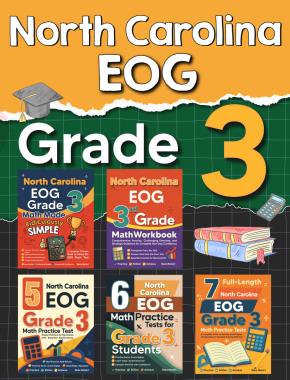
The same jump to Grade 3 happens in math. If your second grader could use a head start there as well, this North Carolina EOG Grade 3 Math bundle is the shortest path, workbook, study guide, and full practice tests in one instant download, with answer keys throughout.

Related to This Article
More math articles
- The Declaration of Independence
- MTEL Elementary Mathematics (68) Worksheets: FREE & Printable
- The Best Strategies For Successful Math Tutoring Online
- Fiscal Policy, Deficits, and Public Debt
- 5th Grade DCAS Math Worksheets: FREE & Printable
- PSAT 10 Math Practice: Official Tests and 48 Skill Questions
- AP Cybersecurity Evidence-Based Responses: Write a Clear Recommendation (2027 Prep)
- The Best Grade 7 ELA Practice Tests for Connecticut Students
- A payoff matrix must be read player by player
- The Best Grade 3 Math Book for Kansas Students




What people say about "North Carolina Grade 2 English Worksheets: Free PDFs"?
No one replied yet.