Free Grade 3 English Worksheets for Indiana Students

Here’s a true thing about third grade in Indiana: by November, the homework folder coming home each Friday includes more reading than math. Books with chapters. Articles about how seeds travel. Short writing prompts that ask your kid not just to answer, but to *explain*. It’s a lot, all at once, and it lands on families who haven’t had to think hard about reading instruction since kindergarten.
This page is for that, a stack of free PDFs covering the Grade 3 ELA skills the Indiana Academic Standards spell out, the same skills ILEARN turns into questions in the spring. Each worksheet is one skill, short enough to actually finish, with an answer key written to teach, not just to grade.
No signup. No paywall. No “subscribe for premium.” Click a title, the PDF opens in a new tab, and you can print it, save it, or just look at it on screen.
What’s on this page
A grouped list of single-skill worksheets that map to the Indiana Academic Standards for Grade 3 English/Language Arts. Reading literature, reading nonfiction, the foundational stuff like decoding multisyllable words, writing tasks, grammar, spelling, and the vocabulary work that ties it all together.
Two ground rules before you scroll:
- Pick fewer worksheets than you think you should
- Read the Quick Review at the top *together* before the pencil comes out
That’s about it.
Reading: Literature
- Text Evidence in Stories, [RL.3.1] find proof in the story for what you say about it
- Central Message, Lesson, or Moral, [RL.3.2] figure out the lesson a story teaches
- Describing Characters in a Story, [RL.3.3] traits, feelings, motivations
- Literal and Nonliteral Language, [RL.3.4] the difference between what words say and what they mean
- Parts of Stories, Dramas, and Poems, [RL.3.5] chapters, scenes, stanzas
- Point of View in Stories, [RL.3.6] who’s telling the story
- Illustrations in Stories, [RL.3.7] reading the pictures alongside the words
- Comparing Stories, [RL.3.9] two stories side by side
Reading: Nonfiction
- Text Evidence in Nonfiction, [RI.3.1] back up answers with the article itself
- Main Idea and Key Details, [RI.3.2] what the passage is mostly about, and the facts that support it
- Sequence, Steps, and Cause & Effect, [RI.3.3] first, next, because, so
- Vocabulary in Nonfiction, [RI.3.4] the topic-specific words in science and social-studies texts
- Text Features in Nonfiction, [RI.3.5] headings, sidebars, captions
- Author’s Point of View in Nonfiction, [RI.3.6] what the writer thinks vs. Plain facts
- Using Maps, Photos, and Diagrams, [RI.3.7] the picture is doing some of the work
- Logical Connections in Nonfiction, [RI.3.8] how paragraphs connect
- Comparing Two Texts on the Same Topic, [RI.3.9] two articles, same topic, different angles
Foundational Reading Skills
- Prefixes and Suffixes, [RF.3.3a] word parts that change meaning
- Words with Latin Suffixes, [RF.3.3b] -tion, -sion, -able
- Decoding Multisyllable Words, [RF.3.3c] break the long ones into pieces
- Irregularly Spelled Words (Sight Words), [RF.3.3d] the tricky words that just have to be memorized
- Reading Fluency: Rate and Expression, [RF.3.4b] read aloud so it sounds like talking
- Self-Correcting While You Read, [RF.3.4c] fix it when the sentence stops making sense
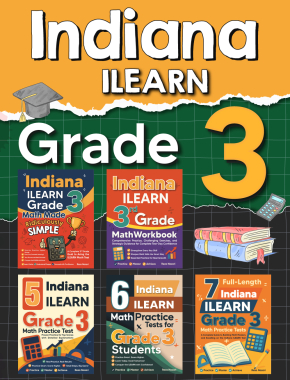
Working on Math Too? Try the Indiana ILEARN Grade 3 Math Bundle
Many third graders are getting ready for the ILEARN in both subjects. If your child also needs math practice that matches the same standards, this companion bundle is the shortest path, workbook, study guide, and full practice tests in one download.
Writing
- Opinion Writing, [W.3.1] say what you think and back it up
- Informative / Explanatory Writing, [W.3.2] teach someone something they didn’t know
- Narrative Writing, [W.3.3] tell a story in order, with details
- Organizing Writing for Task and Purpose, [W.3.4] different writing for different jobs
- Editing and Revising, [W.3.5] make a draft better, one pass at a time
- Short Research Project, [W.3.7] ask a question, find some answers
- Gathering Information and Taking Notes, [W.3.8] write down what you find, not everything you see
Listening and Speaking
- Listening for Main Idea (Read-Aloud), what was that mostly about?
- Asking Questions of a Speaker, what to ask after a presentation
- Reporting on a Topic, telling a class about something, clearly
Grammar
- Parts of Speech, nouns, pronouns, verbs, adjectives, adverbs
- Regular and Irregular Plural Nouns, [L.3.1b] tables; geese; children
- Abstract Nouns, [L.3.1c] words for ideas and feelings
- Regular and Irregular Verbs, [L.3.1d] walked vs. Went
- Simple Verb Tenses, past, present, future
- Subject, Verb and Pronoun, Antecedent Agreement, [L.3.1f] the dog barks; the dogs bark
- Comparative and Superlative Adjectives and Adverbs, [L.3.1g] fast, faster, fastest
- Coordinating and Subordinating Conjunctions, [L.3.1h] and, but, because, when
- Simple, Compound, and Complex Sentences, [L.3.1i] all three sentence types
Capitalization, Punctuation, and Spelling
- Capitalizing Words in Titles, [L.3.2a] title-case rules
- Commas in Addresses and Dates, [L.3.2b] where the commas go
- Commas and Quotation Marks in Dialogue, [L.3.2c] punctuating what characters say
- Possessives, [L.3.2d] showing that something belongs
- Conventional Spelling, common words you’ll spell often
- Spelling Patterns and Generalizations, [L.3.2f] the rules behind the spellings
- Using Reference Materials to Check Spelling, [L.3.2g] look it up to confirm
Vocabulary and Word Study
- Word Choice for Effect, [L.3.3a] pick vivid words for a stronger sentence
- Spoken vs. Written English, [L.3.3b] casual vs. Formal
- Context Clues, [L.3.4a] use surrounding words to find meaning
- Affixes for Vocabulary, [L.3.4b] use word parts to figure out meaning
- Root Words, [L.3.4c] the base word inside a longer one
- Using Glossaries and Beginning Dictionaries, [L.3.4d] look up words to confirm meaning
- Figurative Language: Similes, Metaphors, and Idioms, [L.3.5a] read figurative phrases with confidence
- Real-Life Word Connections, [L.3.5b] connect words to real situations
- Shades of Meaning, [L.3.5c] tell apart words with similar meanings
- Academic and Domain-Specific Vocabulary, [L.3.6] Grade 3 academic words
Getting actual mileage out of them
There’s a version of “doing worksheets” that mostly involves the parent reading the question, the kid guessing, and the parent saying “correct.” Avoid that version. Better to do half a worksheet honestly than a full one with a translator.
Sit beside them, not across. Across the table feels like a test. Beside them on the couch with the PDF on your lap and a clipboard on theirs feels like reading together.
When a question stumps your kid, don’t answer it. Re-read the part of the passage that holds the clue. Then ask them what *they* think. Most of the time the answer’s already in their head. They just needed permission to slow down and find it.
Use the answer key as a teaching tool, not a verdict. After they’ve answered, flip to the last page together. The explanations are written so the student can follow them. The kid who reads their own answer key is the kid who internalizes the lesson.
Don’t drill the same worksheet twice. If they got 60% the first time, switch to a different worksheet on the same skill in a week. Variety with spacing beats repetition with pressure.
A note about ILEARN
ILEARN, the Indiana Learning Evaluation Assessment Readiness Network, gives a Grade 3 ELA snapshot in the spring. A lot of Indiana parents land here in February or March looking for “test prep.” The honest answer: this isn’t that. There’s no cram pack for reading. There’s only the slow buildup of fluency, vocabulary, and the habit of actually thinking about what you just read.
The good news is that the skills ILEARN measures are also the skills your kid’s teacher is already teaching. If you want a place to start, Main Idea and Key Details is the single highest-use worksheet on this whole page. Context Clues is the second.
Questions parents in Indiana ask
Do these match the Indiana Academic Standards? Yes. Every worksheet here targets a specific Grade 3 skill from Indiana’s ELA standards.
Will they help on ILEARN? Indirectly, yes, by building the underlying skills. Don’t think of them as test prep; think of them as “the work that makes the test feel familiar.”
Can I use these at home and have the teacher reinforce? That’s the ideal pattern. Pick the same skill the teacher mentioned in the most recent report card or progress note, and use the related worksheet for the next week’s practice.
My kid hates writing. Start with Narrative Writing, telling a story is the easiest place to begin because it feels like talking. Save Opinion and Informative for after they trust the page.
My kid reads ahead of grade level. Try Comparing Two Texts on the Same Topic and Figurative Language. They reward careful, layered reading without becoming “older” content.
Last note
You’re going to print one of these and your kid is going to push back. That’s the deal in third grade. Try a different one tomorrow. Try a shorter one. Try the same one in two weeks when the resistance has cooled. None of this needs to be perfect to be working. Come back when you need the next one.
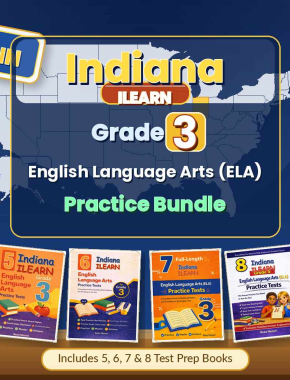
Best Bundle to Ace the Indiana ILEARN Grade 3 ELA
Looking for the best resource to help your kid ace the Indiana ILEARN? Try this bundle, four full practice-test books (5 + 6 + 7 + 8 tests) covering the same Grade 3 reading, writing, and language skills your child is already learning. Instant PDF download, answer keys included.

Related to This Article
More math articles
- ISEE Middle Level Math Formulas
- How to Find the Unit Price of a Product?
- Ratio Tables
- Free Grade 3 English Worksheets for Oregon Students
- 4th Grade SC Ready Math Worksheets: FREE & Printable
- Marginal product pulls average product
- Percent Change Calculator (Increase, Decrease & Percent Error)
- What Level of Maths Is Tested on the PSAT/NMSQT®?
- Essential Scientific Vocabulary
- How is the ASVAB Test Scored?








What people say about "Free Grade 3 English Worksheets for Indiana"?
No one replied yet.