How Do You Prove Angles Are Congruent?
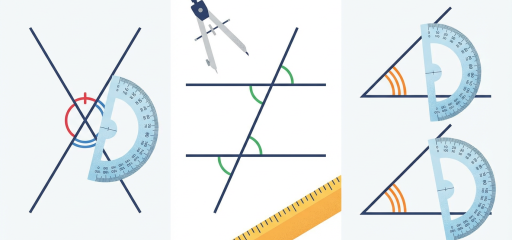
Proving that angles are congruent is a core skill in geometry. Two angles are congruent when they have the same measure (in degrees). Unlike measuring with a protractor, a proof uses definitions, postulates, and theorems to show that angles must be equal. Here’s how to prove angles are congruent.
The Absolute Best Book to Ace Your Math Test
Our Featured Products
Key Theorems for Proving Angle Congruence
1. Vertical Angles Theorem
When two lines intersect, the angles opposite each other (vertical angles) are congruent. If lines AB and CD intersect at E, then ∠AEC ≅ ∠BED and ∠AED ≅ ∠BEC. No measurement needed—it follows from the definition of vertical angles. For more geometry practice, visit our math worksheets.
2. Corresponding Angles (Parallel Lines)
If a transversal crosses two parallel lines, corresponding angles are congruent. Same position (e.g., both top-left) means equal measure. This is one of the most useful tools for proofs involving parallel lines.
3. Alternate Interior Angles
When a transversal crosses parallel lines, alternate interior angles (on opposite sides of the transversal, inside the parallels) are congruent. Same for alternate exterior angles.
4. Angle Bisector
If a ray bisects an angle, it creates two congruent angles. Definition of bisector.
5. Congruent Triangles Imply Congruent Angles
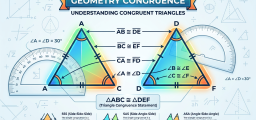
If two triangles are congruent (by SSS, SAS, ASA, AAS, or HL), then corresponding angles are congruent. So proving triangle congruence can prove angle congruence. Explore Effortless Math for more.
Proof Structure
Start with given information. List what you know (parallel lines, equal sides, etc.). State the theorem or definition that applies. Conclude that the angles are congruent. Be explicit about which theorem you use.
Frequently Asked Questions
Recommended Resources
What’s the difference between equal and congruent angles?
For angles, “congruent” and “equal” are used interchangeably—both mean the same measure. “Congruent” is the formal geometric term.
Can you prove angles congruent without parallel lines?
Yes. Vertical angles, angles in congruent triangles, and angles formed by bisectors can all be proven congruent without parallel lines.

Related to This Article
More math articles
- How to Find Powers and Roots of Complex Numbers
- How to Factor the Difference between Two Perfect Squares?
- How to Prepare for the OAR Math Test?
- Decimals in Action: Completing Addition and Subtraction Sentences
- Top 10 SIFT Math Practice Questions
- Grade 3 Vocabulary and Fluency: Build Word Power Without the Stress
- Top 10 SHSAT Math Practice Questions
- Finding Derivatives Made Easy! Product Rule of Differentiation
- Algebra Puzzle – Critical Thinking 14
- Full-Length 8th Grade Common Core Math Practice Test



What people say about "How Do You Prove Angles Are Congruent? - Effortless Math: We Help Students Learn to LOVE Mathematics"?
No one replied yet.