Free Grade 3 English Worksheets Aligned to Common Core (CCSS)
If you’ve spent any time looking at your kid’s school papers, you’ve probably seen a code in the corner: something like *RL.3.1* or *L.3.2*. Those little tags are Common Core standard codes. They’re the shorthand teachers use to point at exactly which skill a worksheet is practicing. *RL.3.1* is “ask and answer questions to demonstrate understanding of a story, referring explicitly to the text.” Translated into kid-speak: when someone asks a question about the story, show them where in the story you found the answer.
The worksheets on this page are organized around those codes, the full Grade 3 list from the Common Core State Standards for English Language Arts. There’s a worksheet for each of the standards that translates cleanly into a single-page practice activity. The PDFs are free, no signup is required, and the answer keys explain the reasoning behind each correct answer, which is honestly the part of a worksheet that does the most teaching.
This page is a little different from a state hub page. It isn’t built for a specific state’s test. It’s for parents, teachers, tutors, and homeschoolers anywhere who want practice that’s plainly aligned to Common Core, wherever you live and whatever your local assessment looks like.
A quick primer on what Common Core actually is
The Common Core State Standards came out of a multi-state effort that wrapped up in 2010. The idea was simple: a third grader in Iowa should be working toward roughly the same reading and writing milestones as a third grader in Maryland, and parents who move between states shouldn’t find that schools are teaching entirely different curricula.
More than 40 states have adopted Common Core in some form, sometimes with their own state name slapped on top. California calls them California Common Core State Standards. New York adopted them as New York Next Generation Learning Standards (a revised version). Most states just call them their state standards now, but the bones are the same.
A handful of states never adopted CCSS or have since stepped away: Texas (uses TEKS), Virginia (uses SOL), Florida (uses B.E.S.T. Standards), Oklahoma, Nebraska, and Alaska all use their own frameworks. There’s a lot of overlap, third-grade reading is third-grade reading, but if you live in one of those states, you might want to check that page on this site instead for the version mapped to your state’s labels.
For everyone else, this page is a clean Common Core slate.
What Grade 3 ELA standards cover
Common Core breaks Grade 3 English into four broad strands: Reading (split into Literature, Informational Text, and Foundational Skills), Writing, Speaking and Listening, and Language. Each strand has anchor standards and grade-specific substandards.
In real-classroom terms, that means a third grader is supposed to be:
- Reading short stories *and* nonfiction articles independently
- Finding the main idea and supporting details
- Backing up answers with evidence from the text
- Writing in three genres, opinion, informative, and narrative
- Editing and revising a draft, not just turning in a first try
- Speaking up in discussions and listening carefully to others
- Using grammar and conventions that hold up in writing
- Building academic vocabulary that they can actually use
The worksheets below are organized along those same lines. Each PDF is one standard, focused.
Reading: Literature
- Text Evidence in Stories, find proof in the story for what you say about it
- Central Message, Lesson, or Moral, figure out the lesson a story teaches
- Describing Characters in a Story, traits, feelings, motivations
- Literal and Nonliteral Language, the difference between what words say and what they mean
- Parts of Stories, Dramas, and Poems, chapters, scenes, stanzas
- Point of View in Stories, who’s telling the story
- Illustrations in Stories, reading the pictures alongside the words
- Comparing Stories, two stories side by side
Reading: Nonfiction
- Text Evidence in Nonfiction, back up answers with the article itself
- Main Idea and Key Details, what the passage is mostly about, and the facts that support it
- Sequence, Steps, and Cause & Effect, first, next, because, so
- Vocabulary in Nonfiction, the topic-specific words in science and social-studies texts
- Text Features in Nonfiction, headings, sidebars, captions
- Author’s Point of View in Nonfiction, what the writer thinks vs. Plain facts
- Using Maps, Photos, and Diagrams, the picture is doing some of the work
- Logical Connections in Nonfiction, how paragraphs connect
- Comparing Two Texts on the Same Topic, two articles, same topic, different angles
Foundational Reading Skills
- Prefixes and Suffixes, word parts that change meaning
- Words with Latin Suffixes, -tion, -sion, -able
- Decoding Multisyllable Words, break the long ones into pieces
- Irregularly Spelled Words (Sight Words), the tricky words that just have to be memorized
- Reading Fluency: Rate and Expression, read aloud so it sounds like talking
- Self-Correcting While You Read, fix it when the sentence stops making sense
Writing
- Opinion Writing, say what you think and back it up
- Informative/Explanatory Writing, teach someone something they didn’t know
- Narrative Writing, tell a story in order, with details
- Organizing Writing for Task and Purpose, different writing for different jobs
- Editing and Revising, make a draft better, one pass at a time
- Short Research Project, ask a question, find some answers
- Gathering Information and Taking Notes, write down what you find, not everything you see
Speaking and Listening
- Listening for Main Idea (Read-Aloud), what was that mostly about?
- Asking Questions of a Speaker, what to ask after a presentation
- Reporting on a Topic, telling a class about something, clearly
Language: Grammar
- Parts of Speech, nouns, pronouns, verbs, adjectives, adverbs
- Regular and Irregular Plural Nouns, tables; geese; children
- Abstract Nouns, words for ideas and feelings
- Regular and Irregular Verbs, walked vs. Went
- Simple Verb Tenses, past, present, future
- Subject, Verb and Pronoun, Antecedent Agreement, the dog barks; the dogs bark
- Comparative and Superlative Adjectives and Adverbs, fast, faster, fastest
- Coordinating and Subordinating Conjunctions, and, but, because, when
- Simple, Compound, and Complex Sentences, all three sentence types
Language: Conventions
- Capitalizing Words in Titles, title-case rules
- Commas in Addresses and Dates, where the commas go
- Commas and Quotation Marks in Dialogue, punctuating what characters say
- Possessives, showing that something belongs
- Conventional Spelling, common words you’ll spell often
- Spelling Patterns and Generalizations, the rules behind the spellings
- Using Reference Materials to Check Spelling, look it up to confirm
Language: Vocabulary
- Word Choice for Effect, pick vivid words for a stronger sentence
- Spoken vs. Written English, casual vs. Formal
- Context Clues, use surrounding words to find meaning
- Affixes for Vocabulary, use word parts to figure out meaning
- Root Words, the base word inside a longer one
- Using Glossaries and Beginning Dictionaries, look up words to confirm meaning
- Figurative Language: Similes, Metaphors, and Idioms, read figurative phrases with confidence
- Real-Life Word Connections, connect words to real situations
- Shades of Meaning, tell apart words with similar meanings
- Academic and Domain-Specific Vocabulary, Grade 3 academic words
A practical question: does “Common Core aligned” actually mean anything?
Honest answer: it depends. The phrase gets used loosely. Some publishers slap it on a workbook because the topics roughly overlap with the standards. That’s not really alignment. That’s a coincidence.
Alignment that matters means one of two things. Either (a) the worksheet practices a *specific* CCSS standard end-to-end, or (b) the worksheet’s questions ask kids to *do the cognitive work* that standard requires. CCSS isn’t a topic list. It’s a list of intellectual moves. “Identify the main idea” is a different cognitive move from “underline what the passage is about,” even if they sound similar.
The worksheets on this page are built around the second kind of alignment. Each one asks for the same thinking the standard asks for, with answer keys that explain the reasoning so the kid sees how the answer gets there.
How to use these well
A few habits that pay off, learned over many years of watching parents try to “do worksheets” with tired third graders.
Start at the top of the PDF. Each one opens with a small lesson and example. Read it together, even if it feels too simple. That two-minute warm-up is half the worksheet’s value.
Pick one skill at a time. Trying to power through five standards in one sitting almost always backfires. One page, one conversation about the wrong answers, done.
Use the answer key as your teaching co-pilot. The explanations are written in plain language for a kid to read. Walk through them together when something was missed.
Space the practice. A skill that gave your kid trouble Monday is worth revisiting next Monday, not Tuesday. Spaced retrieval is the closest thing learning research has to a free lunch.
High-use standards for Grade 3
If you only had time for a handful of the 59 standards in the list, which would matter most? Speaking from a decade of watching third graders, these three carry the most weight downstream:
1. RI.3.2, Main Idea and Key Details. Reading informational text well is the skill that opens up science and social studies in the upper grades.
2. L.3.4, Context Clues. Kids who can figure out a word from the words around it read independently in a way that everyone else can’t.
3. W.3.5, Editing and Revising. Drafting is easier than fixing. Kids who can re-read their own work and improve it become noticeably stronger writers by fifth grade.
Common questions
Will these worksheets help my kid on our state test? If your state adopted Common Core (or a renamed version), yes. These are the same skills your test measures. Smarter Balanced, PARCC, NWEA MAP, AzM2, Milestones, M-STEP, MCAS, and a dozen other state assessments draw from the CCSS skill list at Grade 3.
My state has its own standards. Are these still useful? Mostly yes. Texas, Virginia, Florida, Oklahoma, Nebraska, and Alaska use their own frameworks, but the overlap with CCSS is real, typically 80% or more at Grade 3. If you’re in one of those states, look for the state-specific page on this site for an exact match.
Can homeschoolers use these as a curriculum? As the only ELA you do, probably not. There’s no story sequence or grammar progression baked in. But as a daily practice spine alongside a curriculum or a reading program, absolutely.
How long should a third grader spend on one worksheet? Plan on twelve to twenty minutes, including the talk-through of the answer key. If it’s stretching past thirty, the page is too hard or the kid is too tired.
Closing note
Common Core gets argued about online a lot. In the classroom, it’s just the map of skills a Grade 3 teacher is helping a kid build over a school year. Whether you love the standards or roll your eyes at them, the practice that matches them is what eventually shows up in your kid’s reading and writing. Print a worksheet tonight, talk it through, and come back for another when you’re ready. The list is here whenever you need it.
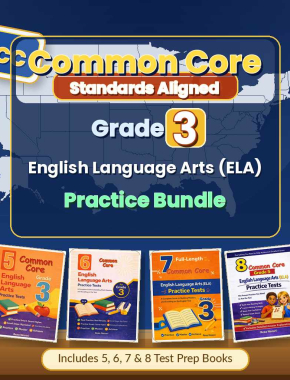
Best Bundle to Ace the Common Core CCSS Grade 3 ELA
Looking for the best resource to help your kid ace the Common Core CCSS? Try this bundle, four full practice-test books (5 + 6 + 7 + 8 tests) covering the same Grade 3 reading, writing, and language skills your child is already learning. Instant PDF download, answer keys included.

Related to This Article
More math articles
- Best Calculators For 10th Grade Students
- Oklahoma OSTP Algebra 1 Free Worksheets: 60 Free PDF Worksheets Aligned to OSTP Algebra 1
- 5th Grade SOL Math Worksheets: FREE & Printable
- 8th Grade STAAR Math FREE Sample Practice Questions
- Cell Cycle Checkpoints: G1, G2 and Spindle Control
- AP Business with Personal Finance: Break-Even Analysis Step by Step (2027 Prep)
- Free Grade 4 English Worksheets for Alabama Students
- CBEST Math FREE Sample Practice Questions
- How to Decode Data Types
- How to Solve Exponential Equations?





What people say about "Free Grade 3 English Worksheets (Common Core)"?
No one replied yet.