Free Grade 6 English Worksheets for Arkansas Students
A parent emailed her daughter’s Arkansas middle school teacher in November, two months into sixth grade, with one sentence: “She used to love reading and now she hates English class, what happened?” The teacher’s reply was honest and useful. Nothing dramatic had happened. Reading had simply gotten harder. The passages were longer. The questions wanted evidence. Writing was no longer “answer the prompt” but “build a paragraph with a claim, two reasons, and a quote.” The daughter had not lost a love of reading. She had run into the wall every sixth grader runs into around October, and her old habits had stopped being enough.
That is the version of the story families across Arkansas live every fall. The gap between where a student finished fifth grade and where Grade 6 expects them to be is not a chasm. It is a series of small, specific skills that have to be practiced. Inference. Central idea. Word meaning in context. Sentence-level evidence. Organized paragraphs. Tools, not vibes.
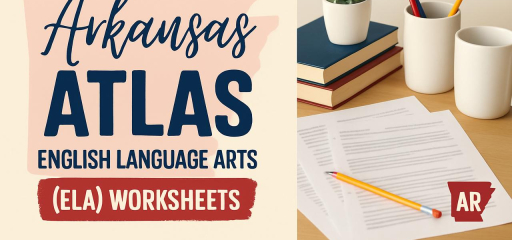
The worksheets on this page are organized around those skills. Each one targets a single standard from the Arkansas K-12 English Language Arts Standards, and each one is free. No account creation, no email collection, no upsell on the way to the PDF.
What’s on this page
Forty-six single-skill PDFs. The first page is always a short Quick Review, small enough that a sixth grader can read it on their own. The middle pages are practice items at grade level. The last page is an answer key with explanations written in plain enough language for the student to use without a translator parent.
The point of organizing them this way is to make the choice easy. If your kid is struggling with figurative language, you do not need to read past a section heading. Click, print, sit down.
Reading: Literature
- Citing Textual Evidence and Drawing Inferences, [RL.6.1] name the inference and quote the line that proves it
- Theme and Objective Summary, [RL.6.2] the whole story’s lesson, written in a real sentence
- Plot, Episodes, and Character Change, [RL.6.3] small events that bend a character over time
- Figurative Language, Connotation, and Tone, [RL.6.4] the feeling on top of the dictionary meaning
- Structure: How a Scene or Stanza Builds the Whole, [RL.6.5] every chunk has a job
- Developing the Narrator’s Point of View, [RL.6.6] whose eyes you are seeing through and how the writer holds you there
- Reading vs. Watching: Comparing Versions, [RL.6.7] what print does that screens cannot
- Comparing Stories Across Forms and Genres, [RL.6.9] same idea, different forms
Reading: Informational Text
- Citing Evidence and Drawing Inferences in Nonfiction, [RI.6.1] careful conclusions, sentence-anchored
- Central Idea and Objective Summary in Nonfiction, [RI.6.2] the article’s whole point, free of a single detail
- How Ideas and Events Are Developed, [RI.6.3] introduce, elaborate, illustrate
- Word Meaning in Nonfiction: Figurative, Connotative, Technical, [RI.6.4] three jobs a single word can hold
- Text Structure: How Sections Fit Together, [RI.6.5] cause-effect, problem-solution, comparison
- Author’s Point of View and Purpose, [RI.6.6] angle and reason for writing
- Integrating Information from Text, Visuals, and Data, [RI.6.7] words plus chart plus image, read as one
- Evaluating Arguments and Claims, [RI.6.8] claim and support, then judge the support
- Comparing Two Authors on the Same Topic, [RI.6.9] different writers, same subject, different choices
Writing
- Argument Writing: Claim, Reasons, Evidence, [W.6.1] defend a position with reasons and quotes
- Informative and Explanatory Writing, [W.6.2] teach a reader something clearly and in order
- Narrative Writing, [W.6.3] hook, develop, resolve
- Clear Writing for Task, Purpose, and Audience, [W.6.4] write for whoever has to read it
- Planning, Revising, and Editing, [W.6.5] drafts get better in passes
- Short Research Projects, [W.6.7] focused question, several sources, tight write-up
- Gathering, Evaluating, and Citing Sources, [W.6.8] which sources to trust and how to credit them
Speaking & Listening
- Collaborative Discussions, [SL.6.1] show up prepared, listen, build
- Interpreting Diverse Media, [SL.6.2] strengths and limits of every format
- Analyzing a Speaker’s Argument, [SL.6.3] claim, reasons, gaps
- Presenting Claims and Findings, [SL.6.4] preview, present, close
- Adapting Speech to Context, [SL.6.6] formal and informal English on demand
Grammar
- Pronoun Case: Subjective, Objective, and Possessive, [L.6.1a] I, me, my, and the rules behind each
- Intensive Pronouns, [L.6.1b] myself, herself, themselves for emphasis
- Avoiding Shifts in Pronoun Number and Person, [L.6.1c] stay in one person and number through a paragraph
- Vague Pronouns and Unclear Antecedents, [L.6.1d] every pronoun needs a clear noun behind it
- Recognizing and Improving Non-Standard English, [L.6.1e] switching into school English on demand
Conventions: Punctuation, Spelling
- Punctuation: Commas, Parentheses, and Dashes, [L.6.2a] three ways to drop in extra information
- Spelling Grade-Appropriate Words, [L.6.2b] homophones and the regular misses
Knowledge of Language and Style
- Varying Sentence Patterns for Style, [L.6.3a] combine, expand, rearrange
- Consistency in Style and Tone, [L.6.3b] pick a register, hold it
Vocabulary and Word Study
- Using Context Clues, [L.6.4a] definitions, examples, contrasts, inferences nearby
- Greek and Latin Roots and Affixes, [L.6.4b] root pieces that unlock hundreds of words
- Using Dictionaries and Thesauruses Effectively, [L.6.4c] pick the right reference tool for the actual question
- Verifying Word Meaning, [L.6.4d] confirm the guess
- Figurative Language: Personification and More, [L.6.5a] language moves writers use on purpose
- Word Relationships: Cause-Effect, Part-Whole, Category, [L.6.5b] patterns that link words to each other
- Connotation: Shades of Meaning, [L.6.5c] slender, thin, skinny, same idea, different feel
- Academic and Domain-Specific Vocabulary, [L.6.6] the all-purpose words and the field-specific ones
How to use these worksheets at home
The biggest mistake well-meaning parents make is volume. They print twelve worksheets, set them on the table on a Sunday afternoon, and expect their sixth grader to work cheerfully through the stack. Two pages in, the kid stops thinking and starts circling. The teaching dies.
Try this instead. One worksheet per session. Twelve to fifteen minutes. Then a conversation, not a lecture, about the answers your child got wrong. That conversation can be as short as two sentences, “Read me what the answer key says, and tell me in your own words why your first pick was off”, but it is the part where the learning actually consolidates.
Vary the section you pull from week to week. Three weeks of inference work followed by three weeks of vocabulary work is more durable than spinning every Tuesday on the same skill. Sixth graders need cross-training, not specialization.
If your child reads above grade level, do not skip the basics. Strong readers still drop points on connotation, on pronoun shifts, on vague antecedents, small mechanics that the harder reading hides until the writing makes them obvious.
A note about ATLAS ELA
ATLAS is Arkansas’s statewide assessment, and the Grade 6 ELA portion measures the Arkansas K-12 English Language Arts Standards. Students read both literary and informational passages and answer questions that demand evidence from the text, not a vibes-based answer, but a specific sentence or detail that supports the choice. The writing portion expects organized responses with clear claims, real reasons, and support from the passages.
The skills these worksheets train are the same skills ATLAS measures. That is by design, but it is not a marketing trick. It is just what happens when both the worksheets and the assessment are aligned to the same Arkansas standards. A sixth grader who works steadily through inference, central idea, word meaning, and structured writing across the year arrives at the spring window already familiar with what the test is asking.
Want everything in one bundle?
Families who prefer one consolidated resource to a long catalog can move directly to the state’s Grade 6 ELA bundle. The bundle is structured around full-length practice tests, which is the format that most closely mirrors the actual spring assessment.
Arkansas Grade 6 ELA Preparation Bundle, four practice-test books, 26 unique full-length tests, complete answer keys with explanations.
Questions Arkansas families ask
My child’s ATLAS practice scores have been wobbly, what should I focus on? Inference and central idea first. Those two carry more of the test than any other single skill, and they are the easiest to build through single-skill practice on pages like the ones in the Reading sections above.
Do these worksheets work for homeschool? Yes. Many Arkansas homeschool families use single-skill worksheets as the practice piece after a longer lesson, or as a four- or five-day rotation through the major skill areas.
My sixth grader hates writing, how do I get them practicing? Start with the planning and revising worksheet, not the full-draft writing pages. Most kids who hate writing actually hate the blank-page moment. The planning worksheet teaches a structure they can use to defeat that blank-page problem.
Is there an answer key? Every PDF includes an answer key on its last page, written so the student can read and use it themselves without a parent translating.
A short closing
Sixth grade does not have to be a disaster. It has to be a year of small wins on small skills, repeated often enough that the wins start to add up. Print one worksheet tonight. Have one conversation about it. Come back tomorrow.
Best Bundle to Ace the Arkansas ATLAS Grade 6 ELA
Looking for the best resource to help your kid ace the Arkansas ATLAS? Try this bundle, four full practice-test books (5 + 6 + 7 + 8 tests) covering the same Grade 6 reading, writing, and language skills your child is already learning. Instant PDF download, answer keys included.


Related to This Article
More math articles
- The Best Grade 3 Math Book for Rhode Island Students
- Full-Length HiSET Math Practice Test
- Texas STAAR Grade 8 Math Free Worksheets: 72 Printable TEKS-Aligned PDFs with Answer Keys
- Why the Articles of Confederation Failed
- ASTB Math-Test Day Tips
- Race, Ethnicity, and Migration
- The Ultimate AP Calculus AB Course
- How to Understand Convergent and Divergent Series
- 12 Tools Math Students Love When It Comes to Essay Writing
- A Comprehensive Collection of Free AFOQT Math Practice Tests







What people say about "Free Grade 6 English Worksheets for Arkansas"?
No one replied yet.