Resource Mobilization
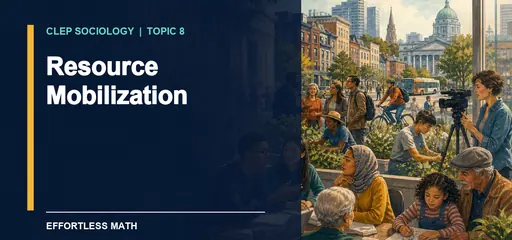
Chapter 8 of the CLEP Sociology study guide on Effortless Math covers Resource Mobilization: the key terms, the core ideas, and worked examples showing how this topic is tested on the exam.

CLEP Sociology – Chapter 8
Resource Mobilization
CLEP Introductory Sociology · Chapter 8
Resource mobilization theory studies how movements acquire and use money, leadership, labor, skills, meeting space, communication systems, legitimacy, and social networks. Participants are not treated as a mindless crowd. They make strategic choices under constraints.
A social movement organization is a formal organization that works toward movement goals. Several organizations can belong to the same broader movement while competing over tactics or funds. Professional movement organizations may rely on paid staff and outside contributors, while grassroots groups may depend more heavily on members’ labor and local networks.
The theory explains why equally intense grievances can produce different outcomes. A group with experienced organizers, trusted networks, stable funding, and communication capacity can sustain action longer than a group with frustration alone. Resources include a respected ally, legal expertise, and a compelling cultural symbol as well as money and facilities.
Preexisting networks lower the cost of recruitment because trust and communication are already in place. Congregations, unions, neighborhood associations, professional groups, and online communities can provide meeting space, leaders, mailing lists, and shared routines. These resources help turn individual support into coordinated action.
Organizations face choices about where resources come from. Outside funding can expand staff and reach, but donors may influence priorities. Professional leadership can supply expertise while weakening member control. Resource mobilization examines those organizational tradeoffs without assuming that participants are irrational.
Success also depends on how resources are deployed. Money cannot replace a credible message, local knowledge, or a tactic suited to the political setting. The theory studies capacity and strategy together.
Allocation exposes the difference between possessing resources and deploying them. A tenant campaign has 12,000, two attorneys willing to help, forty volunteers, and one month before a hearing. Spending everything on advertising may increase awareness but leave no one trained to gather testimony. Using all volunteer hours for door knocking may produce stories that the legal team cannot organize in time. Strategy means matching money, labor, skill, and deadline to the bottleneck that blocks the next step.
Resources are not perfectly interchangeable. A donated meeting hall cannot translate notices, and a famous endorsement cannot replace residents who know which buildings lack heat. Some assets become useful only in combination. Legal expertise plus documented violations can support a complaint, while either one alone may sit unused. A reserve fund also provides slack when an opponent delays a hearing or a sudden arrest creates bail costs. Capacity includes the ability to survive surprise, the total spent on the planned tactic.
A comparison can test effective deployment. Two campaigns begin with similar budgets, supporter counts, and public approval. One assigns volunteers by skill, tracks deadlines, and shifts funds when translation becomes the recruitment bottleneck. The other duplicates tasks and exhausts its money before the hearing. Different outcomes would not prove that planning alone caused success, but process records could show where nominally equal resources became usable action. The deciding evidence is the conversion of assets into a timely task, not a list of assets detached from strategy.
Brokerage turns separate pockets of support into usable capacity. A bilingual tenant organizer may connect residents, legal clinics, and reporters who otherwise share no direct ties. The organizer does more than add one volunteer. The new connection lets information, credibility, and specialized help cross network boundaries. Losing that broker can fragment a campaign even when its total membership remains unchanged.
Resource conversion also matters. A long membership list has limited value if organizers cannot contact people quickly, and money cannot substitute for trusted local knowledge during recruitment. Researchers therefore examine how a movement combines assets for a task. One clean test compares two campaigns with similar grievances and funding but different network reach or leadership continuity. If the campaign with stronger brokerage recruits faster and survives turnover, the result supports a resource mechanism. A CLEP stem about an election opening still points to political opportunity, while a stem about using a congregation’s phone tree to reach isolated supporters points to mobilization capacity.
Quick review: Resource mobilization follows money, labor, leadership, skills, legitimacy, facilities, and networks. An SMO is one formal vehicle within a broader movement. Free riding concerns shared benefits without contribution. Professionalization trades added expertise and continuity against possible distance from members.
Watch the chapter connection
How Societies Change gives you a second explanation of the chapter ideas surrounding this lesson. As you watch, pause when the lesson concept appears and explain how the example fits.
Use this lesson for CLEP practice
Write one original example, one close nonexample, and one observation that would help you choose between them. This turns vocabulary recognition into the kind of applied reasoning the exam expects.

Related to This Article
More math articles
- Pythagorean Theorem: Formula, Examples, and How to Use It
- Continuity at a point Explained: How to Identify Discontinuities and Their Significance
- Estimating Sums and Differences for 4th Grade
- Volume Calculator (3D Solids, with Diagram)
- Algebra Puzzle – Challenge 37
- Free Grade 4 English Worksheets for New Hampshire Students
- Cartels face an incentive to cheat
- The Best Grade 7 ELA Practice Tests for Indiana Students
- Full-Length 7th Grade GMAS Math Practice Test
- Top 10 7th Grade PSSA Math Practice Questions




















What people say about "Resource Mobilization | CLEP Sociology"?
No one replied yet.