LEARN · PRACTICE · EXPLORE
New Hampshire Grade 4 Math
Study New Hampshire Grade 4 math through rounding and midpoint reasoning, a checked example, selected curriculum references, worksheets and topic quizzes.
State resources · Focused study · Clear next steps
What do New Hampshire 4th graders learn in math?
In 4th grade, New Hampshire math centers on multi-digit multiplication and division, equivalent fractions, adding fractions with like denominators, decimals to hundredths, and angles. Students take the NH SAS grade 4 math test in the spring. This page explains each New Hampshire grade 4 math standard and pairs it with short lessons, skill quizzes, printable worksheets and a full-length practice test.
Printable New Hampshire grade 4 math books:
- 5 New Hampshire NH SAS Grade 4 Math Practice Tests
- 6 New Hampshire NH SAS Grade 4 Math Practice Tests
- 7 Full-Length New Hampshire NH SAS Grade 4 Math Practice Tests
- New Hampshire NH SAS Grade 4 Math Preparation Bundle
- New Hampshire NH SAS 4th Grade Math Workbook
- New Hampshire NH SAS Grade 4 Math Made Ridiculously Simple
- New Hampshire NH SAS Grade 4 Math in 30 Days
Standards source: New Hampshire school-approval rules, Ed 306.34.
Start with Grade 4 Math Practice
Use this general Grade 4 math practice test to check your skills, then review the missed topics below. It is independent practice, not an official state assessment or a replica of its timing, scoring, or question types.
Open the Grade 4 practice test Explore Grade 4 lessons and worksheetsClassroom practice and state assessment information
The 2025–2026 public NH SAS manual describes general mathematics testing in Grades 3–8, including Grade 4, using a computer-adaptive assessment. Confirm the learner’s assigned pathway, tools, and the school’s current administration directions. The reviewed manual is the 2025–2026 edition; confirm later-year directions with the school. Independently published practice may use its own timer, tools, question count, and scoring; these are not official administration specifications or a prediction of a state performance level. Read the public NH SAS manual resource page for official guidance.
Use the worked activity and lesson directory to choose a skill. Confirm the directions of an independent practice resource before assigning it.
Round the original number separately for each place
The requested place determines the two neighboring multiples and the midpoint used for rounding. A number can round upward to the nearest hundred and downward to the nearest thousand. Each answer should start from the original number.
Try this original activity
Round 2,499 to the nearest hundred and, separately, to the nearest thousand. Explain each choice using its neighboring multiples. Then examine why rounding first to hundreds and reusing that answer for thousands can fail.
Work through the reasoning
The neighboring hundreds are 2,400 and 2,500. Their midpoint is 2,450. Since 2,499 lies above that midpoint, it rounds to 2,500. Its distance to 2,500 is one, compared with ninety-nine to 2,400. The neighboring thousands are 2,000 and 3,000, with midpoint 2,500. The original 2,499 is below that midpoint, so it rounds to 2,000. It is 499 from 2,000 and 501 from 3,000. These answers are consistent because the two requested places use different intervals. The hundred answer is not a replacement for the original value in the second question.
Check the common mistake
Rounding 2,499 to 2,500 first loses the information that the original number was just below the thousand midpoint. Applying the usual halfway-up classroom convention to that changed number would give 3,000, which is not the nearest thousand to 2,499. Keep the original value visible for every requested place. State the rounding convention when a value is exactly halfway; this example’s original value is not a tie.
Try a related case
Round 2,501 directly to each place. It is nearest to 2,500 among neighboring hundreds and to 3,000 among neighboring thousands. Compare this with 2,499: a difference of only two changes the thousand result but leaves the hundred result unchanged. Explain the midpoint responsible for the change.
Selected Common Core references for this activity
New Hampshire’s current school-approval rules, Ed 306.34, allow local boards to use the adopted 2010 Common Core mathematics standards or approved alternative academic standards. Confirm the school’s standards choice and local competencies first. The selected Common Core references below were checked in the original publisher’s 2010 document. They identify this activity’s focus, rather than a complete local course. Read the full requirements, mathematical practices, examples, and progression with the school’s curriculum.
| Selected Common Core reference | Activity focus | Publisher’s document |
|---|---|---|
| 4.NBT.3 | Rounding multi-digit whole numbers | Read the publisher’s PDF, page 29 |
Sources checked October 6, 2026. Read complete requirements, clarifications, limitations, and mathematical practices alongside the school’s sequence. This selected activity is an entry point for instruction.
Connect the explanation with practice
Use the lesson, worksheet, and quiz directory to choose a related skill. The existing resource links remain available; open each activity’s directions to understand its timer, tools, question count, and scoring.
The 2025–2026 public NH SAS manual describes general mathematics testing in Grades 3–8, including Grade 4, using a computer-adaptive assessment. Confirm the learner’s assigned pathway, tools, and the school’s current administration directions. The reviewed manual is the 2025–2026 edition; confirm later-year directions with the school. Independently published practice may use its own timer, tools, question count, and scoring; these are not official administration specifications or a prediction of a state performance level. Read the public NH SAS manual resource page.
Read New Hampshire local curriculum rules for later guidance. Keep one example of the student’s reasoning with the practice result. Choose a smaller model, a related question, or a new context according to the difficulty revealed in the worked activity.
New Hampshire Grade 4 Math Topics
Choose a lesson, printable worksheet collection, or topic quiz. This broader library includes review and enrichment. Use the school’s current sequence and the standards selected by the school when choosing skills; these rows are not a certified full-course crosswalk.
Curriculum guidance: New Hampshire school-approval rules, Ed 306.34.
Place Value & Number Sense
Multi-Digit Operations
- Adding Multi Digit Whole NumbersWorksheetsQuiz
- Subtracting Multi Digit Whole NumbersWorksheetsQuiz
- Multiplying By A One Digit NumberWorksheetsQuiz
- Multiplying Two Two Digit NumbersWorksheetsQuiz
- Dividing With RemaindersWorksheetsQuiz
- Finding Factors And MultiplesWorksheetsQuiz
- Prime And Composite NumbersWorksheetsQuiz
Multiplicative Thinking
Fractions
- Equivalent FractionsWorksheetsQuiz
- Comparing FractionsWorksheetsQuiz
- Adding Fractions Like DenominatorsWorksheetsQuiz
- Subtracting Fractions Like DenominatorsWorksheetsQuiz
- Decomposing FractionsWorksheetsQuiz
- Adding And Subtracting Mixed NumbersWorksheetsQuiz
- Multiplying A Fraction By A Whole NumberWorksheetsQuiz
- Fraction Word ProblemsWorksheetsQuiz
Decimals & Fractions
Measurement, Area & Data
Angles
New Hampshire Grade 4 Math Books and Resources
Each book has a job: start from scratch, drill weak skills, or build pacing with full tests. All of them pair with the free tools on this page.
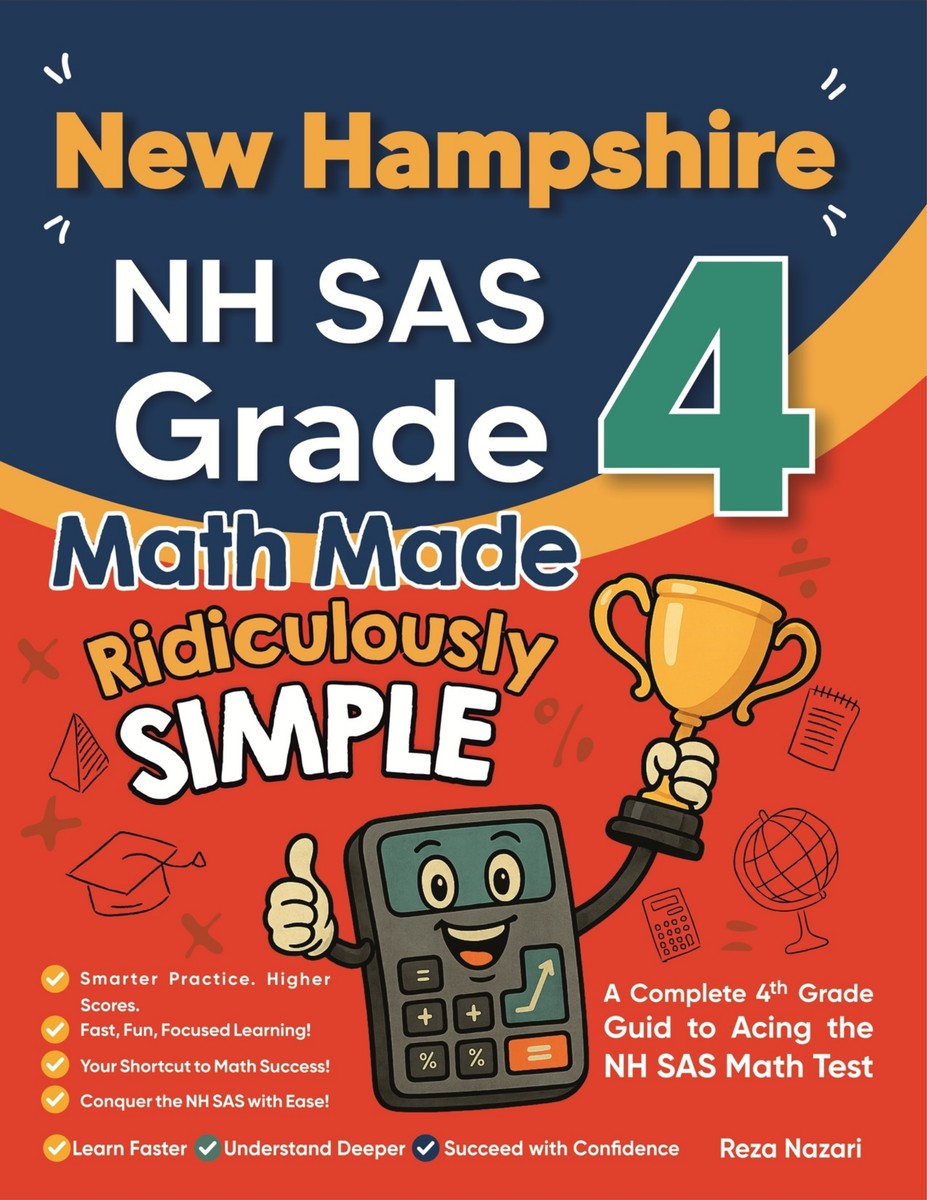
New Hampshire NH SAS Grade 4 Math Made Ridiculously Simple
An independently published Grade 4 mathematics resource. Check its edition and contents against New Hampshire’s adopted document and the school’s course before choosing preparation.
- Best starting point for the NH SAS math test
- Pairs with New Hampshire flashcards and worksheets
- Use it before full timed practice tests
- Organized for students who need examples before drills
Step-by-step lessons
Short explanations show the move before the student practices it.
✍Worked examples
Check the listed book’s contents and edition against the learner’s course before choosing it.
Targeted practice
Rebuild one skill at a time instead of jumping around.
Test-day bridge
After each topic, connect to formulas, flashcards, and practice questions.
How to use it
- Read one lesson and copy the worked example.
- Do a short worksheet set on the same topic.
- Review the matching flashcards or formulas.
- Try a mixed quiz and mark every miss.
Pair it with free tools
Choose the right New Hampshire Grade 4 math book
New Hampshire NH SAS Grade 4 Math Made Ridiculously Simple
Start here for New Hampshire Grade 4 math, step by step.
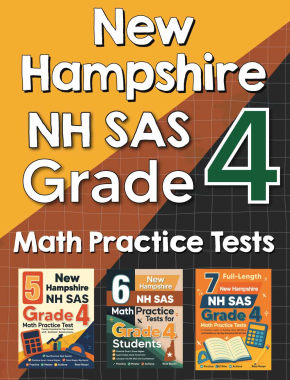
New Hampshire NH SAS Grade 4 Math Preparation Bundle
Study guide, workbook, and practice tests together.
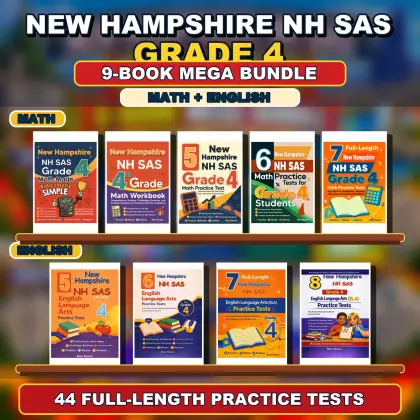
New Hampshire NH SAS Grade 4 Math & ELA Mega Bundle
9 books and 44 full-length practice tests in one TPT bundle.
New Hampshire Grade 4 math: useful study questions
Can I round to hundreds first and then to thousands?
That can change the answer. For 2,499, direct rounding to thousands gives 2,000, while first rounding to 2,500 loses the original position below the midpoint.
Which statewide mathematics assessment pathway applies to New Hampshire Grade 4?
The 2025–2026 public NH SAS manual describes general mathematics testing in Grades 3–8, including Grade 4, using a computer-adaptive assessment. Confirm the learner’s assigned pathway, tools, and the school’s current administration directions. The reviewed manual is the 2025–2026 edition; confirm later-year directions with the school. Independently published practice may use its own timer, tools, question count, and scoring; these are not official administration specifications or a prediction of a state performance level.
Grade 4 Math in Other States
Explore Grade 4 math standards, practice tests, and worksheets for every state.
- Alabama
- Alaska
- Arizona
- Arkansas
- California
- Colorado
- Connecticut
- Delaware
- Florida
- Georgia
- Hawaii
- Idaho
- Illinois
- Indiana
- Iowa
- Kansas
- Kentucky
- Louisiana
- Maine
- Maryland
- Massachusetts
- Michigan
- Minnesota
- Mississippi
- Missouri
- Montana
- Nebraska
- Nevada
- New Jersey
- New Mexico
- New York
- North Carolina
- North Dakota
- Ohio
- Oklahoma
- Oregon
- Pennsylvania
- Rhode Island
- South Carolina
- South Dakota
- Tennessee
- Texas
- Utah
- Vermont
- Virginia
- Washington
- West Virginia
- Wisconsin
- Wyoming
- District of Columbia
Plan Your Next Grade 4 Math Task
Choose a related practice resource, compare its feedback with classroom explanations, and follow the school’s current learning and assessment guidance.
Start a practice testA USEFUL NEXT STEP
New Hampshire Grade 4 Math: study questions
Can I round to hundreds first and then to thousands?
That can change the answer. For 2,499, direct rounding to thousands gives 2,000, while first rounding to 2,500 loses the original position below the midpoint.
Which statewide mathematics assessment pathway applies to New Hampshire Grade 4?
The 2025–2026 public NH SAS manual describes general mathematics testing in Grades 3–8, including Grade 4, using a computer-adaptive assessment. Confirm the learner’s assigned pathway, tools, and the school’s current administration directions. The reviewed manual is the 2025–2026 edition; confirm later-year directions with the school. Independently published practice may use its own timer, tools, question count, and scoring; these are not official administration specifications or a prediction of a state performance level.
Official source ↗Resources from Effortless Math · Editorial standards