LEARN · PRACTICE · EXPLORE
Arizona Grade 4 Math
Add mixed-number lengths with a visual quarter-unit model, check fraction equivalence, and find Arizona Grade 4 standards, lessons, worksheets, and quizzes.
State resources · Focused study · Clear next steps
What do Arizona 4th graders learn in math?
In 4th grade, Arizona math centers on multi-digit multiplication and division, equivalent fractions, adding fractions with like denominators, decimals to hundredths, and angles. Students take the AASA grade 4 math test in the spring. This page explains each Arizona grade 4 math standard and pairs it with short lessons, skill quizzes, printable worksheets and a full-length practice test.
Printable Arizona grade 4 math books:
- 5 Arizona AASA Grade 4 Math Practice Tests
- 6 Arizona AASA Grade 4 Math Practice Tests
- 7 Full-Length Arizona AASA Grade 4 Math Practice Tests
- Arizona AASA Grade 4 Math Preparation Bundle
- Arizona AASA 4th Grade Math Workbook
- Arizona AASA Grade 4 Math Made Ridiculously Simple
- Arizona AASA Grade 4 Math in 30 Days
Standards source: Arizona Academic Standards, Arizona Department of Education.
Start with Grade 4 Math Practice
Use this general Grade 4 math practice test to check your skills, then review the missed topics below. It is independent practice, not an official state assessment or a replica of its timing, scoring, or question types.
Open the Grade 4 practice test Explore Grade 4 lessons and worksheetsArizona Grade 4 Math Resource Snapshot
Use the topic directory below for grade-level skills and linked standards. The general practice test is an independent learning tool, not an official state test. Timing and calculator rules depend on your school or testing program.
Arizona Grade 4 math: Keep the unit whole fixed when adding mixed numbers
Use a worked problem to connect a calculation with its meaning. The selected references below come from Arizona’s official Grade 4 mathematics document, linked in the state mathematics directory.
Join two ribbon lengths
In this original example, a ribbon is 2¼ meters long and another is 1¾ meters long. What is their combined length? Each whole is one meter, and each fractional part is measured in quarters of that same unit.
Add the whole-number parts: 2 + 1 = 3. Add the quarter parts: ¼ + ¾ = 4/4 = 1. The combined length is 3 + 1 = 4 meters. An equivalent calculation uses improper fractions: 9/4 + 7/4 = 16/4 = 4.
The colors separate the two ribbons; each meter has four equal parts. The drawing is a unit model, not an actual ribbon to measure on the screen.
Explain why the denominator stays four
A response of 3 4/8 changes the size of the fractional unit. Four quarter-meter pieces make one meter, not half a meter. The denominator names the unit pieces; adding their counts does not turn quarters into eighths. Likewise, ½ meter can be shown as 2/4 meter by dividing the same one-meter whole into more equal parts.
Use the model to decide what to review
If the student finds 4/4 but leaves the answer as 3 4/4, ask how many wholes the four quarters make. If the student changes the denominator, return to the equal parts in one meter. If the student adds correctly but cannot explain ½ = 2/4, compare two partitions of an equally sized whole before changing to a new denominator.
- Name the whole and the fractional unit before calculating.
- Show both lengths using quarter-meter pieces.
- Join the pieces, regroup a full meter, and write the result with a unit.
- Check using improper fractions or estimate that 2¼ + 1¾ is close to 4.
For the next session, use the topic directory’s equivalent-fractions or mixed-numbers row. Choose its lesson first, then the worksheet or quiz according to the learning need the explanation reveals.
Selected Arizona requirements
| Arizona code | Activity focus | Official requirement |
|---|---|---|
| 4.NF.A.1 | Explain fraction equivalence with a model | State document, page 9 |
| 4.NF.B.3c | Add mixed numbers with like denominators | State document, page 9 |
| 4.NF.B.3d | Solve a same-whole fraction word problem | State document, page 9 |
These focus labels identify the requirements used in this activity. Open the state document for their complete wording and the rest of the grade’s course.
Fraction study questions
Why is ¼ + ¾ equal to one whole?
Both fractions count quarters of the same whole. One quarter plus three quarters makes four quarters, which is one whole.
Which state document supports the fraction activity?
The selected references link Arizona’s Grade 4 mathematics document updated January 29, 2025. The full document covers additional topics beyond this worked example.
State sources checked October 5, 2026. Read official AASA information.
Arizona Grade 4 Math Topics
Student-friendly Grade 4 math skills, with a focused lesson, practice resources where available, and a topic quiz. Displayed codes are broad reference groups, not a certified state crosswalk.
Standards source: Arizona Academic Standards, Arizona Department of Education.
Place Value & Number Sense
Multi-Digit Operations
Multiplicative Thinking
Fractions
Decimals & Fractions
Measurement, Area & Data
Angles
Best Arizona AASA Grade 4 Math Books
Each book has a job: start from scratch, drill weak skills, or build pacing with full tests. All of them pair with the free tools on this page.
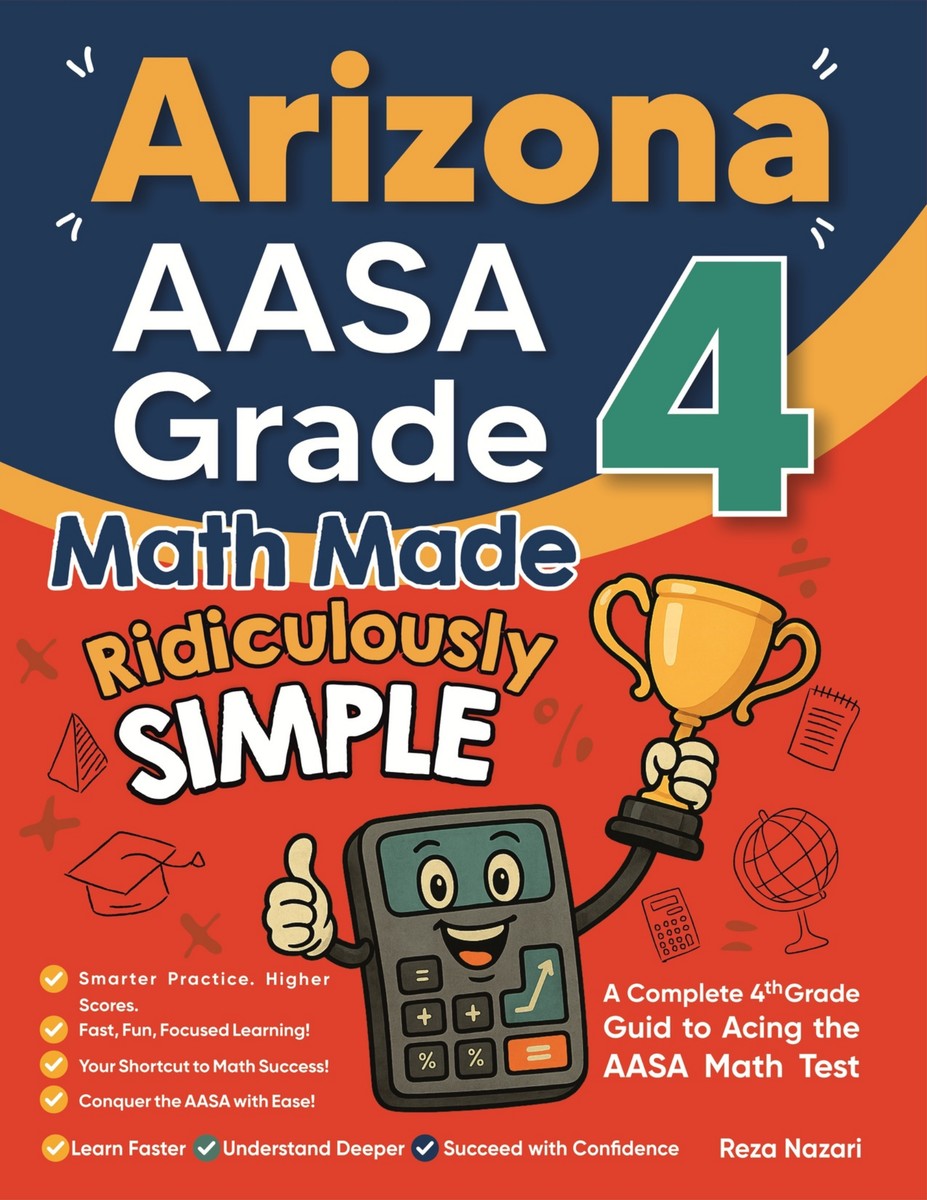
Arizona AASA Grade 4 Math Made Ridiculously Simple
A step-by-step AASA Grade 4 math book that rebuilds every tested skill clearly and in order, built to match the Arizona standards.
- Best starting point for the AASA math test
- Pairs with Arizona flashcards and worksheets
- Use it before full timed practice tests
- Organized for students who need examples before drills
Step-by-step lessons
Short explanations show the move before the student practices it.
✍Worked examples
Examples translate AASA-style wording into clear math steps.
Targeted practice
Rebuild one skill at a time instead of jumping around.
Test-day bridge
After each topic, connect to formulas, flashcards, and practice questions.
How to use it
- Read one lesson and copy the worked example.
- Do a short worksheet set on the same topic.
- Review the matching flashcards or formulas.
- Try a mixed quiz and mark every miss.
Pair it with free tools
Choose the right Arizona Grade 4 math book
Arizona AASA Grade 4 Math Made Ridiculously Simple
Start here for Arizona Grade 4 math, step by step.
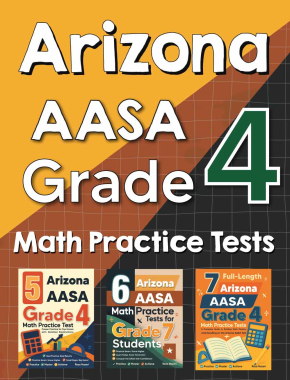
Arizona AASA Grade 4 Math Preparation Bundle
Study guide, workbook, and practice tests together.
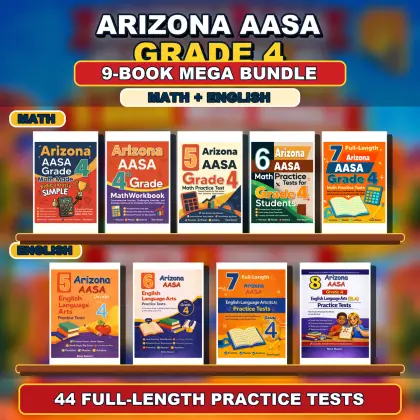
Arizona AASA Grade 4 Math & ELA Mega Bundle
9 books and 44 full-length practice tests in one TPT bundle.
Arizona AASA Grade 4 Math FAQ
What is the AASA Grade 4 math test?
The AASA (Arizona's Academic Standards Assessment) is Arizona’s Grade 4 mathematics assessment. The linked activities are independent Grade 4 practice. Their question count, timer, scoring, and item types may differ from the official assessment. Use the directions inside each activity.
Can I use a calculator?
Calculator rules depend on the grade, assessment, test segment, and approved accommodations. Follow the current assessment guidance and ask your school which rules apply. A tool available in independent practice does not establish permission on the official test.
How long is each practice test?
Read the timer and question count shown in the practice activity you open. These are practice settings, not a statement of the official assessment’s duration or scoring.
Is it free?
The linked general practice and topic resources are available separately from optional books. Check each activity’s directions and access requirements. The study guide and bundle are optional next steps.
Grade 4 Math in Other States
Explore Grade 4 math standards, practice tests, and worksheets for every state.
- Alabama
- Alaska
- Arkansas
- California
- Colorado
- Connecticut
- Delaware
- Florida
- Georgia
- Hawaii
- Idaho
- Illinois
- Indiana
- Iowa
- Kansas
- Kentucky
- Louisiana
- Maine
- Maryland
- Massachusetts
- Michigan
- Minnesota
- Mississippi
- Missouri
- Montana
- Nebraska
- Nevada
- New Hampshire
- New Jersey
- New Mexico
- New York
- North Carolina
- North Dakota
- Ohio
- Oklahoma
- Oregon
- Pennsylvania
- Rhode Island
- South Carolina
- South Dakota
- Tennessee
- Texas
- Utah
- Vermont
- Virginia
- Washington
- West Virginia
- Wisconsin
- Wyoming
- District of Columbia
Make This Your Arizona AASA Starting Point
Take a timed practice test, find your weakest topic, and study it with the linked lessons, worksheets, and the AASA study guide.
Start a practice testA USEFUL NEXT STEP
Arizona Grade 4 Math: study questions
Why is ¼ + ¾ equal to one whole?
Both fractions count quarters of the same whole. One quarter plus three quarters makes four quarters, which is one whole.
Which state document supports the fraction activity?
The selected references link Arizona’s Grade 4 mathematics document updated January 29, 2025. The full document covers additional topics beyond this worked example.
Resources from Effortless Math · Editorial standards