What are the 12 Algebraic Formulas?
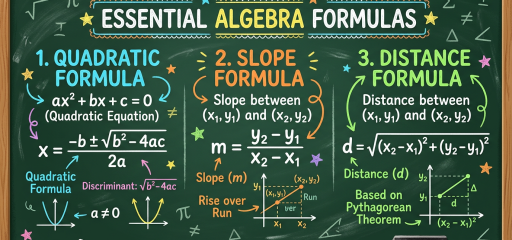
Algebra relies on a core set of formulas that appear again and again in equations, word problems, and standardized tests. Mastering these 12 algebraic formulas gives you a strong foundation for algebra, geometry, and beyond. Here’s a clear reference with explanations, examples, and tips for when to use each one.
The Absolute Best Book to Ace Your Math Test
Our Featured Products

The 12 Essential Algebraic Formulas
1. Slope Formula
m = (y₂ − y₁)/(x₂ − x₁). The slope of a line through points (x₁, y₁) and (x₂, y₂). Slope represents rate of change: rise over run. Example: Through (2, 3) and (5, 9), m = (9 − 3)/(5 − 2) = 6/3 = 2. For more practice, see our algebra worksheets.
2. Slope-Intercept Form
y = mx + b. A line with slope m and y-intercept b. This is the most common form for graphing—plot the y-intercept (0, b), then use the slope to find another point. Example: y = 2x + 3 has slope 2 and crosses the y-axis at (0, 3).
3. Point-Slope Form
y − y₁ = m(x − x₁). A line with slope m passing through (x₁, y₁). Use this when you know a point and the slope but not the y-intercept. Example: Through (4, 5) with slope −2: y − 5 = −2(x − 4).
4. Quadratic Formula
x = (−b ± √(b² − 4ac))/(2a). Solves ax² + bx + c = 0. Works for any quadratic, even when factoring fails. The discriminant b² − 4ac tells you: positive = two real roots, zero = one repeated root, negative = no real roots. Example: For x² − 5x + 6 = 0, a = 1, b = −5, c = 6; x = (5 ± 1)/2 gives x = 3 or x = 2.
5. Distance Formula
d = √[(x₂ − x₁)² + (y₂ − y₁)²]. Distance between two points in the coordinate plane. It’s the Pythagorean theorem in disguise: the horizontal and vertical legs form a right triangle. Example: Distance from (0, 0) to (3, 4) is √(9 + 16) = 5.
6. Midpoint Formula
M = ((x₁ + x₂)/2, (y₁ + y₂)/2). Midpoint of a segment. Average the x-coordinates and the y-coordinates. Example: Midpoint of (2, 4) and (8, 10) is (5, 7).
7. Difference of Squares
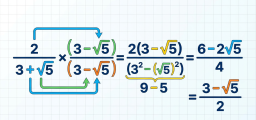
a² − b² = (a + b)(a − b). Useful for factoring and simplifying. Example: x² − 9 = (x + 3)(x − 3). Also appears when rationalizing denominators with radicals.
8. Perfect Square Trinomials
(a + b)² = a² + 2ab + b² and (a − b)² = a² − 2ab + b². Essential for completing the square and factoring. Example: x² + 6x + 9 = (x + 3)². Watch the middle term: it’s 2ab, not just ab.
9. Sum and Difference of Cubes
a³ + b³ = (a + b)(a² − ab + b²) and a³ − b³ = (a − b)(a² + ab + b²). Less common than quadratics but appear in advanced algebra. The second factor doesn’t factor further over the reals.
10. Simple Interest
I = Prt. Interest = Principal × rate × time. Use when interest is calculated once. Example: $1000 at 5% for 3 years gives I = 1000 × 0.05 × 3 = $150.
11. Compound Interest
A = P(1 + r/n)^(nt). Amount with compounding. P = principal, r = annual rate, n = compounding periods per year, t = time in years. Example: $1000 at 5% compounded monthly for 3 years: A = 1000(1 + 0.05/12)^(36) ≈ $1161.47.
12. Average (Mean)
Average = (sum of values)/(number of values). Foundational for statistics. If you know the average and the count, you can find the sum: sum = average × count.
How to Use These Formulas
Identify what you’re given and what you need. Match the structure of your problem to the right formula. Substitute carefully and simplify. For word problems, assign variables to unknown quantities before substituting. Visit Effortless Math for more algebra resources.
Quick Reference Table
Keep a mental map: lines and slopes → formulas 1–3; quadratics → formula 4; coordinate geometry → formulas 5–6; factoring → formulas 7–9; finance → formulas 10–11; statistics → formula 12.
Frequently Asked Questions

Recommended Resources
Popular Math Books

Recommended Math Practice Resource
Which formula do I use for word problems?
Look for keywords: “slope” or “rate” → slope formula; “distance” or “how far” → distance formula; “interest” → interest formulas; “average” → mean formula.
Do I need to memorize all 12?
Yes for most algebra courses and standardized tests. Practice using them until they become second nature. Flashcards and worked examples help.
What if the quadratic formula gives a negative under the square root?
That means no real solutions. The equation has complex roots. For most high school and GED contexts, you’d report “no real solution.”
When do I use point-slope vs. slope-intercept?
Use point-slope when you’re given a point and slope. Convert to slope-intercept (y = mx + b) if you need to graph or find the y-intercept.

Related to This Article
More math articles
- How to Find Modulus (Absolute Value) and Argument (Angle) of Complex Numbers?
- The Ultimate SBAC Algebra 1 Course (+FREE Worksheets)
- 6th Grade SBAC Math FREE Sample Practice Questions
- 7th Grade ILEARN Math Worksheets: FREE & Printable
- How to Fall in Love with Math and Studying?
- Organizing the Products: How to Sorting Results from Multiplying Fractions and Whole Numbers
- The Ultimate 7th Grade MAAP Math Course (+FREE Worksheets)
- How to Determine Indeterminate Form and Vague Limits
- The Ultimate ASVAB Math Formula Cheat Sheet
- Probability Distribution












What people say about "What are the 12 Algebraic Formulas? - Effortless Math: We Help Students Learn to LOVE Mathematics"?
No one replied yet.