10 Most Common SSAT Upper-Level Math Questions
10 Most Common SSAT Upper-Level Math Questions

8- A
Let \(x\) be the cost of one-kilogram orange, then:\( 2x+(2×5.2)=28.4→\)
\(2x+10.4=28.4→2x=28.4-10.4→2x=18→x=\frac{18}{2}=$9\)

9- B
Let’s review the choices provided.
A.4. In 4 years, David will be 48 and Ava will be 8.48 is not 5 times 8.
B.6. In 6 years, David will be 50 and Ava will be 10. 50 is 5 times 10!
C.8. In 8 years, David will be 52 and Ava will be 12.52 is not 5 times 12.
D.10. In 10 years, David will be 54 and Ava will be 14.54 is not 5 times 14.
E.14. In 14 years, David will be 58 and Ava will be 18.58 is not 5 times 18.

10- B
Let b be the amount of time Alec can do the job, (change 2.5 hours to 150 minutes) then:
\(\frac{1}{a}+\frac{1}{b}=\frac{1}{50}→\frac{1}{150}+\frac{1}{b}=\frac{1}{50}→\frac{1}{b}=\frac{1}{50}-\frac{1}{150}=\frac{2}{150}=\frac{1}{75}\), Then: b=75 minutes

Looking for the best resource to help you succeed on the SSAT Upper-Level Math test?

The Best Books to Ace the SSAT Upper-Level Math Test
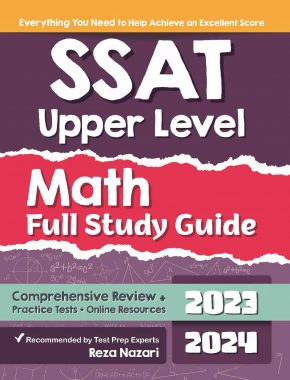
Original price was: $29.99.Current price is: $16.99.

Original price was: $109.99.Current price is: $54.99.

Mastering the 10 Most Common SSAT Upper Level Math Questions

The SSAT Upper Level math section features recurring question types that test specific skills. Understanding these ten common question categories helps you prepare efficiently and recognize patterns during the actual test. Each question type has a distinct strategy for approaching the problem.

Question Type 1: Simplifying Fractions and Operations

Question: What is 3/4 + 2/3 – 1/6? Solution: Find a common denominator for 4, 3, and 6. The LCD is 12. Convert: 3/4 = 9/12, 2/3 = 8/12, 1/6 = 2/12. Now: 9/12 + 8/12 – 2/12 = 15/12 = 5/4. The strategy is to convert all fractions to the LCD immediately.

Question Type 2: Working with Percentages

Question: If 25 percent of a number is 15, what is 40 percent of that number? Solution: If 25% of the number equals 15, then the number is 15 divided by 0.25 = 60. Now find 40% of 60: 0.40 times 60 = 24. The strategy is first to find the whole number from the percentage, then calculate the percentage of that whole.

Question Type 3: Exponents and Powers

Question: What is 3^4 divided by 3^2 times 3^-1? Solution: Using exponent rules: 3^4 divided by 3^2 = 3^(4-2) = 3^2. Then 3^2 times 3^-1 = 3^(2-1) = 3^1 = 3. The strategy is to use exponent rules rather than computing the actual values.

Question Type 4: Solving Linear Equations

Question: If 2x + 5 = 17, what is x? Solution: Subtract 5 from both sides: 2x = 12. Divide both sides by 2: x = 6. The strategy is to isolate the variable by performing inverse operations step-by-step.

Question Type 5: Geometric Shapes and Area

Question: A triangle has a base of 8 and a height of 5. What is its area? Solution: Area = 1/2 times base times height = 1/2 times 8 times 5 = 20. The strategy is to recall the formula and apply it directly.

Question Type 6: Word Problems Requiring Setup

Question: A store sells notebooks for 2 dollars each and pens for 1 dollar each. If you buy 5 notebooks and some pens and spend exactly 12 dollars, how many pens did you buy? Solution: Set up: 5(2) + 1p = 12, which simplifies to 10 + p = 12, so p = 2. The strategy is to identify what you know and what you are looking for, then set up an equation.

Question Type 7: Probability

Question: A bag contains 3 red balls, 4 blue balls, and 5 green balls. If you draw one ball randomly, what is the probability of drawing a blue ball? Solution: Total balls = 3 + 4 + 5 = 12. Probability of blue = 4/12 = 1/3. The strategy is to count favorable outcomes and total possible outcomes, then form the ratio.

Question Type 8: Average (Mean, Median, Mode)

Question: A student has test scores of 78, 82, 85, 92, and 93. What is the median? Solution: The median is the middle value of 5 numbers: 85. The strategy is to remember that median is the middle value and that data must be ordered first.

Question Type 9: Ratio and Proportion

Question: If the ratio of boys to girls in a class is 3:4, and there are 12 boys, how many girls are there? Solution: The ratio is boys:girls = 3:4. If there are 12 boys: 3 times 4 = 12, so the multiplier is 4. Therefore girls = 4 times 4 = 16. The strategy is to find what multiplier converts the ratio number to the given quantity.

Question Type 10: Inequalities and Absolute Value

Question: What is the value of |minus 5| + |3|? Solution: |minus 5| = 5 and |3| = 3, so the result is 5 + 3 = 8. The strategy is to remember that absolute value means the distance from zero (always positive).

Test-Taking Strategies

Work backward from answer choices when unsure. Substitute each option to see which works. Draw diagrams for geometry problems. Show all your work, even if you are checking answers. Skip difficult questions and return to them after solving easier ones.

Common Mistakes to Avoid

Read questions carefully; misunderstanding what is being asked is a common error. Check whether the question asks for a specific value or a relationship. Verify your arithmetic by estimating what the answer should be roughly. Do not assume similar-looking problems have the same solution method.

Practice and Mastery

Work through each question type systematically until you are comfortable with the approach. Review incorrect answers deeply. Identify whether you made a conceptual mistake, misread the question, or made an arithmetic error.

Related Resources

Access the SSAT Upper Level formula cheat sheet to review essential formulas. Study the SSAT Middle Level math course. Compare testing approaches by reviewing ISEE vs SSAT.

Mastering the 10 Most Common SSAT Upper Level Math Questions

The SSAT Upper Level math section features recurring question types that test specific skills. Understanding these ten common question categories helps you prepare efficiently and recognize patterns during the actual test. Each question type has a distinct strategy for approaching the problem.

Question Type 1: Simplifying Fractions and Operations

Question: What is 3/4 + 2/3 – 1/6? Solution: Find a common denominator for 4, 3, and 6. The LCD is 12. Convert: 3/4 = 9/12, 2/3 = 8/12, 1/6 = 2/12. Now: 9/12 + 8/12 – 2/12 = 15/12 = 5/4. The strategy is to convert all fractions to the LCD immediately.

Question Type 2: Working with Percentages

Question: If 25 percent of a number is 15, what is 40 percent of that number? Solution: If 25% of the number equals 15, then the number is 15 divided by 0.25 = 60. Now find 40% of 60: 0.40 times 60 = 24. The strategy is first to find the whole number from the percentage, then calculate the percentage of that whole.

Question Type 3: Exponents and Powers

Question: What is 3^4 divided by 3^2 times 3^-1? Solution: Using exponent rules: 3^4 divided by 3^2 = 3^(4-2) = 3^2. Then 3^2 times 3^-1 = 3^(2-1) = 3^1 = 3. The strategy is to use exponent rules rather than computing the actual values.

Question Type 4: Solving Linear Equations

Question: If 2x + 5 = 17, what is x? Solution: Subtract 5 from both sides: 2x = 12. Divide both sides by 2: x = 6. The strategy is to isolate the variable by performing inverse operations step-by-step.

Question Type 5: Geometric Shapes and Area

Question: A triangle has a base of 8 and a height of 5. What is its area? Solution: Area = 1/2 times base times height = 1/2 times 8 times 5 = 20. The strategy is to recall the formula and apply it directly.

Question Type 6: Word Problems Requiring Setup

Question: A store sells notebooks for 2 dollars each and pens for 1 dollar each. If you buy 5 notebooks and some pens and spend exactly 12 dollars, how many pens did you buy? Solution: Set up: 5(2) + 1p = 12, which simplifies to 10 + p = 12, so p = 2. The strategy is to identify what you know and what you are looking for, then set up an equation.

Question Type 7: Probability

Question: A bag contains 3 red balls, 4 blue balls, and 5 green balls. If you draw one ball randomly, what is the probability of drawing a blue ball? Solution: Total balls = 3 + 4 + 5 = 12. Probability of blue = 4/12 = 1/3. The strategy is to count favorable outcomes and total possible outcomes, then form the ratio.

Question Type 8: Average (Mean, Median, Mode)

Question: A student has test scores of 78, 82, 85, 92, and 93. What is the median? Solution: The median is the middle value of 5 numbers: 85. The strategy is to remember that median is the middle value and that data must be ordered first.

Question Type 9: Ratio and Proportion

Question: If the ratio of boys to girls in a class is 3:4, and there are 12 boys, how many girls are there? Solution: The ratio is boys:girls = 3:4. If there are 12 boys: 3 times 4 = 12, so the multiplier is 4. Therefore girls = 4 times 4 = 16. The strategy is to find what multiplier converts the ratio number to the given quantity.

Question Type 10: Inequalities and Absolute Value

Question: What is the value of |minus 5| + |3|? Solution: |minus 5| = 5 and |3| = 3, so the result is 5 + 3 = 8. The strategy is to remember that absolute value means the distance from zero (always positive).

Test-Taking Strategies

Work backward from answer choices when unsure. Substitute each option to see which works. Draw diagrams for geometry problems. Show all your work, even if you are checking answers. Skip difficult questions and return to them after solving easier ones.

Common Mistakes to Avoid

Read questions carefully; misunderstanding what is being asked is a common error. Check whether the question asks for a specific value or a relationship. Verify your arithmetic by estimating what the answer should be roughly. Do not assume similar-looking problems have the same solution method.

Practice and Mastery

Work through each question type systematically until you are comfortable with the approach. Review incorrect answers deeply. Identify whether you made a conceptual mistake, misread the question, or made an arithmetic error.

Related Resources

Access the SSAT Upper Level formula cheat sheet to review essential formulas. Study the SSAT Middle Level math course. Compare testing approaches by reviewing ISEE vs SSAT.

Mastering the 10 Most Common SSAT Upper Level Math Questions

The SSAT Upper Level math section features recurring question types that test specific skills. Understanding these ten common question categories helps you prepare efficiently and recognize patterns during the actual test. Each question type has a distinct strategy for approaching the problem.

Question Type 1: Simplifying Fractions and Operations

Question: What is 3/4 + 2/3 – 1/6? Solution: Find a common denominator for 4, 3, and 6. The LCD is 12. Convert: 3/4 = 9/12, 2/3 = 8/12, 1/6 = 2/12. Now: 9/12 + 8/12 – 2/12 = 15/12 = 5/4. The strategy is to convert all fractions to the LCD immediately.

Question Type 2: Working with Percentages

Question: If 25 percent of a number is 15, what is 40 percent of that number? Solution: If 25% of the number equals 15, then the number is 15 divided by 0.25 = 60. Now find 40% of 60: 0.40 times 60 = 24. The strategy is first to find the whole number from the percentage, then calculate the percentage of that whole.

Question Type 3: Exponents and Powers

Question: What is 3^4 divided by 3^2 times 3^-1? Solution: Using exponent rules: 3^4 divided by 3^2 = 3^(4-2) = 3^2. Then 3^2 times 3^-1 = 3^(2-1) = 3^1 = 3. The strategy is to use exponent rules rather than computing the actual values.

Question Type 4: Solving Linear Equations

Question: If 2x + 5 = 17, what is x? Solution: Subtract 5 from both sides: 2x = 12. Divide both sides by 2: x = 6. The strategy is to isolate the variable by performing inverse operations step-by-step.

Question Type 5: Geometric Shapes and Area

Question: A triangle has a base of 8 and a height of 5. What is its area? Solution: Area = 1/2 times base times height = 1/2 times 8 times 5 = 20. The strategy is to recall the formula and apply it directly.

Question Type 6: Word Problems Requiring Setup

Question: A store sells notebooks for 2 dollars each and pens for 1 dollar each. If you buy 5 notebooks and some pens and spend exactly 12 dollars, how many pens did you buy? Solution: Set up: 5(2) + 1p = 12, which simplifies to 10 + p = 12, so p = 2. The strategy is to identify what you know and what you are looking for, then set up an equation.

Question Type 7: Probability

Question: A bag contains 3 red balls, 4 blue balls, and 5 green balls. If you draw one ball randomly, what is the probability of drawing a blue ball? Solution: Total balls = 3 + 4 + 5 = 12. Probability of blue = 4/12 = 1/3. The strategy is to count favorable outcomes and total possible outcomes, then form the ratio.

Question Type 8: Average (Mean, Median, Mode)

Question: A student has test scores of 78, 82, 85, 92, and 93. What is the median? Solution: The median is the middle value of 5 numbers: 85. The strategy is to remember that median is the middle value and that data must be ordered first.

Question Type 9: Ratio and Proportion

Question: If the ratio of boys to girls in a class is 3:4, and there are 12 boys, how many girls are there? Solution: The ratio is boys:girls = 3:4. If there are 12 boys: 3 times 4 = 12, so the multiplier is 4. Therefore girls = 4 times 4 = 16. The strategy is to find what multiplier converts the ratio number to the given quantity.

Question Type 10: Inequalities and Absolute Value

Question: What is the value of |minus 5| + |3|? Solution: |minus 5| = 5 and |3| = 3, so the result is 5 + 3 = 8. The strategy is to remember that absolute value means the distance from zero (always positive).

Test-Taking Strategies

Work backward from answer choices when unsure. Substitute each option to see which works. Draw diagrams for geometry problems. Show all your work, even if you are checking answers. Skip difficult questions and return to them after solving easier ones.

Common Mistakes to Avoid

Read questions carefully; misunderstanding what is being asked is a common error. Check whether the question asks for a specific value or a relationship. Verify your arithmetic by estimating what the answer should be roughly. Do not assume similar-looking problems have the same solution method.

Practice and Mastery

Work through each question type systematically until you are comfortable with the approach. Review incorrect answers deeply. Identify whether you made a conceptual mistake, misread the question, or made an arithmetic error.

Related Resources

Access the SSAT Upper Level formula cheat sheet to review essential formulas. Study the SSAT Middle Level math course. Compare testing approaches by reviewing ISEE vs SSAT.

Related to This Article

What people say about "10 Most Common SSAT Upper-Level Math Questions - Effortless Math: We Help Students Learn to LOVE Mathematics"?

No one replied yet.

Leave a Reply

X
44% OFF

Limited time only!

Save Over 44%

Take It Now!

SAVE $28

It was $64.99 now it is $36.99

The Most Comprehensive SSAT Upper Level Math Preparation Bundle: Includes SSAT Upper Level Math Prep Books, Workbooks, and Practice Tests