10 Most Common 6th Grade IAR Math Questions

Because 6th-grade students’ scores on the Illinois Assessment of Readiness (IAR) math test affect their fate, we also decided to compile 10 Most Common 6th Grade IAR Math Questions for 6th-Grade IAR Math and provide them to 6th-grade students.
These questions are very similar to the main test questions and this helps a lot in 6th-grade students mastering the concepts of the 6th-grade IAR Math Test.
Make sure to follow some of the related links at the bottom of this post to get a better idea of what kind of mathematics questions your students need to practice.
The Absolute Best Book to Ace the IAR Math Test
10 Sample 6th Grade IAR Math Practice Questions
What is the equation of a line that passes through points \((0, 4)\) and \((2, 8)\)?
\(y = x\)
\(y = x + 4\)
\(y = 2x + 4\)
\(y = 2x – 4\)
Show answer and explanation
C
The slope of the line is:
\(\frac{y_2-y_1}{x_2-x_1 }= \frac{8 – 4}{2 – 0}=\frac{4}{2}=2\)
The equation of a line can be written as:
\( y-y_0=m(x – x_0 )→y-4 = 2(x – 0)→y-4 = 2x→y = 2x + 4\)
What is the volume of a box with the following dimensions?
Height \(= 6 cm\), Width \(= 7 cm\), Length \(= 9 cm\)
\(63 \space cm^3\)
\(126\space cm^3\)
\(189\space cm^3\)
\(378\space cm^3\)
Show answer and explanation
D
Volume of a \(box = length × width × height = 6 × 7 × 9 = 378\)
Anita’s trick, or, treat bag contains \(14\) pieces of chocolate, \(15\) suckers, \(16\) pieces of gum, and \(20\) pieces of licorice. If she randomly pulls a piece of candy from her bag, what is the probability of her pulling out a piece of sucker?
\(\frac{1}{13}\)
\(\frac{3}{13}\)
\(\frac{14}{65}\)
\(\frac{16}{65}\)
Show answer and explanation
B
\(Probability = \frac{number \space of \space desired \space outcomes}{number \space of \space total \space outcomes}=\frac{15}{14+15+16+20}= \frac{15}{65}=\frac{3}{13}\)
In the following rectangle, which statement is false?
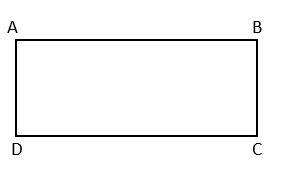
AD is parallel to BC
The measure of the sum of all the angles equals \(360^\circ\).
Length of AB equal to length DC.
AB is perpendicular to AC.
Show answer and explanation
D
In any rectangle, sides are not perpendicular to diagonals.
The area of a rectangular yard is \(90\) square meters. What is its width if its length is \(15\) meters?
\(10\) meters
\(8\) meters
\(6\) meters
\(4\) meters
Show answer and explanation
C
Let \(y\) be the width of the rectangle. Then; \(15×y=90→y=\frac{90}{15}=6\)
Which statement about \(4\) multiplied by \(\frac{3}{5}\) must be true?
The product is between \(1\) and \(2\)
The product is greater than \(3\)
The product is equal to \(\frac{75}{31}\)
The product is between \(2\) and \(2.5\)
Show answer and explanation
D
\( 4×\frac{3}{5}=\frac{12}{5}=2.4 \)
\( 2.4>2\)
\( 2.4<3\)
\( \frac{75}{31}=2.419≠2.4\)
\(2<2.4<2.5 \) This is the answer!
Which of the following lists shows the fractions in order from least to greatest?
\(\frac{3}{4}, \frac{2}{7}, \frac{3}{8} , \frac{5}{11}\)
\(\frac{3}{8}, \frac{2}{7}, \frac{3}{4}, \frac{5}{11}\)
\(\frac{2}{7}, \frac{5}{11}, \frac{3}{8}, \frac{3}{4}\)
\(\frac{2}{7}, \frac{3}{8}, \frac{5}{11}, \frac{3}{4}\)
\(\frac{3}{8}, \frac{2}{7}, \frac{5}{11}, \frac{3}{4}\)
Show answer and explanation
C
Let’s compare each fraction:
\(\frac{2}{7}< \frac{3}{8}< \frac{5}{11} < \frac{3}{4}\)
Only choice C provides the right order.
A car costing \($300\) is discounted \(10\%\). Which of the following expressions can be used to find the selling price of the car?
\((300)(0.4)\)
\(300-(300×0.1)\)
\((300)(0.1)\)
\( 300-(300×0.9)\)
Show answer and explanation
B
To find the discount, multiply the number (\(100\%\)\(-\) rate of discount)
Therefore; \(300(100\%-10\%)=300(1-0.1)=300-(300×0.1)\)
What is the missing price factor of the number \(420\)?
\(420=2^2×3^1×…\)
\(2^2×3^1×5^1×7^1\)
\(2^2×3^1×7^1×9^1\)
\(1^2×2^3×2^1×3^1\)
\(3^2×5^1×7^1×9^1\)
Show answer and explanation
A
\(420=2^2×3^1×5^1×7^1\)
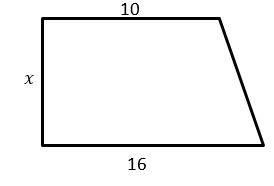
If the area of the following trapezoid is equal to \(A\), which equation represents \(x\)?
Best 6th Grade IAR Math Practice Resource
\(x = \frac{13}{A}\)
\(x = \frac{A}{13}\)
\( x=A+13\)
\( x=A-13\)
Show answer and explanation
B
The area of the trapezoid is: area= \(\frac{(base 1+base 2)}{2}×height= (\frac{10 + 16}{2})x = A\)
\( →13x = A→x = \frac{A}{13}\)
Common Core Math Exercise Book for Grade 6 Student Workbook and Two Realistic Common Core Math Tests

Related to This Article
More math articles
- The Best Grade 3 ELA Practice Tests for Oklahoma Students
- How to Master Calculus: A Beginner’s Guide to Understanding and Applying Limits
- Fibonacci Calculator — nth Number & Sequence
- 3rd Grade K-PREP Math Worksheets: FREE & Printable
- Top 10 CHSPE Math Prep Books (Our 2023 Favorite Picks)
- Grade 8 ELA Tests: A Clear Parent Guide to Reading, Writing, and Test-Day Readiness
- Word Problems That Use Algebra: 15 Examples Solved Step by Step
- Full-Length 8th Grade FSA Math Practice Test
- How to Write an Equation from a Graph?
- 4th Grade KAP Math Worksheets: FREE & Printable






What people say about "10 Most Common 6th Grade IAR Math Questions"?
No one replied yet.