Number Properties Puzzle – Challenge 15
A mathematical challenge to tease your brain. Have a look at the solution to the puzzle if you can’t solve it! Let’s challenge your brain!
Challenge:
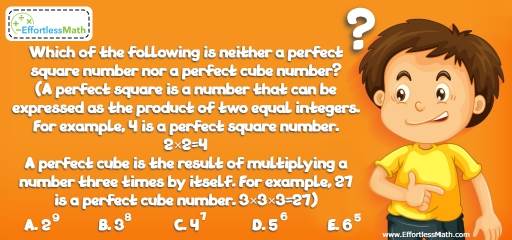
Which of the following is neither a perfect square number nor a perfect cube number? (A perfect square is a number that can be expressed as the product of two equal integers. For example, 4 is a perfect square number. 2×2=4
A perfect cube is the result of multiplying a number three times by itself. For example, 27 is a perfect cube number. 3×3×3=27)
A- \(2^9\)
B- \(3^8\)
C- \(4^7\)
D- \(5^6\)
E- \(6^5\)
The Absolute Best Book to Challenge Your Smart Student!

The correct answer is E.
Let’s analyze each option:
\(2^9 = (2^3)^3\), therefore, \(2^9\) is a perfect cube number.
\(3^8 = (3^4)^2\), therefore, \(3^8\) is a perfect square number.
\(4^7 = (2^2)^7 = 2^{14} = (2^7)^2\), therefore, \(4^7\) is a perfect square number.
\(5^6 = (5^3)^2\), therefore, \(5^6\) is a perfect square and perfect cube number.
\(6^5\) cannot be written with different base. So, this is the answer!The Absolute Best Books to Ace Algebra

Related to This Article
More math articles
- Top 10 Free Websites for HSPT Math Preparation
- Grade 2 English Worksheets for Nevada Students — Free PDFs
- 3rd Grade MEAP Math Practice Test Questions
- Free Grade 5 English Worksheets for Maryland Students
- 6th Grade MAP Math Practice Test Questions
- Top 10 Tips to Create the CLEP College Algebra Study Plan
- Free Grade 4 English Worksheets for Kentucky Students
- Top 10 Tips to Overcome SSAT Math Anxiety
- 4th Grade Scantron Math Worksheets: FREE & Printable
- How to Calculate the Volume of Cubes and Prisms








What people say about "Neither a Perfect Square Nor a Perfect Cube"?
No one replied yet.