Distributive Property: Examples, Signs and Equations
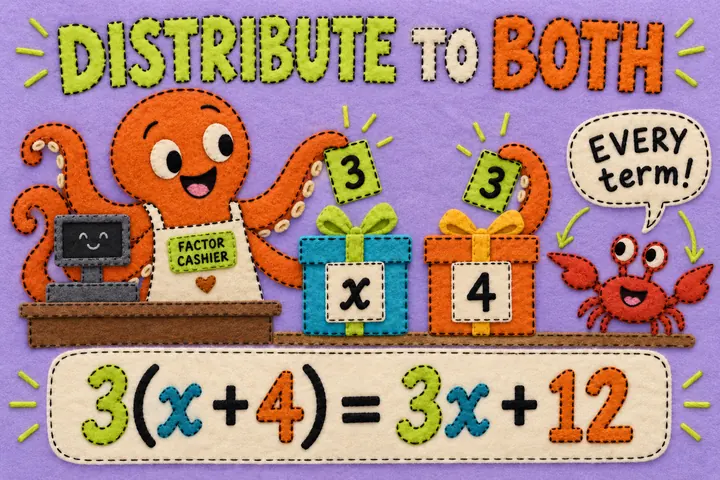
Use the distributive property to multiply a factor by every term in parentheses. For example, \(3(x+4)=3x+12\). Keep each term’s sign, then combine like terms. Use the examples below to compare expanding an expression with solving an equation.
Quick answer: The distributive property says a(b + c) = ab + ac. Multiply the number outside the parentheses by every term inside, then add the results. Example: 3(x + 8) = 3·x + 3·8 = 3x + 24. If the outside number is negative, it changes the sign of every term: −7(x − 2) = −7x + 14.
Solving Equations with the Distributive Property: what to notice and how to work it
What to notice first
Common student mistake
Key formulas and cues
A reliable path
- Simplify each sideDistribute and combine like terms before moving variables.
- Collect variablesUse inverse operations to get variable terms on one side and constants on the other.
- Check in the originalSubstitute the solution into the original equation to check both sides.
Worked examples
Distribute, then solve
- Distribute 3: \(3x+6=21\).
- Subtract 6, then divide by 3: \(3x=15\), so \(x=5\).
- Check in the original: \(3(5+2)=21\).
Distribute with variables on both sides
- Distribute 2: \(4x-6=2x+10\).
- Subtract \(2x\) and add 6: \(2x=16\).
- Divide by 2, then check: \(2(2(8)-3)=26=2(8)+10\).
Try one before moving on
Equation warm-up: pop-up practice
What Is the Distributive Property?
The distributive property states that multiplying a number by a sum (or difference) is the same as multiplying that number by each addend and then adding (or subtracting) the results:

\(a(b + c) = \text{ ab } + \text{ ac }\)
\(a(b – c) = \text{ ab } – \text{ ac }\)
This works for any real numbers a, b, and c, and it works with variables too.
How to Apply the Distributive Property
With Numbers
Multiply the outside factor by each term inside the parentheses.
- \(3(2 + 4) = 3 \times 2 + 3 \times 4 = 6 + 12 = 18\) ✓ (same as \(3 \times 6 = 18\))
- \(5(6 – 3) = 5 \times 6 – 5 \times 3 = 30 – 15 = 15\) ✓
With Variables
The process is identical — multiply the outside term by every term inside.
- \(3(x + 4) = 3x + 12\)
- \(5(2x – 3) = 10x – 15\)
With a Negative Factor
A negative sign outside the parentheses flips the sign of every term inside.
- \(-2(x + 6) = -2x – 12\)
- \(-(x + 9) = -x – 9\)
Step-by-Step Summary
- Identify the factor being multiplied outside the parentheses.
- Multiply that factor by the first term inside the parentheses.
- Multiply that factor by the second term (and every additional term).
- Keep the same operation (+ or −) between the resulting terms.
- Combine like terms if possible.
Watch: The Distributive Property (Algebra Basics)
Math Antics introduces the distributive property in its general algebraic form with clear examples:
The Distributive Property – Worked Examples
Example 1: Expand \(4(x + 5)\).
Multiply 4 by each term: \(4 \times x = 4x\) and \(4 \times 5 = 20\).
Result: \(4x + 20\). Check (\(x = 2\)): \(4(7) = 28 = 4(2)+20 = 28\) ✓
Example 2: Expand \(5(2x – 3)\).
Multiply 5 by each term: \(5 \times 2x = 10x\) and \(5 \times (-3) = -15\).
Result: \(10x – 15\).
Example 3: Expand \(-2(x + 6)\).
\(\text{ Multiply } -2\) by each term: \((-2) \times x = -2x\) and \((-2) \times 6 = -12\).
Result: \(-2x – 12\).
Example 4: Simplify \(3(x + 2) + 4(x – 1)\).
Distribute: \(3x + 6 + 4x – 4\). Combine like terms: \(7x + 2\).
More Practice: Distributive Property with Algebraic Expressions
Khan Academy applies the distributive property to algebraic expressions with additional examples:
Exercises for the Distributive Property
Expand each expression using the distributive property.
- \(4(x + 5)\)
- \(-3(2x – 1)\)
- \(6(3 + x)\)
- \(2(5x – 4)\)
- \(-(x + 9)\)
- \(3(x + 2) + 4(x – 1)\)
Answers
- \(4x + 20\)
- \(-6x + 3\)
- \(18 + 6x\)
- \(10x – 8\)
- \(-x – 9\)
- \(7x + 2\)
Free The Distributive Property Worksheet
Ready to practice on your own? Download our free The Distributive Property worksheet below, work through each problem at your own pace, and then check your answers. If a few give you trouble, scroll back up to the worked examples and try again, steady practice is the surest way to master The Distributive Property before a quiz or test.
Download Variables Expressions and Properties Worksheet
Distributive Property Examples, Step by Step
These are the kinds of problems you will see in homework. Multiply the outside number by each term inside, and keep track of the signs.
- Use the distributive property to expand 3(x + 8). 3 · x = 3x and 3 · 8 = 24. Answer: 3x + 24.
- Distribute −3(2 + 2x). −3 · 2 = −6 and −3 · 2x = −6x. Answer: −6 − 6x. You can also write it as −6x − 6.
- Expand −7(x − 2). −7 · x = −7x and −7 · (−2) = +14. A negative times a negative is positive. Answer: −7x + 14.
- Expand −(4x − 5). A minus sign in front means −1. −1 · 4x = −4x and −1 · (−5) = +5. Answer: −4x + 5.
- Simplify 2(3x − 1) + 5. Distribute first: 6x − 2 + 5. Then combine the numbers: 6x + 3.
Check your work: pick a value such as x = 1. For −7(x − 2): −7(1 − 2) = −7(−1) = 7, and −7(1) + 14 = 7. Both sides match.
Distributive Property Rules at a Glance
| Form | Rule | Example |
|---|---|---|
| Over addition | a(b + c) = ab + ac | 4(x + 5) = 4x + 20 |
| Over subtraction | a(b − c) = ab − ac | 5(2x − 3) = 10x − 15 |
| Negative outside | −a(b + c) = −ab − ac | −2(x + 6) = −2x − 12 |
| Negative outside, minus inside | −a(b − c) = −ab + ac | −7(x − 2) = −7x + 14 |
| Factoring (in reverse) | ab + ac = a(b + c) | 6x + 12 = 6(x + 2) |
| Mental math | Split a number into easy parts | 7 × 98 = 7(100 − 2) = 700 − 14 = 686 |
The most common mistake is multiplying only the first term, such as writing 3(x + 8) = 3x + 8. Every term inside the parentheses gets multiplied.
Frequently Asked Questions
What is the distributive property?
The distributive property says a(b + c) = ab + ac: multiply the number outside the parentheses by every term inside, then add the products. For example, 5(6 + x) = 30 + 5x. It works with subtraction too, as in 10(2x − 3) = 20x − 30, and it is the main tool for removing parentheses in algebra.
How do you use the distributive property to expand 3(x + 8)?
Multiply 3 by each term inside the parentheses: 3 × x = 3x and 3 × 8 = 24, so 3(x + 8) = 3x + 24. Stop there, because 3x and 24 are not like terms and cannot be combined. A quick check: if x = 2, the original gives 3 × 10 = 30, and 3(2) + 24 = 30 as well.
How do you distribute −3(2 + 2x)?
Multiply −3 by both terms and keep track of signs: −3 × 2 = −6 and −3 × 2x = −6x, so −3(2 + 2x) = −6 − 6x. A negative outside the parentheses flips the sign of every term inside. With a subtraction inside, such as −7(x − 2), the second product becomes positive: −7x + 14.
How does the distributive property work with variables?
Treat the variable like any other factor and use exponent rules when variables multiply. For example, −3x(−x + 2) = (−3x)(−x) + (−3x)(2) = 3x² − 6x. Likewise, 2(10x² + 4x) = 20x² + 8x. Multiply the coefficients, add the exponents on matching variables, and keep each sign attached to its term.
How do you use the distributive property for 24 + 40?
Factor out the greatest common factor, which is 8: 24 + 40 = 8(3 + 5). Then 8 × 8 = 64, which matches the original sum. This reverse use of the distributive property is called factoring, and it is a common fifth- and sixth-grade task where students rewrite a sum as a product of the GCF and a smaller sum.
What is an example of a distributive property word problem?
Suppose a class buys 6 notebooks at $3 and 6 pens at $2. The total is 6(3 + 2) = 6 × 3 + 6 × 2 = 18 + 12 = $30. The property also speeds up mental math: 7 × 98 = 7(100 − 2) = 700 − 14 = 686, which is easier than multiplying 98 directly.
Related Topics
- Order of Operations
- Translate Phrases into an Algebraic Statement
- Multiplying and Dividing Integers
- Integers and Absolute Value
- Exponential Growth and Decay
For connected lessons, use the Algebra 1 learning center. For another explanation of the rule, see the OpenStax distributive property lesson.

Related to This Article
More math articles
- The Best Grade 8 ELA Practice Tests for Ohio Students
- Production Explains the U Shapes
- The Best Grade 8 Math Book for Rhode Island Students
- How to Solve Multi-Step Inequalities? (+FREE Worksheet!)
- FREE 6th Grade MEAP Math Practice Test
- Advanced Vocabulary Words: Gauche to Illustrious
- The Best Grade 3 Math Book for Nevada Students
- Community, Gemeinschaft, and Gesellschaft
- FREE 3rd Grade PSSA Math Practice Test
- 10 Most Common 5th Grade FSA Math Questions
What people say about "Distributive Property: Rules, Examples and Practice"?
No one replied yet.