How to Help Your 6th Grade Student Prepare for the Maryland MCAP Math Test

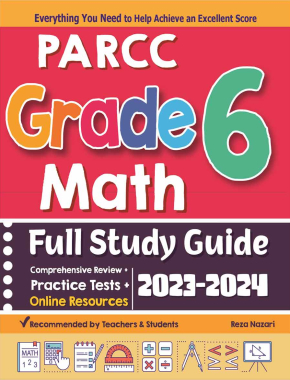
The Maryland MCAP tests 6th grade math across ratios and proportional relationships, the number system, expressions and equations, geometry, and statistics. This guide covers what your student needs in each area, how the test is formatted, and where to start if time is short.
Understanding the Maryland MCAP 6th Grade Math Test
The MCAP assesses students’ understanding of key math concepts and skills essential for academic success. In 6th grade, the test covers various math domains, including operations, geometry, measurement, data, and more. It features a set number of questions with specific time limits and different question types. Understanding the scoring system and proficiency levels is fundamental for interpreting your child’s results. The test is typically administered at a specific time during the academic year, and the results does much of the work in understanding your child’s math proficiency level. For additional educational resources website.

Key Math Skills Your 6th Grader Needs to Master
Operations & Algebraic Thinking
In this domain, students should demonstrate a solid understanding of mathematical operations, equations, and patterns. For example, your child should be able to solve multi-step word problems involving all four operations and recognize numerical patterns in sequences. For additional educational resources website.
Number & Operations in Base Ten
Understanding place value and performing operations with whole numbers and decimals are essential skills for 6th graders. Your child should be able to fluently divide multi-digit numbers and apply place value concepts to solve real-world problems. For additional educational resources website.
Number & Operations, Fractions
Being proficient in fraction operations, comparing fractions, and converting between fractions and decimals are key skills at this level. Your child should understand how to add, subtract, multiply, and divide fractions and apply these skills in various contexts. For additional educational resources website.
Measurement & Data
In this domain, students work with various units of measurement, interpret data from graphs and tables, and solve problems involving area, perimeter, and volume. Your child should be able to analyze data sets and draw conclusions based on the information provided. For additional educational resources website.
Geometry
Geometry concepts such as identifying and classifying shapes, calculating area and perimeter, and understanding angles are fundamental for 6th graders. Your child should be able to apply geometric principles to solve problems involving shapes and spatial relationships. For additional educational resources website.
Building Strong Math Foundations at Home
Supporting your child’s math learning at home is essential for their success. Here are some strategies to help your 6th grader develop a strong math foundation:
- Daily Practice: Encourage your child to practice math regularly, focusing on areas where they need improvement.
- Real-World Math: Incorporate math into everyday activities like cooking, budgeting, and measuring to make learning fun and practical.
- Games and Activities: Engage your child with math games that reinforce number sense and problem-solving skills.

Using Manipulatives and Visual Aids
Manipulatives such as blocks, counters, and geometric shapes can help your child visualize math concepts and strengthen their understanding. Incorporating visual aids like diagrams and charts can make abstract ideas more concrete.
Reading Math Books Together
Exploring math-themed books with your child can spark their interest and deepen their understanding of mathematical concepts. Look for engaging books that present math in a relatable and enjoyable way.
Technology Resources
Uses educational apps and websites that offer interactive math lessons and practice problems tailored to your child’s skill level. Incorporating technology into your child’s learning can make math more engaging and accessible.
Effective Study and Practice Strategies
Help your child develop effective study habits and practice strategies to prepare for the MCAP. Here are some tips to support their learning:
- Creating a Realistic Study Schedule: Establish a consistent study routine that includes dedicated time for math practice.
- Making Practice Engaging: Use games, puzzles, and hands-on activities to make math practice enjoyable for your child.
- Using Practice Tests: Familiarize your child with the test format by providing practice tests and guiding them through the solutions.
Test-Taking Strategies and Techniques
Equip your child with effective test-taking strategies to approach the MCAP with confidence. Here are some techniques to help them perform their best:
- Time Management: Teach your child how to allocate time wisely during the test to ensure they complete all questions.
- Reading Word Problems: Guide your child through the process of understanding and interpreting word problems accurately.
- Problem-Solving Strategies: Encourage your child to explore different approaches to solving math problems and choose the most efficient method.
Supporting Your Child Emotionally
Emotional support is necessary for your child’s success on the MCAP. Here are some strategies to help them manage test anxiety and stay motivated:
- Recognizing Test Anxiety: Learn to identify signs of test anxiety in your child and provide strategies to help them cope.
- Building Confidence: Celebrate your child’s progress and strengths to boost their confidence and self-esteem.
- Positive Learning Environment: Create a supportive and encouraging atmosphere at home that encourages a love for learning and growth.
Practice Resources and Tools
Explore a variety of practice resources and tools to sharpen your child’s math skills and test readiness. Here are some recommendations:
- Practice Materials: Review high-quality practice materials that align with the MCAP standards and provide targeted practice for your child.
- Online Resources: Uses online platforms and apps that offer interactive math lessons, practice problems, and educational games.
- Creating Your Own Problems: Develop custom math problems that challenge your child’s thinking and reinforce key concepts.
Creating a Test Day Success Plan
Popular Math Books
Prepare your child for test day with a well-structured plan that includes both academic and personal readiness. Here’s a guide to help you work through the days leading up to the MCAP:
- Week Before the Test: Review key concepts, ensure your child gets enough rest, and maintain a healthy routine.
- Day Before the Test: Organize necessary materials, encourage relaxation, and offer words of encouragement and support.
- Test Day Preparation: Establish a morning routine, pack essential items, and provide a nutritious breakfast to fuel your child’s brain.
Frequently Asked Questions
What does 6th grade math cover?
Sixth grade math in Maryland covers five domains: ratios and proportional relationships, the number system, expressions and equations, geometry, and statistics and probability. Students find unit rates and percents, divide fractions, work with negative numbers, solve equations like 4x = 28, find area of triangles and volume of prisms, and describe data with mean and median.
What are the Maryland 6th grade math standards?
Maryland’s 6th grade math standards are part of the Maryland College and Career Ready Standards, which share the structure of the Common Core: ratios, number system, expressions and equations, geometry, and statistics. The MCAP grade 6 math test is built on these standards. The Maryland State Department of Education website has the full standards and assessment details.
What is the Maryland 6th grade math curriculum?
Maryland sets the standards, but each county school system chooses its own curriculum, textbooks and pacing. Most 6th grade programs begin with ratios and rates, move to fraction division and negative numbers, then expressions and equations, geometry and statistics. Your child’s teacher or the county’s math office can share the unit sequence so home practice matches class.
Can 6th graders do algebra?
Yes. Sixth graders begin algebra by writing and evaluating expressions such as 3x + 2 when x = 5 (which gives 17), and by solving one-step equations and inequalities. Some Maryland students who are ahead move into accelerated math that leads to Algebra 1 by 7th or 8th grade. Placement depends on your county’s policies and your child’s readiness.
Is 6th grade math hard?
Sixth grade math can feel harder because it moves from arithmetic into more abstract ideas like ratios, negative numbers and variables. Students who are solid with multiplication facts and fractions usually adjust well. If your child is struggling, review fraction skills first, since dividing fractions like 2/3 ÷ 1/6 = 4 and ratio problems build on them.
How do you learn 6th grade math?
Work through one topic at a time, starting with ratios and fractions, and practice a few problems daily rather than cramming. Use real situations: if 3 notebooks cost $4.50, one costs $1.50, which is a unit rate. Before the MCAP, try the official practice tests from the Maryland State Department of Education so the online format feels familiar.
Final Thoughts
In summary, supporting your 6th-grade student in preparing for the Maryland MCAP Math Test involves a combination of academic guidance, emotional support, and effective study strategies. By creating a positive learning environment at home, implementing practical study techniques, and supporting your child’s confidence, you can help them succeed on test day and beyond.
Remember, the journey of math learning is a continuous process that builds essential skills for lifelong success. Encourage your child to embrace challenges, celebrate their progress, and stay motivated on their mathematical journey. Together, you can equip your child to excel in math and achieve their full potential.
For additional practice and resources to support your child’s math education, explore our Grade 6 Math Worksheets and other helpful materials. Keep nurturing your child’s mathematical growth, and witness their achievements soar!
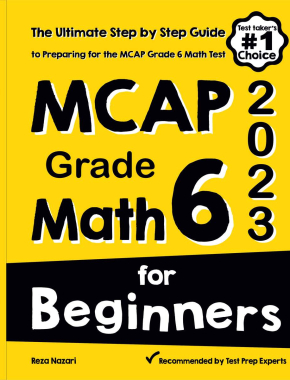
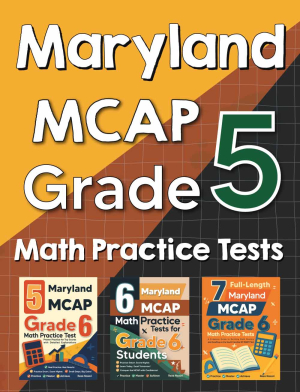
Our Featured Products

Related to This Article
More math articles
- Rise of the Republican Party: Why the Whigs Collapsed
- How to Simplify Ratios? (+FREE Worksheet!)
- Louisiana LEAP Grade 3 Math: 49 Free Single-Page Printables, One Skill Each, Answer Keys Included
- The Ultimate MTTC Mathematics (Elementary) (089) Course (+FREE Worksheets & Tests)
- 6th Grade MAP Math FREE Sample Practice Questions
- Fiscal Federalism: Grants, Matching Funds and Conditions
- Free Grade 4 English Worksheets for Washington Students
- Absolute Value Definition
- The Freedmen’s Bureau and the Meanings of Freedom
- Oklahoma OSTP Grade 6 Math Free Worksheets: 72 Free PDF Worksheets Aligned to OAS Math Standards




What people say about "Preparing Your Grade 6 Student for Maryland MCAP Math"?
No one replied yet.