Unlock Your Potential: “HiSET Math for Beginners” Comprehensive Guide
This Solution Manual is a compendium of invaluable resources, meticulously providing detailed solutions to all the exercises in the original book. It includes a comprehensive answer key and step-by-step explanations, all aimed at enriching your understanding and elevating your confidence. Dive into this indispensable tool, uniquely designed to propel you to HiSET Math mastery! For additional educational resources,.
Commence Your HiSET Math Odyssey Today!
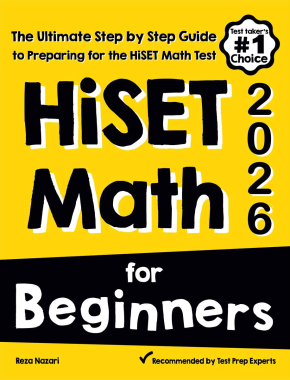
Feeling daunted by the HiSET Math exam? Cast aside your concerns! Our “HiSET Math for Beginners” is specially curated to streamline and optimize your study experience. This isn’t just a guide; it’s a strategic blueprint for your HiSET Math triumph in 2026.
The Absolute Best Book to Ace the HiSET Math Test
Active Learning Strategies Using This HiSET Math Answer Guide
The HiSET (High School Equivalency Test) Mathematics section evaluates your ability to solve practical problems involving arithmetic, algebra, geometry, and data interpretation. This guide provides answers plus reasoning explanations for every problem. Most importantly, you’ll get maximum benefit by using the guide actively rather than passively. Active approaches include Self-Check (solve first, then verify), Learning (read examples first for unfamiliar topics), and Pattern Recognition (identify recurring problem structures).
Three Active Approaches to Using This Guide
The Self-Check approach means you solve each problem completely before consulting the guide. Once you’ve written your solution and arrived at an answer, check the guide. If your answer matches, examine the explained solution. Often multiple valid methods exist; learning alternative approaches builds flexibility and speed. If your answer differs, study the guide’s solution to locate your error. Categorize your mistake: Did you misread the question? Make an arithmetic error? Apply incorrect methodology? Understanding error types prevents repetition.
The Learning approach works when material is entirely new to you. Read the worked examples in the guide first. See how experts approach the problem. Observe which steps are performed and why. Then attempt similar problems independently. This sequence builds your mental model before you face unsupported problem-solving. Many students learn more efficiently through worked examples than through solving blind and checking afterward.
The Pattern Recognition approach involves studying multiple solutions to identify recurring structures. HiSET questions frequently follow predictable patterns. Percent increase and decrease problems have standard setup procedures. Finding missing angles in geometry uses consistent logical steps. Table interpretation requires systematic data extraction. Identifying these patterns during study accelerates your test-day problem-solving because you immediately recognize question type and access the corresponding solution method.
Guide Organization and Study Plan Structure
Part One covers foundational arithmetic including whole numbers, decimals, fractions, and basic operations. Part Two focuses on percentages, ratios, and rates with emphasis on real-world applications. Part Three addresses algebra and word problems requiring equation setup and solution. Part Four covers geometry and measurement. Part Five includes data interpretation from graphs, tables, and statistical measures. Begin with a diagnostic practice test to identify weak areas. Concentrate study effort on identified weaknesses rather than attempting to review everything equally.
Five-Week Intensive Preparation Plan
Week One includes diagnostic testing and arithmetic review. Identify your specific weak areas. Review foundational concepts you’ve forgotten. Build confidence with basic operations. Week Two focuses on percentages and real-world math. Study money-related problems, discounts, tips, and commission calculations. Practice rate problems involving distance, time, and speed. Week Three tackles algebra, equation-solving, and word problem translation. Learn to transform English descriptions into mathematical equations. Practice solving multiple equation types. Week Four covers geometry and data interpretation. Study area and volume formulas. Practice extracting information from graphs and tables. Week Five includes full-length practice tests (2-3 tests) completed under timed conditions. After each test, thoroughly review every error using this guide. Focus on understanding the reasoning, not memorizing answers.
Extracting Maximum Value from Each Solution Explanation
Read problem statements carefully before checking the answer. Ensure you understand what’s being asked. Following the solution step-by-step, understand why each step matters. For word problems, identify the information you need versus irrelevant details. For computational problems, verify each arithmetic operation. Try problems again days later without consulting the guide. Successful re-solving indicates mastery; repeated errors signal topics needing additional focus. Track which problem types give you consistent difficulty and plan extra review for these areas.
Common error patterns include misreading (restate what you need to find before solving), computational mistakes (guide shows all steps allowing you to pinpoint errors), incorrect methodology (guide demonstrates correct approach), and incomplete solutions (guide shows all necessary steps). By analyzing your personal error patterns, you can target remediation efficiently.
Use our ultimate HiSET math formula cheat sheet for quick reference and the GED math test-taking strategies which largely transfer to HiSET preparation.
Active Learning Strategies Using This HiSET Math Answer Guide
The HiSET (High School Equivalency Test) Mathematics section evaluates your ability to solve practical problems involving arithmetic, algebra, geometry, and data interpretation. This guide provides answers plus reasoning explanations for every problem. Most importantly, you’ll get maximum benefit by using the guide actively rather than passively. Active approaches include Self-Check (solve first, then verify), Learning (read examples first for unfamiliar topics), and Pattern Recognition (identify recurring problem structures).
Three Active Approaches to Using This Guide
The Self-Check approach means you solve each problem completely before consulting the guide. Once you’ve written your solution and arrived at an answer, check the guide. If your answer matches, examine the explained solution. Often multiple valid methods exist; learning alternative approaches builds flexibility and speed. If your answer differs, study the guide’s solution to locate your error. Categorize your mistake: Did you misread the question? Make an arithmetic error? Apply incorrect methodology? Understanding error types prevents repetition.
The Learning approach works when material is entirely new to you. Read the worked examples in the guide first. See how experts approach the problem. Observe which steps are performed and why. Then attempt similar problems independently. This sequence builds your mental model before you face unsupported problem-solving. Many students learn more efficiently through worked examples than through solving blind and checking afterward.
The Pattern Recognition approach involves studying multiple solutions to identify recurring structures. HiSET questions frequently follow predictable patterns. Percent increase and decrease problems have standard setup procedures. Finding missing angles in geometry uses consistent logical steps. Table interpretation requires systematic data extraction. Identifying these patterns during study accelerates your test-day problem-solving because you immediately recognize question type and access the corresponding solution method.
Guide Organization and Study Plan Structure
Part One covers foundational arithmetic including whole numbers, decimals, fractions, and basic operations. Part Two focuses on percentages, ratios, and rates with emphasis on real-world applications. Part Three addresses algebra and word problems requiring equation setup and solution. Part Four covers geometry and measurement. Part Five includes data interpretation from graphs, tables, and statistical measures. Begin with a diagnostic practice test to identify weak areas. Concentrate study effort on identified weaknesses rather than attempting to review everything equally.
Five-Week Intensive Preparation Plan
Week One includes diagnostic testing and arithmetic review. Identify your specific weak areas. Review foundational concepts you’ve forgotten. Build confidence with basic operations. Week Two focuses on percentages and real-world math. Study money-related problems, discounts, tips, and commission calculations. Practice rate problems involving distance, time, and speed. Week Three tackles algebra, equation-solving, and word problem translation. Learn to transform English descriptions into mathematical equations. Practice solving multiple equation types. Week Four covers geometry and data interpretation. Study area and volume formulas. Practice extracting information from graphs and tables. Week Five includes full-length practice tests (2-3 tests) completed under timed conditions. After each test, thoroughly review every error using this guide. Focus on understanding the reasoning, not memorizing answers.
Extracting Maximum Value from Each Solution Explanation
Read problem statements carefully before checking the answer. Ensure you understand what’s being asked. Following the solution step-by-step, understand why each step matters. For word problems, identify the information you need versus irrelevant details. For computational problems, verify each arithmetic operation. Try problems again days later without consulting the guide. Successful re-solving indicates mastery; repeated errors signal topics needing additional focus. Track which problem types give you consistent difficulty and plan extra review for these areas.
Common error patterns include misreading (restate what you need to find before solving), computational mistakes (guide shows all steps allowing you to pinpoint errors), incorrect methodology (guide demonstrates correct approach), and incomplete solutions (guide shows all necessary steps). By analyzing your personal error patterns, you can target remediation efficiently.
Use our ultimate HiSET math formula cheat sheet for quick reference and the GED math test-taking strategies which largely transfer to HiSET preparation.

Related to This Article
More math articles
- Exponents and Powers: Rules You’ll Use for Life
- Adding & Subtracting Fractions Practice — Free Drills
- Gender Socialization and Social Structure
- 10 Most Common 7th Grade PARCC Math Questions
- How to Solve Angles and Angle Measure? (+FREE Worksheet!)
- Claims in Science: What Is Being Argued
- 5th Grade AZMerit Math Worksheets: FREE & Printable
- Free Grade 6 English Worksheets for Washington Students
- Overview of the ISEE Middle-Level Mathematics Test
- New Mexico NM-MSSA Grade 8 Math Free Worksheets: Printable Grade 8 Math PDFs with Worked Solutions








What people say about "Unlock Your Potential: “HiSET Math for Beginners” Comprehensive Guide - Effortless Math"?
No one replied yet.