Free Grade 5 English Worksheets for Florida Students
Fifth grade in Florida comes with its own framework, the Florida B.E.S.T. (Benchmarks for Excellent Student Thinking) Standards. That’s *not* Common Core. It has its own organization and its own emphasis. The good news: universal Grade 5 reading and writing skills don’t change at the state line. Main idea is main idea. Context clues are context clues. The worksheets below cover those universal skills, lined up against what BEST expects.
Quick answer: These 21 free Grade 5 English worksheets are made for Florida kids and follow the B.E.S.T. ELA standards that FAST Reading measures. They cover literature, nonfiction, foundational reading, writing, listening and speaking, and vocabulary. A good first pair is one reading skill, such as main ideas and summary, and one word skill, such as context clues.
This page is a working stash for Florida fifth graders. The worksheets line up with the Florida B.E.S.T. (Benchmarks for Excellent Student Thinking) Standards, the same skills your child’s teacher is hitting between August and May. They also happen to be the same skills F.A.S.T. leans on in the spring, but that’s not the point. The point is steady practice on the right things.
Everything here is a free PDF. Click the title, the file opens, you print it. No account, no email, no “sign up to unlock.” Hand the same worksheet to a tutor, photocopy it for two cousins, leave it folded in the glove compartment, whatever works.
A note on the count
You’ll notice this Florida page has fewer worksheets than the pages for some other states. That’s intentional. We’ve included the 21 worksheets that genuinely match what BEST asks at Grade 5 ELA, and skipped the ones built around standards that don’t appear in the Florida framework in the same way. The goal is relevance, not volume.
What’s actually on this page
21 single-skill worksheets, grouped by what they’re actually doing. Each one is short on purpose. Fifth graders don’t need a 14-page packet. They need ten or fifteen minutes on one thing, a conversation about why an answer was wrong, and then dinner.
The Quick Review at the top of every PDF is the actual teaching part. Read it with your kid before they pick up the pencil. The answer key on the last page explains the *why*, not just the *what*, which is where most of the learning happens.
Reading: Literature
- Theme and Summary in Stories, Drama, and Poetry, [ELA.5.R.1.2] the big idea, in your own words
- How Chapters, Scenes, and Stanzas Fit Together, [ELA.5.R.1.3] how each part builds on the last
- How a Narrator’s Point of View Shapes a Story, [ELA.5.R.3.3] who is telling, and what that changes
Reading: Nonfiction
- Two or More Main Ideas and Summary, [ELA.5.R.2.2] long articles often have more than one
- Comparing Text Structures Across Two Texts, [ELA.5.R.2.1] how two writers organize the same topic
- Comparing Multiple Accounts of the Same Event, [ELA.5.R.2.3] two angles on what happened
- Reasons and Evidence Supporting Specific Points, [ELA.5.R.2.4] claim → reason → evidence
Foundational Reading Skills
- Decoding Multisyllable Words: Roots, Affixes, and Syllable Patterns, [ELA.5.F.1.3] break the long ones into pieces
- Reading Fluency: Accuracy, Rate, and Expression, [ELA.5.F.1.4] read aloud like talking, not robot
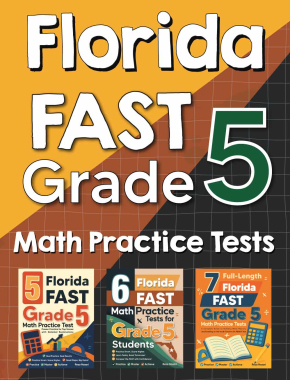
Working on Math Too? Try the Florida FAST Grade 5 Math Bundle
Many fifth graders are getting ready for the FAST in both subjects. If your child also needs math practice that matches the same standards, this companion bundle is the shortest path, workbook, study guide, and full practice tests in one download.
Writing
- Opinion Writing with Logically Ordered Reasons, [ELA.5.C.1.3] say what you think, and order your reasons
- Informative / Explanatory Writing with Concrete Details, [ELA.5.C.1.4] teach with specific facts, not vague hints
- Narrative Writing with Pacing, Dialogue, and Description, [ELA.5.C.1.2] tell a story with pacing and dialogue
- Planning, Revising, Editing, and Rewriting, [ELA.5.C.5.1] make a draft better in passes
- Short Research Projects with Multiple Sources, [ELA.5.C.4.1] ask a question, find sources, write it up
Listening and Speaking
- Engaging in Collaborative Discussions, [ELA.5.C.2.1] how to be a useful voice in a group
- Reporting on a Topic with a Logical Sequence, [ELA.5.C.2.1] tell a class about something, in order
Vocabulary and Word Study
- Context Clues for Word Meaning, [ELA.5.V.1.3] use surrounding words to find meaning
- Greek and Latin Roots and Affixes, [ELA.5.V.1.2] tele-, photo-, port, dict, struct, anti-
- Interpreting Figurative Language: Similes and Metaphors, [ELA.5.R.3.1] what the comparison is really saying
- Idioms, Adages, and Proverbs, [ELA.5.R.3.1] piece of cake; the early bird gets the worm
- Synonyms, Antonyms, and Homographs, [ELA.5.V.1.2] near-meanings, opposites, and tricky same-spelled words
How to actually use these without burning your kid out
A small confession from years of watching well-meaning parents pile up the printouts: the trick isn’t more worksheets. It’s slower worksheets. Three suggestions that actually work:
Pick one. Sit with it. The temptation is to grab six and call it a study session. Resist that. One worksheet, with a real conversation about the wrong answers, will teach more than six speed-runs.
Talk about the misses, not the hits. When your kid gets one wrong, ask them to read the explanation in the answer key out loud. If they can re-explain why the right answer is right, that’s the moment the skill actually went in.
Wait several days before circling back. If something is shaky today, don’t drill it tonight. Try a different worksheet on the same skill in five or six days. The space between attempts is where retention lives.
A word about F.A.S.T.
In Florida, the spring F.A.S.T. Test samples the BEST skills your child is already supposed to be learning all year. These worksheets aren’t a F.A.S.T. cram pack. They’re skill builders that happen to line up with what F.A.S.T. measures because both use the same BEST skill list.
If you only have time to pick two to start with, make them Main Idea, Key Details, and Summary and Context Clues for Word Meaning. Both show up disproportionately on the reading sections, and most kids who lose points on F.A.S.T. Reading lose them on one or the other.
Questions that come up a lot
Are these aligned to Florida’s standards? Yes. Each worksheet targets a specific Grade 5 skill from the Florida B.E.S.T. (Benchmarks for Excellent Student Thinking) Standards.
Can I use these for homeschool? Yes, and plenty of Florida homeschool families do. They work well as the practice piece after a longer lesson, or as a five-day rotation through the four big skill areas.
My kid reads above grade level, what should I pick? Try Comparing Themes and Patterns Across Cultures and Greek and Latin Roots and Affixes. Both stretch confident readers in ways that are still on grade.
My kid is behind on reading, where do I start? Don’t start with the long passages. Start with Greek and Latin Roots and Affixes and Context Clues for Word Meaning. They unlock a surprising amount of the rest.
Is there an answer key? Every PDF has one on the last page, written so the student can understand the explanation themselves.
Before you print
If the first worksheet doesn’t land, don’t take it personally. Some skills need a different angle on a different day. Try a shorter one. Try one in a different skill area. Try the same one again next Tuesday after school. Practice doesn’t have to be perfect to be useful. It just has to keep happening. Come back whenever you need a new one.
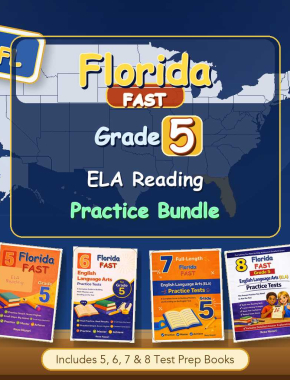
Best Bundle to Ace the Florida FAST Grade 5 ELA
Looking for the best resource to help your kid ace the Florida FAST? Try this bundle, four full practice-test books (5 + 6 + 7 + 8 tests) covering the same Grade 5 reading, writing, and language skills your child is already learning. Instant PDF download, answer keys included.
How FAST Reading and B.E.S.T. Writing Fit Fifth Grade
Florida fifth graders meet two state ELA assessments, and they work a little differently.
- FAST ELA Reading is a progress monitoring test given three times a year, near the beginning, middle and end of the school year. It is computer-based and measures the B.E.S.T. reading and vocabulary benchmarks.
- B.E.S.T. Writing is a separate test for grades 4 through 10. It is not part of the three FAST check-ins, so writing practice deserves its own time.
| Worksheet group on this page | Where it helps most |
|---|---|
| Reading: Literature and Reading: Nonfiction | FAST ELA Reading passages and questions |
| Vocabulary and Word Study | Word meaning questions on FAST ELA Reading |
| Writing | B.E.S.T. Writing and classroom essays |
| Foundational Reading Skills | Reading accurately and fluently, which supports every passage |
| Listening and Speaking | Class discussions and oral reports |
If your child’s fall FAST report shows a weak area, pick the matching group and work one sheet from it each week before the next check-in.
Frequently Asked Questions
Are there free worksheets for kids in Florida?
Yes. The Florida Grade 5 English set has 21 free printable PDFs that follow the B.E.S.T. ELA standards. They cover reading literature and nonfiction, foundational skills, writing, listening and speaking, and vocabulary. A good place to begin is one reading skill, such as main idea and summary, paired with one word skill, such as context clues.
What are the Florida FAST score levels?
FAST results are reported in five achievement levels, from Level 1 to Level 5. Level 3 means a student is on grade level, and Levels 4 and 5 show stronger mastery. If your fifth grader scores at Level 1 or 2 in reading, focused practice on skills like main idea, text structure and vocabulary in context can help close the gap.
Is there a Florida FAST 5th grade practice test?
The Florida Department of Education posts practice materials for FAST on its statewide assessment portal, so students can see the question types and testing tools before the real thing. Pair a practice session with skill worksheets: if your child struggles with a passage, work on that exact skill, like comparing text structures, before trying more test-style questions.
What does a Florida FAST score breakdown show for Grade 5 reading?
The report gives a scale score, an achievement level, and how your child did in each reporting category, such as reading prose and poetry, reading informational text, and reading across genres and vocabulary. Look for the weakest category and choose worksheets that match it, for example nonfiction main idea sheets if informational text is low.

Related to This Article
More math articles
- Exploring the Alternating Series Test: Convergence and Divergence
- Entry determines whether profit persists
- The Physics Toolkit: Measurement, Units, Vectors, and Graphs
- Comparing and Ordering Decimals for 5th Grade: Step-by-Step Guide
- 4th Grade SBAC Math Practice Test Questions
- How to Find the Integral of Radicals
- What is the Relationship Between Arcs and Central Angles?
- 6th Grade PARCC Math FREE Sample Practice Questions
- Number Properties Puzzle – Challenge 16
- The Best Grade 5 ELA Practice Tests for Pennsylvania Students






What people say about "Free Florida Grade 5 ELA Worksheets for Kids (B.E.S.T.)"?
No one replied yet.