Free Grade 6 English Worksheets for Delaware Students
Sixth grade is where reading stops being practice and starts being work. The difference is not subtle. In fifth grade, a student reads a passage and answers questions. In sixth grade, a student reads a passage and is asked to do something with it, quote the line that proves the inference, name the central idea without falling for the convincing detail, identify what an author actually claims versus what an author merely mentions. The verbs change. The questions get sharper. The wrong answers get sneakier.
That shift happens everywhere, but Delaware families feel it on a particular timeline. The school year sits between two short coastlines and one big DelDOT commute, and homework time can be a tight wedge between the end of after-school and the start of dinner. Practice has to be efficient or it does not happen.
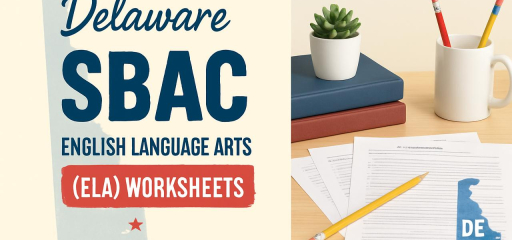
The worksheets below are designed for that reality. Forty-six free PDFs, each one a single-skill page tied to the Delaware English Language Arts Standards. The whole catalog is free. No login, no email, no ads inside the file.
What’s on this page
Each PDF has three pieces: a short Quick Review that explains the skill in plain language, a set of grade-level practice items, and an answer key on the last page that walks through the reasoning behind every right and wrong answer.
The catalog is grouped by skill area below. The order inside each group is rough, start with whatever section matches what your kid’s teacher mentioned in the latest assignment or progress note.
Reading: Literature
- Citing Textual Evidence and Drawing Inferences, [RL.6.1] make the inference, then anchor it to a specific line
- Theme and Objective Summary, [RL.6.2] the whole story’s lesson, said in one careful sentence
- Plot, Episodes, and Character Change, [RL.6.3] small events that bend a character toward change
- Figurative Language, Connotation, and Tone, [RL.6.4] the feeling words carry beyond their definition
- Structure: How a Scene or Stanza Builds the Whole, [RL.6.5] naming the job a section does
- Developing the Narrator’s Point of View, [RL.6.6] how a writer keeps you inside one perspective
- Reading vs. Watching: Comparing Versions, [RL.6.7] what print does that screens cannot
- Comparing Stories Across Forms and Genres, [RL.6.9] same idea, different shapes
Reading: Informational Text
- Citing Evidence and Drawing Inferences in Nonfiction, [RI.6.1] careful conclusions, sentence-anchored
- Central Idea and Objective Summary in Nonfiction, [RI.6.2] the article’s main point versus a supporting detail
- How Ideas and Events Are Developed, [RI.6.3] introduce, elaborate, illustrate, compare
- Word Meaning in Nonfiction: Figurative, Connotative, Technical, [RI.6.4] three different jobs a word can hold
- Text Structure: How Sections Fit Together, [RI.6.5] problem, cause, effect, solution, comparison
- Author’s Point of View and Purpose, [RI.6.6] angle and motive
- Integrating Information from Text, Visuals, and Data, [RI.6.7] words, chart, image as one combined read
- Evaluating Arguments and Claims, [RI.6.8] claim, support, judgment of the support
- Comparing Two Authors on the Same Topic, [RI.6.9] different facts, different angles, same subject
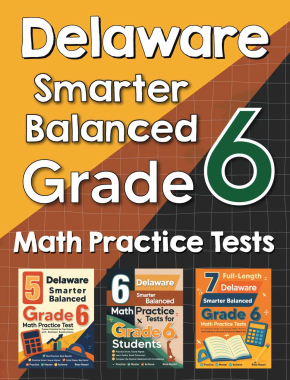
Working on Math Too? Try the Delaware Smarter Balanced Grade 6 Math Bundle
Many third graders are getting ready for the Smarter Balanced in both subjects. If your child also needs math practice that matches the same standards, this companion bundle is the shortest path, workbook, study guide, and full practice tests in one download.
Writing
- Argument Writing: Claim, Reasons, Evidence, [W.6.1] defend a position with reasons and quotes
- Informative and Explanatory Writing, [W.6.2] teach a reader clearly and in order
- Narrative Writing, [W.6.3] hook, develop, resolve
- Clear Writing for Task, Purpose, and Audience, [W.6.4] match the writing to who is reading
- Planning, Revising, and Editing, [W.6.5] drafts improve in passes
- Short Research Projects, [W.6.7] focused question, multiple sources, tight write-up
- Gathering, Evaluating, and Citing Sources, [W.6.8] credible sources, properly credited
Speaking & Listening
- Collaborative Discussions, [SL.6.1] prepared, attentive, additive
- Interpreting Diverse Media, [SL.6.2] strengths and limits of each format
- Analyzing a Speaker’s Argument, [SL.6.3] claim, reasons, gaps
- Presenting Claims and Findings, [SL.6.4] preview, present, close
- Adapting Speech to Context, [SL.6.6] formal and informal English on demand
Grammar
- Pronoun Case: Subjective, Objective, and Possessive, [L.6.1a] I, me, my and the rules behind them
- Intensive Pronouns, [L.6.1b] myself, themselves, for emphasis
- Avoiding Shifts in Pronoun Number and Person, [L.6.1c] hold the person and number through the paragraph
- Vague Pronouns and Unclear Antecedents, [L.6.1d] every pronoun needs a clear noun
- Recognizing and Improving Non-Standard English, [L.6.1e] switching into school English on demand
Conventions: Punctuation, Spelling
- Punctuation: Commas, Parentheses, and Dashes, [L.6.2a] three ways to slip in extra information
- Spelling Grade-Appropriate Words, [L.6.2b] homophones and the steady misses
Knowledge of Language and Style
- Varying Sentence Patterns for Style, [L.6.3a] combine, expand, rearrange
- Consistency in Style and Tone, [L.6.3b] pick a register, hold it
Vocabulary and Word Study
- Using Context Clues, [L.6.4a] read the words around the strange word
- Greek and Latin Roots and Affixes, [L.6.4b] root pieces that unlock hundreds of words
- Using Dictionaries and Thesauruses Effectively, [L.6.4c] match the tool to the question
- Verifying Word Meaning, [L.6.4d] confirm the guess
- Figurative Language: Personification and More, [L.6.5a] language moves writers use on purpose
- Word Relationships: Cause-Effect, Part-Whole, Category, [L.6.5b] predictable patterns that link words
- Connotation: Shades of Meaning, [L.6.5c] between near-synonyms
- Academic and Domain-Specific Vocabulary, [L.6.6] high-utility academic words plus subject-specific ones
How to use these worksheets at home
Three rules. They are not new and they are not clever, but they are the difference between practice that works and practice that does not.
Rule one: short and frequent beats long and rare. Twelve minutes on Tuesday, twelve on Thursday, twelve on Sunday. Three small sessions a week will produce more durable learning than a Saturday-morning sit-down that runs for an hour and ends in tears.
Rule two: the answer key is the lesson. The practice items are the diagnostic. When your sixth grader gets one wrong, do not move on. Hand them the answer key and ask them to read the explanation out loud. The moment they can rephrase the explanation in their own words is the moment the skill consolidates.
Rule three: space the practice. Returning to the same skill four days apart cements the skill better than drilling it twice in one night. The break is not laziness. It is how memory works. Sixth graders do not retain through repetition. They retain through retrieval, which only happens after a forgetting interval.
Beyond the three rules, one piece of practical advice: keep printed worksheets in a folder on the kitchen counter, not buried in a binder. The friction of “where is that worksheet” is the difference between a session that happens and a session that does not.
A note about Smarter Balanced ELA
Delaware uses the Smarter Balanced ELA assessment at Grade 6 in the spring, aligned to the Delaware English Language Arts Standards. The test combines reading sections with literary and informational passages, a listening section, and a performance task with extended writing built on multiple texts. It is computer-adaptive, adjusting to a student’s answers as they go.
The skills the test rewards are not mysterious. They are the moves these worksheets train: pulling evidence, identifying central ideas, working out word meaning in context, evaluating arguments, and writing organized responses that cite the sources. A sixth grader who works through pages like these across the year arrives at the spring window familiar with what the test is asking, even though they have never seen the specific passages.
Want everything in one bundle?
Some Delaware families prefer a single organized resource. The state’s Grade 6 ELA Preparation Bundle is built around full-length practice tests, which mirror the format of the actual spring assessment more closely than any single worksheet can.
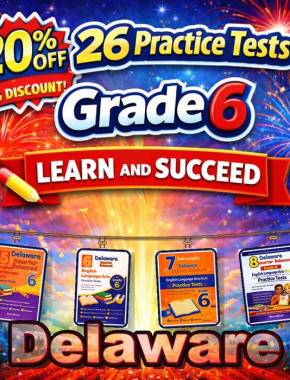
Delaware Grade 6 ELA Preparation Bundle, four practice-test books, 26 unique full-length tests, complete answer keys with explanations.
Questions Delaware families bring up
Are these usable across the Smarter Balanced practice cycle? Yes. The worksheets are not test prep in the cram sense, but they exercise the same standards Smarter Balanced measures, which makes them strong year-round preparation.
My child reads above grade level, what should I pick? Look at the argument analysis, source evaluation, and connotation pages. Strong readers often have weak spots in those areas because their general reading speed lets them skim past the small distinctions that those skills demand.
My child reads below grade level, where do I start? Begin with the Greek and Latin Roots worksheet, the Context Clues worksheet, and the Central Idea worksheet. Those three open more of the rest of the catalog than any other combination, and they tend to feel approachable rather than punishing.
Do these work for tutoring sessions? Yes. A single-skill worksheet is the right scale for a thirty-minute tutoring block, diagnostic at the start, teaching in the middle, retrieval at the end.
Is there a printable answer key? Every PDF includes one on its last page. The answer key explains its reasoning rather than just listing letters, which is what makes it useful for the student to read alone.
A short closing
Print one worksheet tonight. Set the timer for fifteen minutes. Have one short conversation about a single skill. That is the whole strategy, and it works. Come back tomorrow for the next one.
Best Bundle to Ace the Delaware Smarter Balanced Grade 6 ELA
Looking for the best resource to help your kid ace the Delaware Smarter Balanced? Try this bundle, four full practice-test books (5 + 6 + 7 + 8 tests) covering the same Grade 6 reading, writing, and language skills your child is already learning. Instant PDF download, answer keys included.

Related to This Article
More math articles
- Functionalist, Conflict, Feminist, and Interactionist Views of Family
- How to Find the Number of Solutions to a Linear Equation?
- The Wonderful World of the Triangle Inequality Theorem
- The Best Algebra 1 Book for Louisiana Students
- Is ACCUPLACER Math Hard? Tests, Scores and Study Plan
- Key Historical Documents
- How to Understand Convergent and Divergent Series
- Math As The Language Of Chance: An Introduction To Probability
- Top 10 6th Grade FSA Math Practice Questions
- How to Graph Proportional Relationships and Find the Slope





What people say about "Free Grade 6 English Worksheets for Delaware"?
No one replied yet.