Organizations, Control, and the Experience of Work
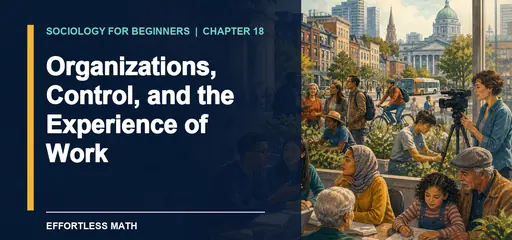
Chapter 18 of the Sociology for Beginners study guide on Effortless Math covers Organizations, Control, and the Experience of Work: the key terms, the core ideas, and worked examples showing how this topic is tested on this course.
Sociology for Beginners · Chapter 18
Organizations, Control, and the Experience of Work
Work is productive activity. An occupation is a recognized category of paid work, while a job is a particular position in an organization or market. Unpaid care, household labor, volunteering, and subsistence production are work even when they do not appear on a payroll. Limiting the analysis to paid employment hides much of the activity that sustains workers and communities.
Frederick Taylor’s scientific management divided work into measured tasks and placed planning under management control. The system can make a process predictable and reduce wasted motion. It can also narrow skill and discretion. Later forms of electronic monitoring can count keystrokes, route drivers, record calls, or rank workers through customer ratings. The tool does not dictate one outcome. Ownership, rules, and worker voice shape how monitoring is used.
Workers exercise skill even in tightly designed jobs. They interpret unusual cases, help coworkers, repair breakdowns, and manage emotions. Emotional labor is the management of feeling and expression as part of paid work. A flight attendant who must remain reassuring during conflict performs emotional labor. Comforting a friend may be demanding emotion work, but it is not paid occupational emotional labor.
Precarious work offers limited security, unpredictable hours, weak protections, or uncertain income. Temporary contracts and platform work can provide flexibility while shifting risk to workers. A contractor may choose when to log in yet lack control over price, account suspension, or access to customers. Flexibility and insecurity can exist together.
Deskilling occurs when a work process removes judgment or expertise from a role, often by transferring knowledge to machinery, software, or management. Upskilling occurs when new tasks require greater knowledge or responsibility. Automation can do both across different positions. A hospital system may automate routine coding while creating specialist roles in data quality. A single claim that technology simply destroys or improves work misses the organizational distribution.
Quick review: Work includes paid and unpaid productive activity. Scientific management moves planning toward management and divides tasks. Emotional labor manages feeling for a paid role. Precarious work shifts insecurity toward workers. Technology may deskill one role and upskill another.
Watch the lesson connection
Economic Systems and the Labor Market gives you a second explanation of the ideas surrounding this lesson. As you watch, pause when the lesson concept appears and explain how the example fits.
Try the idea yourself
Write one original example, one close nonexample, and one observation that would help you tell them apart. That small exercise turns a definition into a sociological tool you can use in daily life.

Related to This Article
More math articles
- The Best Grade 4 ELA Practice Tests for Iowa Students
- North Carolina EOG Grade 7 Math Worksheets: 95 Free Printable Skill PDFs with Keys
- Best Note-Taking Tablet for College Students
- Competing Visions of Modernity: The New Woman, Mass Entertainment, and the Lost Generation
- Overview of the SAT Mathematics Test
- How to Motivating Disengaged Learners to Enjoy Learning Math
- Twenty-Fifth Amendment
- Set Calculator — Union, Intersection & Difference (Free)
- Reading and Interpreting Bar Graphs for 4th Grade
- Understanding Decimals for 5th Grade: Place Value and Meaning


















What people say about "Organizations, Control, and Work Experience"?
No one replied yet.