Top 10 SAT Math Practice Questions

Preparing for the SAT Math test? The best way to prepare for your SAT Math test is to work through as many SAT Math practice questions as possible. Here are the top 10 SAT Math practice questions to help you review the most important SAT Math concepts. These SAT Math practice questions are designed to cover mathematics concepts and topics that are found on the actual test. The questions have been fully updated to reflect the latest 2026 SAT guidelines. Answers and full explanations are provided at the end of the post. For additional educational resources,.
Start your SAT Math test prep journey right now with these samples of SAT Math questions.
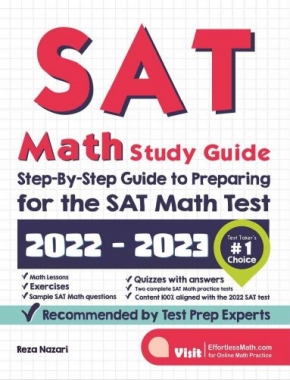
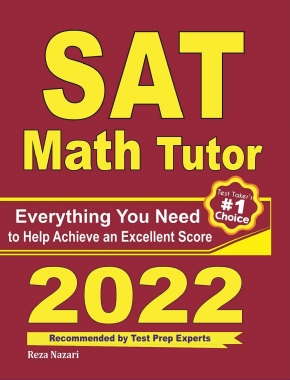
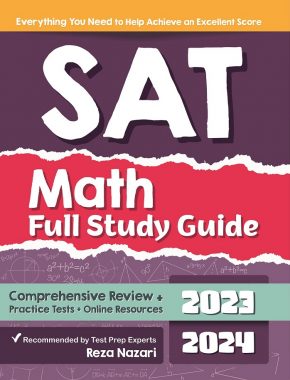
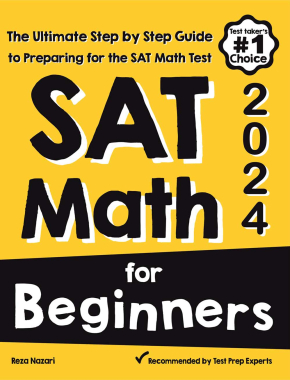
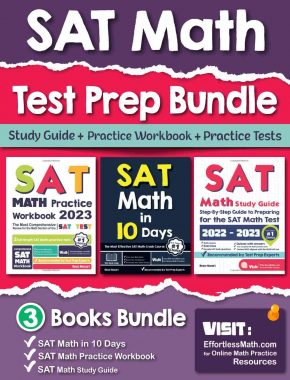
The Absolute Best Book to Ace the SAT Math Test
of \(x\) and \(a + b = 7\), what are the two possible values for c?
A. 22, 21
B. 20, 22
C. 23, 26
D. 24, 23
7- If \(x≠-4\) and \(x≠5\), which of the following is equivalent to \(\frac{1}{\frac{1}{x – 5} + \frac{1}{x + 4}}\)?
A. \(\frac{(x-5)(x+4)}{(x-5)+(x+4)}\)
B. \(\frac{(x+4)+(x-5)}{(x+4)(x-5)}\)
C. \(\frac{(x+4)(x-5)}{(x+4)-(x+5)}\)
D. \(\frac{(x+4)+(x-5)}{(x+4)-(x-5)}\)
8- What is the sum of all values of n that satisfies \(2n^2+16n+24=0\)?
A. 8
B. 4
C. \(-4\)
D. \(-8\)
9- For \(i=\sqrt {(-1)}\), what is the value of \(\frac{3+2i}{5+i}\)
A. \(i\)
B. \(\frac{32i}{5}\)
C. \(\frac{17-i}{5}\)
D. \(\frac{17+7i}{26}\)
10- Calculate \(f(5)\) for the following function \(f\).
\(f(x)=x^2-3x\)
A. 5
B. 10
C. 15
D. 20
Best SAT Math Workbook Resource for 2026
Answers:
1- D
Since N=6, substitute 6 for N in the equation \(\frac{x – 3}{5} = N\), which gives \(\frac{x – 3}{5} = 6\).
Multiplying both sides of \(\frac{x – 3}{5}) = 6\) by 5 gives \(x – 3 = 30\)
and then adding 3 to both sides of \(x – 3 = 30\) then, \( x = 33\)
2- C
Method 1: Plugin the values of \(x\) and \(y\) provided in the options into both equations.
\( (4,3) → x+y=0→4+3≠0\)
\((5,4) → x+y=0→5+4≠0\)
\((4,-4) →x+y=0→4+(-4)=0\)
\((4,-6) →x+y=0→4+(-6)≠0\)
Only option C is correct.
3- B
The total number of pages read by Sara is 3 (hours she spent reading) multiplied by her rate of reading: \(N \ \frac{pages}{hour }× 3hours = 3N\)
Similarly, the total number of pages read by Mary is 4 (hours she spent reading) multiplied by her rate of reading:
\(M \space \frac{pages}{hour}× 4hours =4M \)
the total number of pages read by Sara and Mary is the sum of the total number of pages read by Sara and the total number of pages read by Mary: \(3N+4M\)
4- C
First, find the equation of the line. All lines through the origin are of the form \(y = mx\), so the equation is \(y=\frac{1}{3}x\). Of the given choices, only choice C (9,3), satisfies this equation:
\(y=\frac{1}{3}x→3=\frac{1}{3}(9)=3\)
5- C
First, find the value of b, and then find \(f(3)\).
Since \(f(2) = 35\), substuting \(2\) for \(x\) and \(35\) for \(f(x)\) gives \(35=b(2)^2+15=4b+15\).
Solving this equation gives \(b = 5\). Thus
\(f(x)=5x^2+15\)
\(f(3)=5(3)^2+15→f(3)=45+15\)
\( f(3)=60\)
6- C
You can find the possible values of a and b in \((ax + 4)(bx + 3)\) by using the given equation \(a + b = 7\) and finding another equation that relates the variables a and b.
Since \((ax+4)(bx+3)=10x^2+cx+12\), expand the left side of the equation to obtain \(abx^2+4bx+3ax+12=10x^2+cx+12\)
Since ab is the coefficient of \(x^2\) on the left side of the equation and 10 is the coefficient of \(x^2\) on the right side of the equation, it must be true that \(ab=10\)
The coefficient of x on the left side is \(4b + 3a\) and the coefficient of \(x\) in the right side is c. Then:
\(4b+3a=c\)
\(a + b = 7\), then: \(a = 7 – b\)
Now, plug in the value of a in the equation \(ab = 10\). Then:
\(ab=10→(7-b)b=10→7b-b^2=10\)
Add \(-7b+b^2\) both sides. Then:
\(b^2-7b+10=0\)
Solve for \(b\) using the factoring method.
\(b^2-7b+10=0→(b-5)(b-2)=0\)
Thus, either \(b=2\) and \(a = 5\), or \(b = 5\) and \(a = 2\). If \(b = 2\) and \(a = 5\), then:
\(4b+3a=c→4(2)+3(5)=c→c=23\)
If 5 = 2 and a = 2, then
\(4b+3a=c→4(5)+3(2)=c→c=26\)
Therefore, the two possible values for \(c\) are \(23\) and \(26\).
7- A
To rewrite \(\frac{1}{\frac{1}{x – 5} + \frac{1}{x + 4}}\), first simplify \(\frac{1}{x – 5} + \frac{1}{x + 4}\)
\(\frac{1}{x – 5} + \frac{1}{x + 4}= \frac{1(x+4)}{(x-5)(x+4)}+ \frac{1(x-5)}{(x+4)(x-5)}=\frac{(x+4)+(x-5)}{(x+4)(x-5)}\)
Then:
\(\frac{1}{\frac{1}{x – 5} + \frac{1}{x + 4}}= \frac{1}{\frac{(x+4)+(x-5)}{(x+4)(x-5)}
}= \frac{(x-5)(x+4)}{(x-5)+(x+4)}\)
(Remember, \(\frac{1}{\frac{1}{x}} = x\))
This result is equivalent to the expression in choice A.
8- D
The problem asks for the sum of the roots of the quadratic equation (2n^2+16n+24=0). Dividing each side of the equation by 2 gives (n^2+8n+12=0).
If the roots of \(n^2+8n+12=0\) are \(n_{1}\) and \(n_{2}\),
then the equation can be factored as \(n^2+8n+12=(n – n_{1})(n – n_{2} )=0\).
Looking at the coefficient of n on each side of \(n^2+8n+12 = (n + 6)(n+2)\) gives \(n=-6\) or \(n=-2\)
then,
\(-6+(-2)=-8\)
9- D
To perform the division \(\frac{3 + 2i}{5+i}\), multiply the numerator and denominator of \(\frac{3+2i}{5+1i}\) by the conjugate of the denominator, \(5 – i\).
This gives \(\frac{(3+2i)(5-i)}{(5+1i)(5-i)}=\frac{15-3i+10i-2i^2}{5^2-i^2}\).
Since \(i^2=-1\), this can be simplified to
\(\frac{15-3i+10i+2}{25+1}=\frac{17+7i}{26}\).
10- B
The input value is 5. Then: \(x = 5\)
\(f(x)=x^2-3x→ f(5)=5^2-3(5)=25-15=10\)
High School Equivalency Tests
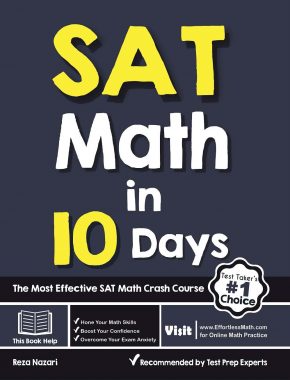
Looking for the best resource to help you succeed on the SAT Math test?
The Best Books to Ace the SAT Math Test
Related to This Article
More math articles
- Top 10 CHSPE Math Prep Books (Our 2023 Favorite Picks)
- Top 10 TSI Math Test-taking Tips
- How to Order Fractions: Step-by-Step Guide
- Special Right Triangles
- The Best HiSET Math Worksheets: FREE & Printable
- 5 Best Mini Laptops to Use Anytime, Anywhere
- 10 Most Common 4th Grade OST Math Questions
- 10 Most Common HSPT Math Questions
- Innovative Forecasts: Population Models are Predicting the Future
- 5th Grade MAP Math FREE Sample Practice Questions


What people say about "Top 10 SAT Math Practice Questions - Effortless Math: We Help Students Learn to LOVE Mathematics"?
No one replied yet.