MTEL Middle School Mathematics Flashcards
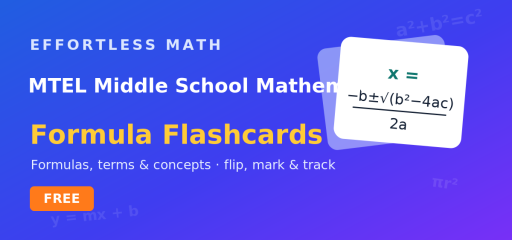
MTEL Middle School Mathematics Flashcards: a free, printable set covering the topics you will see on the test, with answer keys included, so you can practice each topic one skill at a time and check your own work before test day.
Free MTEL Middle School Mathematics review
Lock in every key MTEL Middle School Mathematics formula, term, and concept with a free, interactive flashcard deck covering number theory, algebra and functions, exponential and logarithmic, trigonometry, analytic geometry, sequences and discrete, calculus: derivatives, calculus: integrals, probability and statistics, linear algebra and matrices.
Each card shows the rule or definition, a short explanation, and many include a quick diagram. Flip a card, filter by topic or card type, shuffle, and mark what you know so the cards you miss come back for review.
95flashcards
11topics covered
13cards with a diagram
Freeonline, progress saved
What These MTEL Middle School Mathematics Flashcards Cover
This free deck collects the formulas, key terms, and concepts students use across the whole MTEL Middle School Mathematics course, organized into 11 topics. Use the dropdown to study one topic at a time, or shuffle the full deck for mixed review before a test.
| Topic | Cards | What students review |
|---|---|---|
| Number Theory | 9 cards | Prime number, Fundamental theorem of arithmetic, GCD and LCM relationship, Modular arithmetic. |
| Algebra & Functions | 12 cards | Function, Domain and range, Function composition, Inverse function. |
| Exponential & Logarithmic | 6 cards | Exponent laws, Definition of a logarithm, Logarithm properties, Change of base. |
| Trigonometry | 10 cards | Sine, cosine, tangent, the unit circle, special triangles. |
| Analytic Geometry | 8 cards | Distance formula, Midpoint formula, Slope and line forms, Equation of a circle. |
| Sequences & Discrete | 8 cards | Arithmetic sequence, Arithmetic series, Geometric sequence, Geometric series. |
| Calculus: Derivatives | 12 cards | Limit, Continuity, Definition of the derivative, Power rule. |
| Calculus: Integrals | 8 cards | Power rule for integration, Definite integral, Fundamental theorem of calculus, Common antiderivatives. |
| Probability & Statistics | 10 cards | Measures of center, Spread: range, variance, SD, Probability of an event, Addition rule. |
| Linear Algebra & Matrices | 8 cards | Matrix addition and scalar multiples, Matrix multiplication, Identity matrix, Determinant of a 2×2. |
| Test Facts | 4 cards | Test format, question types, and calculator policy. |
Jump to a Topic
Number TheoryAlgebra & FunctionsExponential & LogarithmicTrigonometryAnalytic GeometrySequences & DiscreteCalculus: DerivativesCalculus: IntegralsProbability & StatisticsLinear Algebra & MatricesTest Facts
Number Theory
9 cards. This topic covers Prime number, Fundamental theorem of arithmetic, GCD and LCM relationship, Modular arithmetic, Rational vs. irrational, and Imaginary unit.
Algebra & Functions
12 cards. This topic covers Function, Domain and range, Function composition, Inverse function, Quadratic formula, and Discriminant.
Exponential & Logarithmic
6 cards. This topic covers Exponent laws, Definition of a logarithm, Logarithm properties, Change of base, Exponential growth and decay, and The number e.
Trigonometry
10 cards. The sine, cosine, and tangent ratios, the unit circle, special right triangles, and basic trig identities.
Analytic Geometry
8 cards. This topic covers Distance formula, Midpoint formula, Slope and line forms, Equation of a circle, Parabola, and Ellipse and hyperbola.
Sequences & Discrete
8 cards. This topic covers Arithmetic sequence, Arithmetic series, Geometric sequence, Geometric series, Binomial theorem, and Permutations.
Calculus: Derivatives
12 cards. This topic covers Limit, Continuity, Definition of the derivative, Power rule, Product rule, and Quotient rule.
Calculus: Integrals
8 cards. This topic covers Power rule for integration, Definite integral, Fundamental theorem of calculus, Common antiderivatives, u-substitution, and Area between curves.
Probability & Statistics
10 cards. This topic covers Measures of center, Spread: range, variance, SD, Probability of an event, Addition rule, Multiplication rule, and Conditional probability.
Linear Algebra & Matrices
8 cards. This topic covers Matrix addition and scalar multiples, Matrix multiplication, Identity matrix, Determinant of a 2×2, Inverse of a 2×2, and Solving systems with matrices.
Test Facts
4 cards. Quick facts about the MTEL Middle School Mathematics test, the math question types, and the calculator policy.
How to Use These MTEL Middle School Mathematics Flashcards
1
Pick one topic
Use the topic dropdown instead of facing all 95 cards at once. Start with the topics you find hardest.
2
Flip, then mark
Read the front, say the rule or definition out loud, then flip. Mark Know it only when you can explain it, not just recognize it.
3
Practice right away
After a set, solve a few problems that use those rules. Flashcards build recall; worked practice turns them into test-day tools.
Best Order for Studying
If the deck feels like a lot, study the foundational topics first, such as numbers, fractions and percents, and exponents, then move on to algebra, geometry, and data, and review the test facts last. This moves from the skills every other topic builds on to the ones that appear in specific problem types.
Most Important Formulas and Facts to Know First
- Order of operations: the sequence that keeps every calculation consistent.
- Exponent rules: product, quotient, power, zero, and negative exponents.
- Fraction operations: and converting between fractions, decimals, and percents.
- Percent of a number and percent of change: the backbone of word problems.
- Slope and slope-intercept form: for reading and writing linear graphs.
- Area, perimeter, and volume: the core geometry formulas.
- The Pythagorean theorem: for right triangles and distance.
- Factoring and the quadratic formula: for solving quadratics.
- Mean, median, mode, and range: the four measures that summarize data.
- Probability of an event: favorable outcomes over total outcomes.
Common Mistakes These Cards Help Fix
- Ignoring order of operations and simply working left to right.
- Adding or subtracting fractions without a common denominator.
- Confusing area with perimeter, or surface area with volume.
- Flipping an inequality sign at the wrong time, instead of only when multiplying or dividing by a negative.
- Mixing up mean, median, and mode.
- Treating a negative exponent as a negative number instead of a reciprocal.
- Applying the Pythagorean theorem to triangles that are not right triangles.
Frequently Asked Questions
Is there an MTEL Middle School Math practice test?
Yes, you can find MTEL Middle School Mathematics practice tests, including official practice materials on the MTEL website. A good routine is to take one practice test early to spot weak areas, review those topics with these flashcards, then take a second test closer to exam day under timed conditions to see how much you have improved.
Is there an MTEL Middle School Math study guide?
Yes, study guides for MTEL Middle School Mathematics are available, and the official test objectives are the best place to start because they list exactly what can be tested. Use the objectives as a checklist, a study guide for explanations, and these flashcards for quick daily review of formulas like the distance formula and exponent laws.
What is on the MTEL Middle School Math test?
The MTEL Middle School Mathematics test covers the math middle school teachers need to know well, including number sense, algebra and functions, geometry and measurement, and statistics and probability, with some higher-level topics as well. Check the official MTEL test objectives for the current breakdown, format and passing score before you plan your study schedule.
How do you teach math in middle school?
Teaching middle school math works best when students see why a rule works before they practice it. Use visuals like number lines and area models, connect ratios and equations to real situations, and give short daily review. Knowing the content deeply, the goal of preparing for the MTEL Middle School Mathematics test, makes it much easier to explain ideas in more than one way.
All 102 Flashcards, Text Version
Every card from the deck above, listed as text so you can read, search, or print it without the flip player.
Number Theory
| Front | Back |
|---|---|
| Prime number | A whole number greater than 1 whose only factors are 1 and itself: 2, 3, 5, 7, 11, 13, … |
| Fundamental theorem of arithmetic | Every integer greater than 1 has a unique prime factorization (apart from order). Example: 60 = 2² · 3 · 5. |
| GCD and LCM relationship | For positive integers a and b: GCD(a,b) · LCM(a,b) = a · b. |
| Modular arithmetic | a ≡ b (mod n) means n divides (a − b); a and b have the same remainder when divided by n. Example: 17 ≡ 2 (mod 5). |
| Rational vs. irrational | Rational = a ratio p/q of integers (q ≠ 0), with a terminating or repeating decimal. Irrational = nonrepeating, nonterminating: √2, π, e. |
| Imaginary unit | i = √(−1), so i² = −1. A complex number is a + bi with real part a and imaginary part b. i⁴ⁿ = 1 cycles every 4 powers. |
| Absolute value | |x| is the distance from 0: |x| = x if x ≥ 0, and −x if x < 0. |a − b| is the distance between a and b. |
| Mathematical induction | Prove a statement for all n ≥ 1 by (1) base case n = 1 and (2) assuming it holds for n = k and proving it for n = k + 1. |
| Divisibility tests | ÷3 if the digit sum is divisible by 3; ÷9 if the digit sum is divisible by 9; ÷4 if the last two digits are; ÷8 if the last three digits are. |
Algebra & Functions
| Front | Back |
|---|---|
| Function | A rule pairing each input with exactly one output. A graph is a function if it passes the vertical line test. |
| Domain and range | Domain = all allowed inputs (x). Range = all resulting outputs (y). Exclude inputs that make a denominator 0 or a square root negative. |
| Function composition | (f ∘ g)(x) = f(g(x)): apply g first, then f. In general f(g(x)) ≠ g(f(x)). |
| Inverse function | f⁻¹ undoes f: f(f⁻¹(x)) = x. Find it by swapping x and y and solving for y. Its graph reflects f over the line y = x. |
| Quadratic formula | For ax² + bx + c = 0: x = (−b ± √(b² − 4ac)) / (2a). |
| Discriminant | D = b² − 4ac. D > 0: two real roots. D = 0: one real (double) root. D < 0: two complex roots. |
| Sum and product of roots | For ax² + bx + c = 0: sum of roots = −b/a, product of roots = c/a. |
| Difference and sum of cubes | a³ − b³ = (a − b)(a² + ab + b²); a³ + b³ = (a + b)(a² − ab + b²). |
| Rational function asymptotes | Vertical asymptote where the denominator = 0 (and numerator ≠ 0). Horizontal asymptote from comparing degrees of numerator and denominator. |
| Graph transformations | f(x) + k shifts up k; f(x − h) shifts right h; −f(x) reflects over the x-axis; a·f(x) stretches vertically by a. |
| Solving inequalities | Solve like an equation, but reverse the inequality sign when multiplying or dividing both sides by a negative number. |
| Polynomial end behavior | Set by the leading term. Even degree: both ends go the same way. Odd degree: ends go opposite ways. Positive leading coefficient: right end rises. |
Exponential & Logarithmic
| Front | Back |
|---|---|
| Exponent laws | For x > 0 and real exponents a and b: xᵃ · xᵇ = xᵃ⁺ᵇ, xᵃ ÷ xᵇ = xᵃ⁻ᵇ, and (xᵃ)ᵇ = xᵃᵇ. Also x⁻ᵃ = 1/xᵃ and x⁰ = 1. For a positive integer n, x^(1/n) = ⁿ√x. |
| Definition of a logarithm | For b > 0, b ≠ 1 and x > 0, log_b(x) = y means bʸ = x. A logarithmic function is the inverse of its corresponding exponential function. |
| Logarithm properties | For x > 0 and y > 0, a common base b > 0 with b ≠ 1, and real n: log_b(xy) = log_b x + log_b y; log_b(x/y) = log_b x − log_b y; log_b(xⁿ) = n log_b x. |
| Change of base | For x > 0 and b > 0 with b ≠ 1: log_b(x) = ln(x)/ln(b). You can use any other valid logarithm base in both numerator and denominator. |
| Exponential growth and decay | With A₀ > 0, A = A₀eᵏᵗ grows for k > 0 and decays for k < 0 as t increases. Compound interest: A = P(1 + r/n)ⁿᵗ, with positive principal P, annual decimal rate r, a positive integer n of compounding periods per year, and t years; require 1 + r/n > 0. |
| The number e | e ≈ 2.718 is the base of natural logarithms: ln x = log_e x for x > 0. For a positive initial amount A₀, the continuous model A = A₀eᵏᵗ gives growth when k > 0 and decay when k < 0. |
Trigonometry
| Front | Back |
|---|---|
| SOH CAH TOA | In a right triangle: sin = opposite/hypotenuse, cos = adjacent/hypotenuse, tan = opposite/adjacent. |
| Radian measure | π radians = 180°. To convert: radians = degrees · π/180. Arc length s = rθ (θ in radians). |
| Pythagorean identity | sin²θ + cos²θ = 1. Where cos θ ≠ 0, division gives 1 + tan²θ = sec²θ. Where sin θ ≠ 0, division gives 1 + cot²θ = csc²θ. |
| Reciprocal identities | csc θ = 1/sin θ; sec θ = 1/cos θ; cot θ = 1/tan θ; tan θ = sin θ/cos θ. Each equality applies only where all functions and denominators shown are defined and denominators are nonzero. |
| Sum and difference formulas | sin(A ± B) = sin A cos B ± cos A sin B; cos(A ± B) = cos A cos B ∓ sin A sin B. |
| Double-angle formulas | sin 2θ = 2 sin θ cos θ; cos 2θ = cos²θ − sin²θ = 2cos²θ − 1 = 1 − 2sin²θ. |
| Law of sines | For a triangle, a/sin A = b/sin B = c/sin C, with each side opposite its matching angle. Two sides and a non-included angle (SSA) may give zero, one or two triangles; check the supplementary-angle possibility. |
| Law of cosines | c² = a² + b² − 2ab·cos C. Use with two sides and the included angle, or all three sides. |
| Unit circle | Circle of radius 1; a point at angle θ is (cos θ, sin θ). Key angles 0, π/6, π/4, π/3, π/2 give the standard sine and cosine values. |
| Inverse trig functions | sin⁻¹, cos⁻¹, tan⁻¹ return the angle with a given ratio, on restricted ranges so each output is unique. |
Analytic Geometry
| Front | Back |
|---|---|
| Distance formula | d = √((x₂ − x₁)² + (y₂ − y₁)²). It comes from the Pythagorean theorem. |
| Midpoint formula | M = ((x₁ + x₂)/2, (y₁ + y₂)/2). |
| Slope and line forms | Slope m = (y₂ − y₁)/(x₂ − x₁). Slope-intercept: y = mx + b. Point-slope: y − y₁ = m(x − x₁). Standard: Ax + By = C. |
| Equation of a circle | (x − h)² + (y − k)² = r², center (h, k), radius r. |
| Parabola | y = a(x − h)² + k has vertex (h, k). Opens up if a > 0, down if a < 0. |
| Ellipse and hyperbola | Ellipse: (x−h)²/a² + (y−k)²/b² = 1. Hyperbola: (x−h)²/a² − (y−k)²/b² = 1, asymptote slopes ±b/a. |
| Vector magnitude | For v = ⟨x, y⟩, |v| = √(x² + y²). Add vectors componentwise. |
| Dot product | a · b = a₁b₁ + a₂b₂ = |a||b|cos θ. The vectors are perpendicular when a · b = 0. |
Sequences & Discrete
| Front | Back |
|---|---|
| Arithmetic sequence | Common difference d. nth term: aₙ = a₁ + (n − 1)d. |
| Arithmetic series | Sum of n terms: Sₙ = (n/2)(a₁ + aₙ) = (n/2)(2a₁ + (n − 1)d). |
| Geometric sequence | Common ratio r. nth term: aₙ = a₁·r^(n−1). |
| Geometric series | For a positive integer n and r ≠ 1: Sₙ = a₁(1 − rⁿ)/(1 − r). When r = 1, Sₙ = na₁. For |r| < 1, the infinite geometric series sums to a₁/(1 − r). |
| Binomial theorem | (a + b)ⁿ = Σ_{k=0}^{n} C(n,k) a^(n−k) bᵏ, where C(n,k) are the binomial coefficients. |
| Permutations | For integers 0 ≤ r ≤ n, ordered selections of r distinct objects from n without repetition: nPr = n!/(n − r)!. If repetition is allowed, the counting rule changes. |
| Combinations | For integers 0 ≤ r ≤ n, unordered selections of r distinct objects from n without repetition: nCr = n!/[r!(n − r)!]. Different orders of the same selection count once. |
| Sets and logic | Union A ∪ B = in either set; intersection A ∩ B = in both. Contrapositive of ‘if p then q’ is ‘if not q then not p’ (logically equivalent). |
Number Sense
| Front | Back |
|---|---|
| Unit rate | Divide the first quantity by the second quantity to find the amount for one unit. If 6 notebooks cost $15, the unit price is $15 ÷ 6 = $2.50 per notebook. |
| Percent change | Percent change = (new − original) ÷ original × 100%, with a nonzero original value. A price rising from $40 to $46 increases by 15%. |
| Fraction division model | Dividing by a fraction asks how many groups of that size fit. There are six groups of 1/4 in 3/2, so (3/2) ÷ (1/4) = 6. |
| Scientific notation | Write a nonzero number as a × 10ⁿ with 1 ≤ |a| < 10 and integer n. For example, 0.0042 = 4.2 × 10⁻³. Check the sign of the exponent against the size of the original number. |
Algebra
| Front | Back |
|---|---|
| Proportional relationship | In y = kx, k is the constant of proportionality. The graph passes through the origin, and y/x = k whenever x is nonzero. |
| Linear versus exponential change | A linear pattern has a constant difference over equal input steps. An exponential pattern has a constant ratio. The sequences 3, 7, 11 and 3, 6, 12 illustrate the difference. |
| No solution or infinitely many | After simplifying, a false statement such as 0 = 5 means no solution. An identity such as 0 = 0 means every input allowed by the original equation is a solution. |
| Piecewise-defined function | A piecewise function uses different rules on specified input intervals. Check the interval conditions before substituting, especially at a shared endpoint. |
| Interpret slope and intercept | In C = 8n + 25, the slope 8 is the cost per item and the intercept 25 is the fixed starting cost. Interpret each value with its units. |
| Solving a system by elimination | Multiply equations when needed so one pair of coefficients are opposites; add to eliminate a variable. Substitute the result into an original equation and check both equations. |
| Continuity of a function | A function is continuous at an input when nearby outputs approach its output there, with no break in the graph. A jump or a hole signals a discontinuity. Check that the function is defined at the input. |
| Modeling a budget inequality | If each ticket costs $8 and the total budget is $50, then 8n ≤ 50 for a nonnegative whole number n. At most 6 tickets fit the budget; rounding 6.25 up would exceed it. |
| Inverse proportionality | In y = k/x with x ≠ 0, the product xy stays constant. For a fixed job, doubling the number of equally productive workers halves the time if they can work independently. |
Geometry
| Front | Back |
|---|---|
| Scale factor and measurement | If all lengths scale by a positive factor k, perimeters scale by k, areas by k², and volumes by k³. Doubling lengths multiplies area by 4 and volume by 8. |
| Rounding and measurement error | A measurement rounded to the nearest unit can differ from the true value by up to half a unit. Using the usual round-half-up convention, a reported length of 8 cm can represent 7.5 cm up to, but not including, 8.5 cm. |
| Similar triangles and indirect measurement | Corresponding side lengths of similar triangles have equal ratios. A 2 m pole with a 3 m shadow gives a 10 m tree height when the tree shadow is 15 m under the same conditions. |
| Pythagorean theorem and converse | For a right triangle, a² + b² = c², where c is the hypotenuse. Conversely, if the positive side lengths satisfy this equation for the longest side c, the triangle is right. |
| Cross section of a solid | A cross section is the shape where a plane intersects a solid. A cylinder sliced parallel to its circular bases has a circular cross section. |
| Rigid motion versus dilation | Translations, rotations and reflections preserve lengths and angles. A dilation with a positive scale factor preserves angles and scales lengths, producing a similar figure; it is congruent when the scale factor is 1. |
| Triangle angle reasoning | The interior angles of a Euclidean triangle sum to 180°. If two angles are 48° and 67°, the third is 65°. An exterior angle equals the sum of the two remote interior angles. |
| Classifying quadrilaterals | A rectangle is a parallelogram with four right angles. A rhombus is a parallelogram with four equal sides. A square has both properties, so every square is both a rectangle and a rhombus. |
Data & Probability
| Front | Back |
|---|---|
| Interquartile range | IQR = Q3 − Q1. It describes the spread of the middle half of an ordered data set and is less sensitive to extreme values than the full range. |
| Random sampling and bias | A random sample gives members of the target population a chance to be selected. A voluntary response poll may overrepresent people with strong opinions and may not represent the whole population. |
| Simulation for compound events | Choose a random device that matches the event probabilities, repeat the complete experiment many times, and estimate probability as successes divided by trials. More trials usually make the estimate more stable. |
| Changing a data set | Adding the same number to every value shifts the mean and median by that number without changing the range or standard deviation. Multiplying all values by c multiplies the standard deviation by |c|. |
| Reading a box plot | A box plot marks the median and lower and upper quartiles; the box spans the middle half of the data. Check the key for the whisker convention, since whiskers may show extremes or use an outlier rule. |
Teaching & Reasoning
| Front | Back |
|---|---|
| Explain prerequisites | For an open response about a grades 5–8 standard, identify prerequisite ideas and explain how they support the target skill. For proportional reasoning, connect equivalent ratios, multiplication and unit rates. |
| Support a prediction with evidence | Label graphs and units, show the method, and connect the conclusion to the data. Discuss assumptions and sources of uncertainty that could change the prediction. |
Probability & Statistics
| Front | Back |
|---|---|
| Measures of center | Mean = sum ÷ count. Median = middle value (ordered). Mode = most frequent value. |
| Spread: range, variance, SD | Range = max − min. Variance = average of squared deviations from the mean. Standard deviation σ = √variance. |
| Probability of an event | P(E) = favorable outcomes / total equally likely outcomes, a value from 0 to 1. |
| Addition rule | P(A ∪ B) = P(A) + P(B) − P(A ∩ B). For mutually exclusive events, P(A ∩ B) = 0. |
| Multiplication rule | P(A ∩ B) = P(A)·P(B | A). If A and B are independent, P(A ∩ B) = P(A)·P(B). |
| Conditional probability | P(A | B) = P(A ∩ B) / P(B). |
| Expected value | E(X) = Σ x·P(x): multiply each outcome by its probability and add. |
| Normal distribution (empirical rule) | Bell-shaped and symmetric: about 68% of data lie within 1 SD of the mean, 95% within 2 SD, 99.7% within 3 SD. |
| z-score | z = (x − μ) / σ: how many standard deviations a value is from the mean. |
| Correlation vs. causation | A correlation coefficient r (from −1 to 1) measures linear association. Correlation alone does not prove that one variable causes the other. |
Test Facts
| Front | Back |
|---|---|
| What is the MTEL Middle School Math test? | Middle School Mathematics (65) is the Massachusetts middle-school mathematics content assessment. Check your licensure requirements before choosing an assessment. |
| How many questions and how long? | 85 multiple-choice questions and 2 open-response assignments; 4 hours of testing. The total appointment is 4 hours 15 minutes, including tutorial and nondisclosure agreement. |
| What score do you need? | You need a scaled score of at least 240 to pass. |
| Calculator and format | A standard four-function calculator and formulas are provided on-screen. Open-response assignments may allow handwritten responses to be scanned. |
Reasoning
| Front | Back |
|---|---|
| Estimate before calculating | Predict the size and sign of an answer first. The estimate helps catch a misplaced decimal, wrong operation, or impossible result. |
| Check with an inverse operation | Undo the operation when possible: addition with subtraction, multiplication with division, and squaring with a square root plus a sign check. |
| Use units as evidence | Carry units through the work. A final unit that does not match the question often reveals an incorrect setup. |
| Translate one phrase at a time | Name the unknown, translate each relationship, and only then combine the pieces into an equation or expression. |
| Test a simple case | Use an easy valid number to check whether a rule or algebraic statement behaves the way you expect. |
| Eliminate impossible choices | Reject answers with the wrong sign, scale, unit, domain, or relationship before doing detailed arithmetic. |
| Distinguish exact and approximate | Keep exact forms such as fractions and radicals during the work; round only when the question or context requires it. |
Explore more free review tools in our math flashcards hub.

Related to This Article
More math articles
- The Best Grade 7 ELA Practice Tests for Virginia Students
- The Best Grade 6 ELA Practice Tests for Washington Students
- New York Grade 6 Math Worksheets: 72 PDF Links
- Rosie the Riveter, Child Care and Women’s Wartime Work
- The Best Grade 4 ELA Practice Tests for Michigan Students
- How to Make Math Lessons More Engaging?
- Total revenue follows elasticity
- Best Laptops for Middle School Students
- Best Strategies to pass the Accuplacer Test
- FREE 5th Grade OST Math Practice Test


















What people say about "MTEL Middle School Mathematics Flashcards"?
No one replied yet.